Marina Lubimova

The US dollar is showing broad-based weakness against major global currencies, according to the latest FX heatmap data. The chart highlights negative performance of USD across nearly all pairs, with declines ranging from -0.02% to -0.13%.
Against the Swiss franc (CHF), the dollar dropped the most at -0.13%, while losses against the euro (EUR) and British pound (GBP) stood at -0.10% and -0.05%, respectively. The trend suggests a softening in dollar demand, potentially reflecting shifting macro sentiment and positioning in global markets.
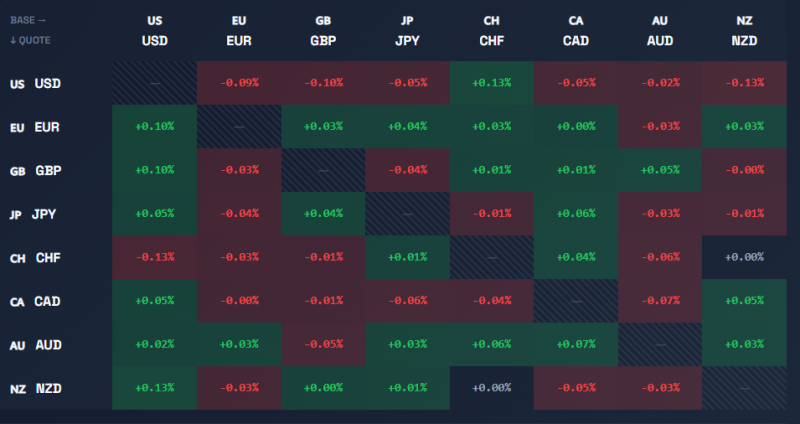
AUD and NZD outperform across the board
The strongest gains in the heatmap are concentrated in commodity-linked currencies, particularly the Australian dollar (AUD) and New Zealand dollar (NZD).
- NZD gained up to +0.13% against USD
- AUD rose +0.02% to +0.07% across multiple pairs
- Both currencies posted consistent gains versus EUR, GBP, and JPY
This pattern points to improving risk sentiment and demand for higher-yielding currencies. The strength in AUD and NZD often correlates with global growth expectations and commodity market stability.
EUR and GBP show moderate strength
The euro and British pound also posted modest gains:
- EUR rose +0.10% vs USD
- GBP gained +0.10% vs USD
- Both currencies showed stable performance against Asian currencies
This suggests a balanced market environment, where European currencies are benefiting from relative stability but not showing aggressive momentum.
JPY and CHF remain defensive plays
Safe-haven currencies such as the Japanese yen (JPY) and Swiss franc (CHF) showed mixed performance:
- JPY gained +0.05% vs USD but weakened against some risk currencies
- CHF outperformed USD but declined against AUD and NZD
This divergence indicates that while some defensive demand remains, capital is rotating toward risk-sensitive assets.
The rotation traders are watching
The overall structure of the heatmap suggests a risk-on environment, where investors are moving away from the US dollar and into higher-beta currencies. The consistent weakness of USD across multiple pairs reinforces the idea of short-term pressure on the currency.
At the same time, the leadership of AUD and NZD highlights growing confidence in global economic conditions, while the relatively stable performance of EUR and GBP suggests a lack of strong directional bias in developed markets.
 Marina Lubimova