Artem Voloskovets
- A Year-Long Case Against Brazilian Policy
- The Trade Surplus Weakens the Standard Tariff Argument
- Goods Tariffs as a Tool for Regulatory Pressure
- National Exposure Hides Concentrated Industrial Damage
- Diversion Toward China Comes With a Price
- U.S. Importers Carry Part of the Cost
- Uncertainty Changes Investment Before Export Volumes
- The 23.1% Figure Captures Only the First Impact
The figure suggests a contained trade shock. The official U.S. justification points to a broader objective.
Washington is not responding to a surge in Brazilian imports or trying to close a bilateral trade deficit. The United States already sells substantially more goods to Brazil than it buys. Instead, the tariffs are intended to pressure Brasília over digital payments, intellectual property, ethanol market access, anti-corruption enforcement, preferential tariffs and illegal deforestation.
The affected goods are the pressure point. Brazil’s domestic policies are the real target.
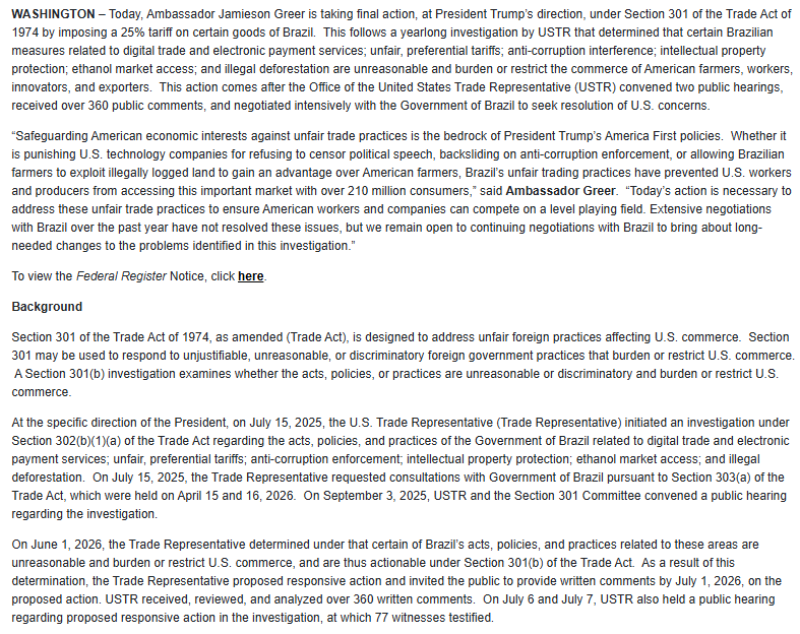
A Year-Long Case Against Brazilian Policy
The Office of the United States Trade Representative launched its Section 301 investigation on July 15, 2025.
It examined Brazilian policies and practices involving:
- digital trade and electronic payment services;
- preferential tariffs;
- anti-corruption enforcement;
- intellectual property protection;
- ethanol market access;
- illegal deforestation.
USTR concluded in June 2026 that some of those policies were unreasonable and burdened or restricted U.S. commerce.
The process included negotiations with Brazil, more than 360 written comments, public consultations and hearings at which 77 witnesses testified. The final tariff was therefore the result of a year-long policy dispute, not an emergency response to changing trade flows.
U.S. Trade Representative Jamieson Greer framed the action as part of the administration’s wider economic agenda:
Safeguarding American economic interests against unfair trade practices is the bedrock of President Trump’s America First policies.
He also argued that Brazilian rules had prevented U.S. workers and producers from gaining greater access to an import market worth more than $210 billion. The language is significant. Washington is treating access to the U.S. market as leverage in disputes over how Brazil regulates its own economy.
The Trade Surplus Weakens the Standard Tariff Argument
The bilateral trade figures do not support a simple deficit-reduction narrative. U.S.–Brazil goods trade reached $94.3 billion in 2025. American exports to Brazil totaled $54.4 billion, up 10.7% from 2024. U.S. imports from Brazil fell 5.7% to $39.9 billion. The result was a $14.4 billion U.S. goods trade surplus, up 67.7% from the previous year. Washington was therefore not facing a widening deficit with Brazil when it imposed the tariff. Its trade position was already improving.
| Indicator | Value |
| Total goods trade | $94.3 billion |
| U.S. exports to Brazil | $54.4 billion |
| U.S. imports from Brazil | $39.9 billion |
| U.S. goods trade surplus | $14.4 billion |
| Annual growth in U.S. exports | 10.7% |
| Annual decline in U.S. imports | 5.7% |
| Annual increase in the U.S. surplus | 67.7% |
The services relationship also favors the United States. Total bilateral services trade reached an estimated $36.1 billion in 2024. U.S. services exports to Brazil were $29.6 billion, while imports were only $6.5 billion, producing a $23.1 billion U.S. services surplus.
Combined, the goods and services data show a relationship in which American companies already hold a strong commercial position. The tariffs are better understood as regulatory pressure than as an attempt to correct an unfavorable trade balance.
Goods Tariffs as a Tool for Regulatory Pressure
The USTR case links tariffs on physical goods to disputes that extend well beyond manufacturing.
Digital trade and electronic payments affect technology companies, financial platforms and data-driven services. Intellectual property rules influence pharmaceuticals, software and branded products. Ethanol market access affects agriculture and energy. Anti-corruption enforcement and deforestation introduce governance and environmental policy into the trade case.
That combination expands the role of Section 301.
The tariff does not need to fall on the industry at the center of a complaint. Duties on machinery, furniture, footwear or other exports can be used to create political pressure over payments regulation or environmental enforcement.
This gives Washington considerable flexibility. It can target industries with concentrated political influence inside Brazil while limiting costs for American consumers through exemptions.
Brazil’s estimate that 23.1% of its exports are affected is therefore only a measure of direct exposure. It does not describe the scope of the policy demands attached to the tariff.
National Exposure Hides Concentrated Industrial Damage
A tariff affecting less than one-quarter of exports may look manageable at the national level. The effect on individual companies can be much larger.
A manufacturer that sends half of its production to the United States does not experience a 23.1% shock. Its relevant exposure is the share of its own revenue tied to American customers.
Industrial exports are also harder to redirect than commodities. Machinery, furniture, footwear and manufactured components may be designed for U.S. technical standards, retail channels or customer specifications. Replacing an established American buyer can require new certification, distribution agreements and product redesign.
Affected exporters have four practical options:
- absorb part of the tariff;
- raise prices in the United States;
- reduce production;
- redirect goods to less profitable markets.
Absorbing the duty reduces margins. Raising prices risks lost contracts. Cutting output affects suppliers and employment. Redirecting exports may require discounts and higher logistics costs.
The tariff is charged at the border, but much of the adjustment takes place inside Brazilian industrial regions.
Diversion Toward China Comes With a Price
Brazilian producers losing access to the U.S. market will look for replacement demand. China is the most obvious candidate, given its existing position as a major buyer of Brazilian commodities.
Manufactured goods present a harder problem.
Brazil’s exports to China are heavily concentrated in products such as soybeans, iron ore and oil. Many goods sold to the United States serve different customers, standards and distribution systems. China cannot automatically absorb every machine, shoe or piece of furniture displaced by a U.S. tariff.
Even where diversion is possible, Brazilian companies may have to accept lower prices or less favorable payment terms.
Deeper Chinese involvement may also follow through financing, logistics and infrastructure rather than imports alone. Exporters entering Asian markets may rely on Chinese banks, shipping companies, distributors and industrial partners.
Over time, those commercial relationships can outlast the tariff that created them.
Washington may gain negotiating leverage in the near term while encouraging Brazil to reduce its dependence on the U.S. market in the longer term.
U.S. Importers Carry Part of the Cost
The tariff is imposed on Brazilian goods, but it is paid by the American importer.
U.S. companies can ask Brazilian suppliers for discounts, switch to alternative sources or pass higher costs through the supply chain. Each response carries a cost.
Replacing suppliers may require product testing, contract renegotiation and changes to logistics. Keeping the same supplier compresses margins or raises prices for downstream businesses and consumers.
The structure of exemptions is therefore important. Products likely to cause visible price increases or supply shortages in the United States can be protected, while duties remain on sectors where domestic disruption appears easier to contain.
That selectivity allows Washington to increase pressure on Brazil without applying a uniform tax to the entire bilateral trade relationship.
It also explains why the share of affected exports matters less than the political and industrial importance of the sectors selected.
Uncertainty Changes Investment Before Export Volumes
The full trade impact will appear gradually in customs data. Companies can change investment plans immediately.
A Brazilian producer considering a factory expansion must now account for unstable access to the U.S. market. An American buyer evaluating a long-term supply agreement must consider the possibility of additional tariffs or removed exemptions. Multinationals may reorganize production so that goods no longer cross the affected border.
These decisions can become permanent.
Once a company builds capacity in another country, approves a new supplier or redesigns a distribution network, reversing the change is expensive. Tariffs can be removed by a policy announcement. Factories and supply chains do not move back as quickly.
The uncertainty also affects products that are currently exempt. Companies cannot assume that today’s exclusions will survive the next stage of negotiations.
That encourages larger inventories, more suppliers and duplicated production capacity. All three improve resilience but raise operating costs.
The 23.1% Figure Captures Only the First Impact
Brazil’s estimate measures the share of exports directly covered by the new U.S. measures. It does not measure lost margins, regional employment risks, postponed investment or the cost of finding new customers.
It also excludes the wider strategic effect of linking market access to domestic regulation.
The United States has a $14.4 billion goods surplus and a $23.1 billion services surplus with Brazil. Those figures make clear that the tariff is not primarily a response to an unfavorable bilateral balance.
Washington is using trade restrictions to press for changes in Brazilian policy.
Brazilian exporters will absorb the first shock. U.S. importers will carry part of the cost. The lasting effect may be a reorganization of investment and trade relationships that reduces the importance of the U.S. market to Brazilian companies.
The tariff applies to 23.1% of exports. The leverage Washington is attempting to create extends far beyond that share.
 Artem Voloskovets