Artem Voloskovets
The U.S. Strategic Petroleum Reserve has fallen to about 285 million barrels, pushing America’s emergency crude stockpile to its lowest level since 1982.
285 million barrels — what does that mean?
The SPR has storage capacity of roughly 714 million barrels. Current stocks therefore fill only about 40% of available capacity, leaving approximately 429 million barrels of storage empty.
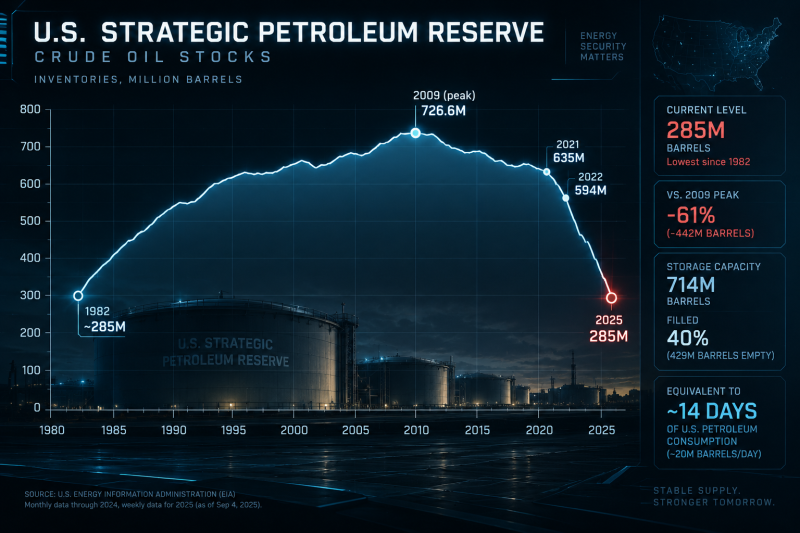
At the 2009 record, the reserve contained 726.6 million barrels. Compared with that peak, the U.S. now holds about 442 million fewer barrels — a decline of roughly 61%.
Then vs. now:
- 2009 peak: 726.6 million barrels
- Early 2021: ~635 million
- Early 2022: ~594 million
- Current level: ~285 million
In other words, for every 100 barrels held in the SPR at its peak, only about 39 barrels remain today.
Another way to measure it
U.S. petroleum consumption is around 20 million barrels per day. Dividing the current SPR inventory by that figure gives the equivalent of roughly 14 days of total U.S. petroleum demand.
That does not mean the country would run out of oil after 14 days — domestic production, commercial inventories and imports continue independently, but it illustrates the scale of the emergency stockpile relative to consumption.
The historical comparison
The last time the SPR contained roughly this amount of crude was 1982, when the reserve itself was still being built following its creation in the 1970s.
The direction of travel can be summarized in three numbers:
726.6M → 594M → 285M barrels
From a record stockpile of more than 700 million barrels to less than 300 million today, the U.S. strategic crude buffer has contracted by more than half.
 Artem Voloskovets