Marina Lubimova
- From $14 Billion to a $1 Billion Deal
- Bumble Has Lost More Than 1 Million Paying Users
- Fewer Subscribers Are Pulling Revenue Lower
- The Users Who Stay Are Spending More
- Bumble Is Rebuilding the Product That Made It Famous
- The Reversal Happened Fast
- The Business Is Shrinking, but It Is Not Burning Cash
- Private Ownership Buys Bumble More Time
- Dating Apps Have a Customer-Retention Paradox
- At $1 Billion, Bumble Is No Longer Priced for Growth
By October 2026, Bumble shares were trading in the low single digits. The proposed deal therefore reflects a sharp reset in how investors value the company.
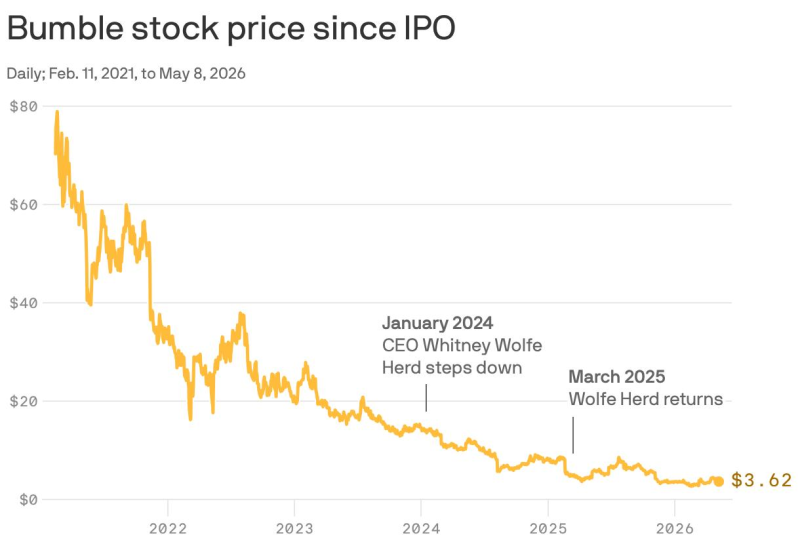
Caption: Bumble's share price fell from more than $70 after its IPO to the low single digits by 2026.
From $14 Billion to a $1 Billion Deal
Bumble's 2021 IPO valued the company at more than $7 billion. Investor demand then pushed the stock higher, briefly taking Bumble's market value above $14 billion.
The reported take-private valuation is about $1 billion. That does not necessarily mean public shareholders would receive $1 billion in equity value. Final deal terms would need to clarify whether the figure refers to equity value, enterprise value or another transaction measure.
As of June 30, 2026, Bumble had:
- $451 million in debt
- $154 million in cash
Bumble Has Lost More Than 1 Million Paying Users
The clearest operational problem is the decline in paying users. Total paying users fell from 4.18 million in Q4 2024 to 3.16 million in Q2 2026. Bumble App paying users fell from 2.81 million to 2.08 million over the same period. That means Bumble lost more than 1 million paying users in roughly 18 months.
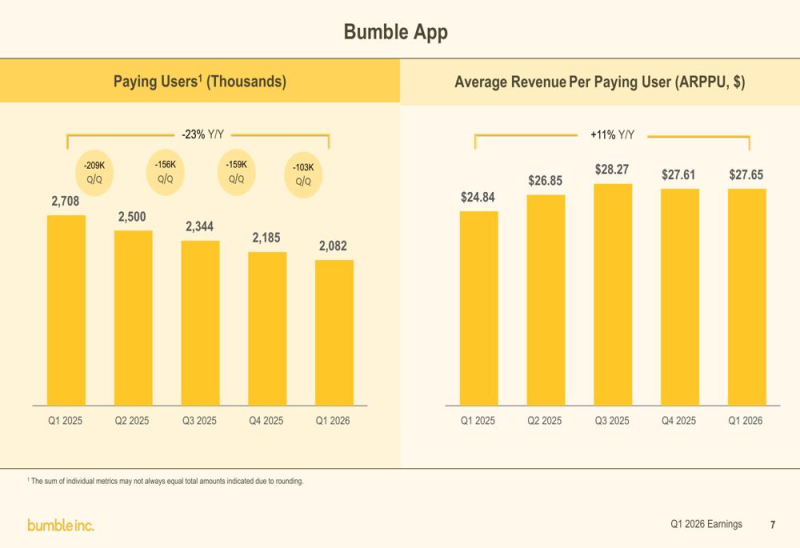
Caption: Bumble lost more than 1 million paying users between Q4 2024 and Q2 2026.
Fewer Subscribers Are Pulling Revenue Lower
Q2 2026 revenue was $210.5 million, down 15.2% year over year. Bumble App revenue fell 14.7% to $171.7 million. Badoo and other revenue fell 17.1% to $38.8 million. Adjusted EBITDA declined from $94.6 million to $72.9 million year over year. Adjusted EBITDA margin fell from 38.1% to 34.6%.
The pattern is straightforward:
Paying users down → revenue down → EBITDA down.
The Users Who Stay Are Spending More
The decline is not coming from lower spending per paying user. Total ARPPU increased from $20.58 in Q4 2024 to $21.96 in Q2 2026. Bumble App ARPPU increased from $25.17 to $27.55. So Bumble is making more money from each remaining paying user while losing users overall.
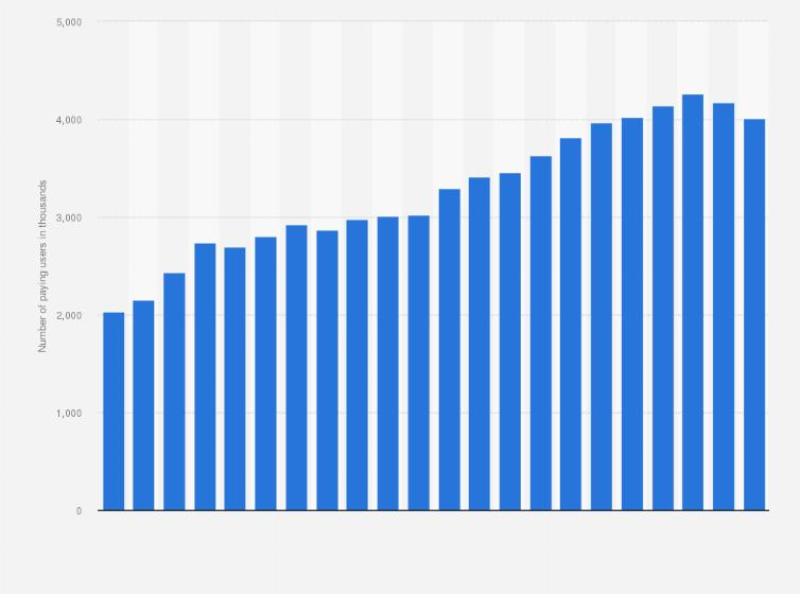
Caption: Bumble's paying-user base contracted sharply even as revenue per payer increased.
Bumble Is Rebuilding the Product That Made It Famous
| Previous model | Current direction |
| Women initiate heterosexual conversations | More flexible conversation initiation |
| Swipe-and-match at the center | Broader matching and discovery systems |
| User growth was a major objective | Focus on engagement and retention |
| Heavy performance marketing | More emphasis on efficiency and organic acquisition |
| Strong brand differentiation | More reliance on algorithms, AI and product redesign |
| Growth-stock valuation | Cash flow and operating efficiency matter more |
Bumble has been moving away from the original women-first messaging rule and redesigning its matching systems.
We are completing our platform migration, transforming our matching algorithms. CEO Whitney Wolfe Herd said
The company is also testing new ways to start conversations and move users toward in-person dates.
The Reversal Happened Fast
In 2024, Bumble reported:
- $1.072 billion in annual revenue
- 4.15 million average paying users
- 11.5% paying-user growth
- $304.1 million in adjusted EBITDA
In 2025:
- revenue fell 9.9% to $965.7 million
- average paying users fell 11.5% to 3.67 million
By Q2 2026, paying users were down another 16.4% year over year. The deterioration is therefore visible in both valuation and operating metrics.
The Business Is Shrinking, but It Is Not Burning Cash
Bumble generated $72.9 million in adjusted EBITDA in Q2 2026, with a 34.6% margin.
The company still has:
- more than 3 million paying users
- more than $200 million in quarterly revenue
- positive adjusted EBITDA
- a globally recognized brand
That helps explain why a buyer may be interested despite falling revenue and users. At a $1 billion valuation, the investment case is based less on high growth and more on cash flow, brand value and the possibility of a turnaround.
Private Ownership Buys Bumble More Time
A private owner could restructure Bumble without the same quarterly pressure from public investors.
The likely priorities would be:
- Rebuild the core matching product.
- Improve retention.
- Reduce inefficient acquisition spending.
- Reposition the Bumble brand.
- Stabilize paying-user growth.
Dating Apps Have a Customer-Retention Paradox
Bumble's decline is severe, but the issue is not limited to one company. Dating apps have a structural problem: successful customers may leave after finding a partner. That forces platforms to constantly replace users.
As growth slows, the business becomes more dependent on:
retention → engagement → premium features → higher ARPPU
Bumble's data shows that monetization is still relatively strong. The weak point is the number of paying users.
At $1 Billion, Bumble Is No Longer Priced for Growth
In 2021, investors were paying for future growth.
In 2026, a buyer would be paying for:
- existing users
- existing cash flow
- brand recognition
- technology infrastructure
- turnaround potential
The core metrics show the change:
| Metric | Q4 2024 | Q2 2026 |
| Total paying users | 4.18M | 3.16M |
| Bumble App paying users | 2.81M | 2.08M |
| Total ARPPU | $20.58 | $21.96 |
| Quarterly revenue | $261.6M | $210.5M |
| Adjusted EBITDA | $72.5M | $72.9M |
The key issue is clear:
Bumble is monetizing remaining users reasonably well, but the paying-user base is shrinking.
A $1 billion take-private deal would therefore mark Bumble's transition from a high-growth public company to a turnaround asset.
 Marina Lubimova