Artem Voloskovets

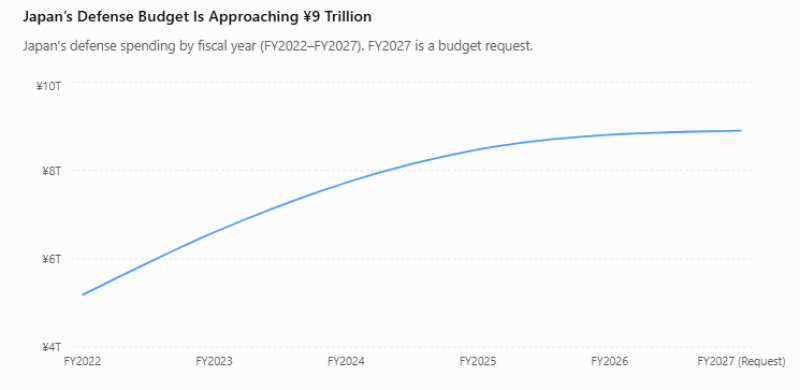
- The budget is roughly 70% above pre-buildup levels
- The ¥43 trillion program extends well beyond weapons purchases
- Long-range missiles are only one part of procurement
- Japan has moved beyond the old 1%-of-GDP constraint
- China remains the main driver of Japan’s military planning
- A ¥9 trillion annual budget is expanding Japan’s defense industry
- Financing becomes harder once the five-year buildup ends
- FY2027 sets the starting point for the next defense plan
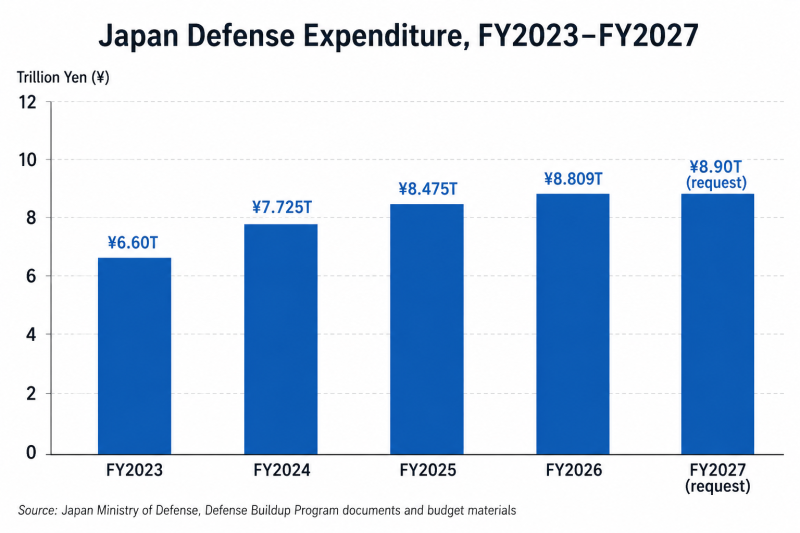
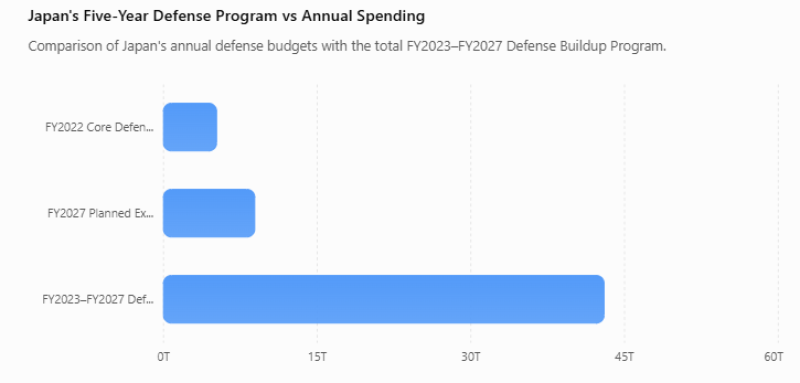
The figure would complete the five-year military buildup launched in FY2023. Under Japan's Defense Buildup Program, Tokyo plans to spend roughly ¥43 trillion between FY2023 and FY2027, with annual expenditure rising from about ¥6.6 trillion at the start of the program to nearly ¥9 trillion.
The FY2027 request therefore represents another year at a much higher spending level rather than a sudden increase.
Defense expenditure has risen about 35% since FY2023
| Fiscal year | Defense Buildup Program expenditure | YoY change |
| FY2023 | ~¥6.60T | — |
| FY2024 | ¥7.725T | +17.0% |
| FY2025 | ¥8.475T | +9.7% |
| FY2026 | ¥8.809T | +3.9% |
| FY2027 request | ~¥8.90T | ~+1.0% |
From FY2023 to the proposed FY2027 level, expenditure under the program increases by approximately 35%.
Most of the increase came early in the cycle. FY2024 added more than ¥1.1 trillion to the annual budget. FY2025 added roughly ¥750 billion, followed by another ¥334 billion in FY2026.
By FY2027, annual growth would slow to around 1%, but expenditure would remain close to ¥9 trillion.
The budget is roughly 70% above pre-buildup levels
Japan's FY2022 initial defense budget was ¥5.18 trillion, before the current expansion began. A FY2027 request of ¥8.9 trillion would be around 72% higher than that level.
| Metric | FY2022 | FY2027 request | Change |
| Core defense expenditure | ¥5.18T | ~¥8.90T | ~+72% |
| Increase | — | +¥3.72T | — |
| Five-year buildup envelope | — | ~¥43T | — |
The comparison also puts the expected FY2027 increase into context. Spending may rise only about 1% from FY2026, but the annual budget has already been reset several trillion yen above its pre-2023 level.
The ¥43 trillion program extends well beyond weapons purchases
Japan's Defense Buildup Program covers seven priority areas:
- stand-off defense capabilities;
- integrated air and missile defense;
- unmanned defense capabilities;
- cross-domain operations;
- command, control and intelligence;
- rapid deployment and civilian protection;
- sustainability and resilience.
Funding therefore includes missiles and military platforms alongside ammunition, communications networks, bases, fuel, logistics, maintenance and domestic production capacity.
By FY2025, Defense Ministry budgets for FY2023 through FY2025 had already allocated about 62% of the ¥43.5 trillion contract-value framework associated with the buildup.
A large part of the program is consequently tied to procurement extending beyond individual fiscal years.
Long-range missiles are only one part of procurement
Japan has been expanding stand-off strike capability through upgraded Type 12 surface-to-ship missiles and imported systems including Tomahawk cruise missiles.
Other spending is directed toward missile defense, maritime surveillance, unmanned systems, communications and infrastructure.
| Capability | Main spending areas |
| Long-range strike | Stand-off missiles and launch platforms |
| Missile defense | Sensors, interceptors and integrated air defense |
| Maritime defense | Warships, submarines and surveillance |
| Unmanned warfare | Air, sea and ground drone systems |
| Command & intelligence | Networks, satellites and data systems |
| Logistics | Ammunition, fuel, spare parts and transport |
| Resilience | Hardened bases and distributed infrastructure |
| Defense industry | Domestic production and supply chains |
The buildup requires both new equipment and the ability to operate it for extended periods. Ammunition stocks, maintenance, fuel, spare parts and protected facilities have therefore received greater attention alongside headline procurement programs.
Japan has moved beyond the old 1%-of-GDP constraint
Japanese defense expenditure remained close to 1% of GDP. The current strategy targets broader defense-related spending of approximately 2% of GDP, bringing Japan closer to spending levels common among major U.S. allies.
The exact comparison depends on the definition used. The 2% figure includes a wider group of national-security expenditures than the Defense Ministry's core budget alone.
Japan nevertheless now operates with a defense budget substantially larger than the one maintained under the previous informal 1% ceiling.
| Indicator | Amount |
| FY2027 Defense Ministry request | ¥8.9T |
| FY2023–FY2027 buildup | ~¥43T |
| Defense-related spending benchmark | ~2% of GDP |
The next fiscal question is whether spending remains near this level after the current five-year program expires.
China remains the main driver of Japan’s military planning
Japan's defense documents identify China's expanding military capabilities as the country's most serious strategic challenge, alongside North Korea's nuclear and missile programs and increased Russian military activity in the region.
China announced another 7% increase in defense spending for 2026. Japan cannot match China in absolute military expenditure. Its strategy instead concentrates resources on capabilities considered critical around the Japanese archipelago and the country's southwestern islands: long-range missiles, missile defense, submarines, surveillance, drones and logistics.
A possible conflict around Taiwan also directly affects Japanese planning because of the proximity of Japan's southwestern islands and the presence of major U.S. bases in the country.
A ¥9 trillion annual budget is expanding Japan’s defense industry
Higher and more predictable government spending increases the addressable domestic defense market for Japanese manufacturers.
| Company | Defense exposure |
| Mitsubishi Heavy Industries | Missiles, aircraft, naval systems |
| Kawasaki Heavy Industries | Aircraft, helicopters, submarines |
| IHI | Aerospace and jet engines |
| Mitsubishi Electric | Radar, electronics and missile systems |
| NEC | Communications, radar and defense electronics |
Orders also flow through suppliers of semiconductors, sensors, precision components, advanced materials, batteries and communications equipment.
Tokyo has simultaneously been trying to strengthen domestic production capacity and make defense exports easier, giving manufacturers a larger potential market than domestic procurement alone.
Financing becomes harder once the five-year buildup ends
Higher defense spending adds another large commitment to a government budget already carrying substantial social-security and debt-service costs.
Japan has one of the highest public-debt ratios among advanced economies. Its aging population continues to increase pension and healthcare expenditure, while higher interest rates gradually raise debt-servicing costs.
The government has planned several funding sources for the defense buildup, including:
- expenditure reforms;
- budget surpluses;
- non-tax revenue;
- a dedicated defense-strengthening fund;
- tax measures.
Those mechanisms can support a defined five-year program. Maintaining defense expenditure near ¥9 trillion after FY2027 would require a more permanent funding structure.
FY2027 sets the starting point for the next defense plan
The trajectory of Defense Buildup Program expenditure is now:
¥6.60T → ¥7.73T → ¥8.48T → ¥8.81T → ¥8.90T
Japan has added roughly ¥2.3 trillion in annual defense expenditure since FY2023 and approximately ¥3.7 trillion compared with the FY2022 core budget. At the same time, Tokyo has committed funds to long-range missiles, missile defense, drones, ships, ammunition, logistics and production capacity.
FY2027 is the final fiscal year covered by the current Defense Buildup Program. Japan is also reviewing its main national-security documents, which will shape spending after the ¥43 trillion program ends.
The next decision is therefore not whether Japan reaches ¥8.9 trillion. It is whether ¥9 trillion becomes the floor for the next phase of Japanese defense spending.
 Artem Voloskovets