Artem Voloskovets

For the first time in several months, fund flow data points to a noticeable shift in investor allocation.
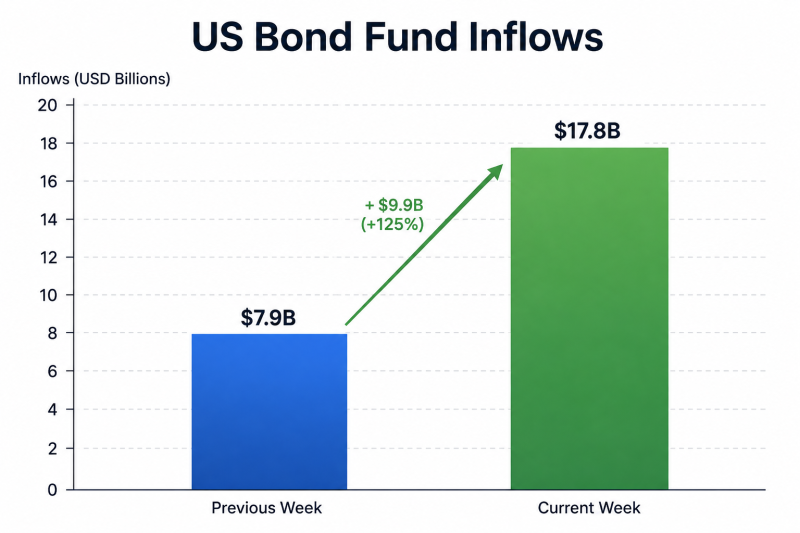
Global bond funds attracted $23 billion during the week, while inflows into global equity funds slowed to $32.9 billion, down sharply from $63.7 billion a week earlier. The biggest move came in the United States, where bond inflows climbed to $17.8 billion, compared with $7.9 billion the previous week.
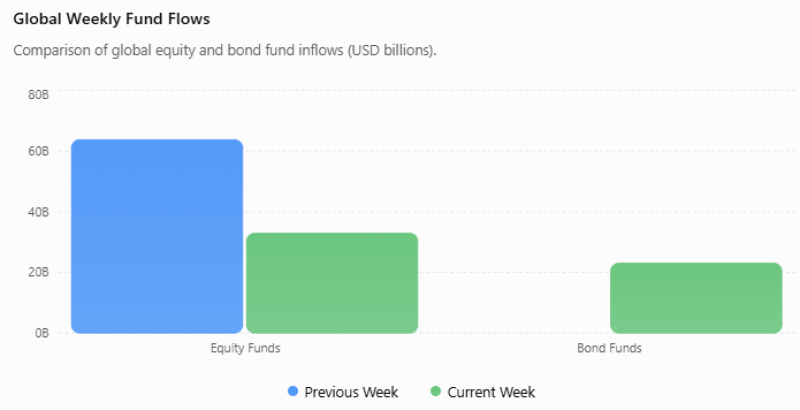
The data does not indicate investors are exiting equities. Instead, it shows that fixed income is once again offering returns attractive enough to draw meaningful capital.
Bonds Now Offer Real Competition
Extremely low interest rates left investors with few alternatives to stocks. That has changed.
With policy rates remaining well above pre-pandemic levels, bond yields have become attractive across both government and corporate debt markets. Investors can now lock in meaningful income without depending entirely on future stock market gains.
For institutions managing long-term liabilities, including pension funds, insurers and asset managers, that makes fixed income a more compelling allocation than it was for most of the past decade.
Investors Are Buying Credit Risk, Not Hiding From It
The composition of bond inflows is just as important as their size. Demand was strongest for US high-yield bonds, suggesting investors are still comfortable taking credit risk. High-yield debt generally performs best when economic growth remains positive, corporate earnings stay healthy and default rates remain contained.
If investors were preparing for a recession, capital would likely be flowing primarily into Treasury securities rather than below-investment-grade corporate debt.
Instead, current positioning suggests a preference for collecting higher yields while maintaining moderate exposure to economic growth.
Equity Buying Is Becoming More Selective
Equity funds continued to receive fresh capital, but at a much slower pace.
The decline in weekly inflows follows a prolonged rally that pushed valuations — particularly in US technology stocks—to elevated levels. After months of strong performance, many institutional investors are likely rebalancing portfolios instead of increasing equity exposure.
That does not imply a bearish outlook. It reflects a market where expected future returns from stocks have become less compelling relative to available bond yields.
Government Debt Is Also Attracting Capital
The shift was not limited to US corporate credit. Canadian and eurozone government bonds also recorded solid inflows, indicating broader demand for high-quality fixed-income assets.
Government bonds continue to provide diversification benefits while offering yields that were largely unavailable throughout the previous decade. If central banks begin lowering interest rates over the coming quarters, today's higher-coupon bonds could also benefit from capital appreciation.
Portfolio Allocation Is Becoming More Balanced
Falling bond yields pushed investors toward equities by default. Higher interest rates are reversing that dynamic.
Instead of choosing between growth and safety, investors can now build portfolios that generate income while maintaining diversified market exposure.
Recent fund flows suggest capital is no longer concentrated almost exclusively in equities. Investors are rebuilding allocations across multiple asset classes rather than chasing a single trade.
What The Flows Suggest
Weekly fund flows rarely predict short-term market direction, but they often reveal changes in institutional positioning before they become visible elsewhere.
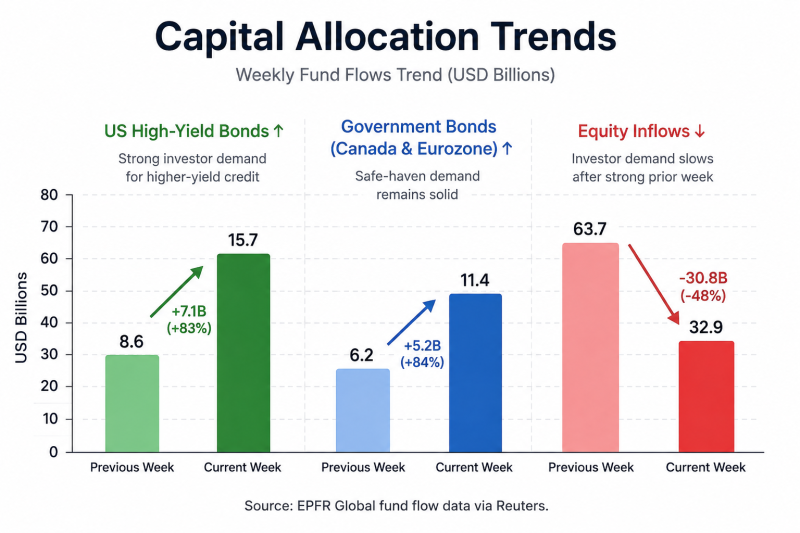
This week's data points to several developing trends:
- fixed income has become competitive with equities again;
- investors remain comfortable with corporate credit risk;
- equity allocations are becoming more disciplined after an extended rally;
- diversification is replacing concentration as portfolio strategy.
The slowdown in equity inflows does not signal that investors expect an imminent downturn. Instead, it reflects a market where bonds once again provide a credible alternative for generating returns.
 Artem Voloskovets