Artem Voloskovets
Brent crude futures gained 4.6%, while WTI rose 2.8%. The restriction applies to refined products, not crude oil. That means the immediate impact is on supplies of diesel, gasoline and jet fuel.
Market data
| Metric | Brent | WTI |
| Latest move | +4.6% | +2.8% |
| Earlier session price | $100.09/bbl | $92.48/bbl |
| Earlier session change | +2.1% | +2.28% |
| Front contract | Dec. 2026 | Nov. 2026 |
The later move shows that buying accelerated during the session.
U.S. distillate stocks are falling
EIA data show that U.S. distillate inventories peaked at 107.86 million barrels in the week ended September 11. By September 25, stocks had fallen to 105.18 million barrels.
That is a decline of 2.68 million barrels, or about 2.5%, in two weeks.
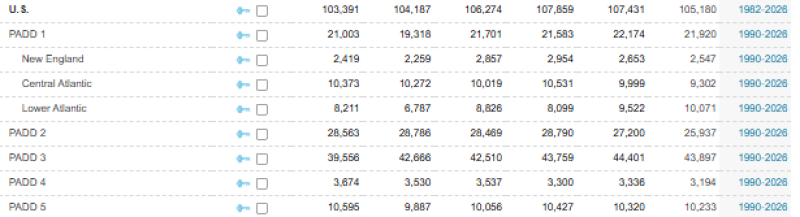
*U.S. distillate stocks fell from 107.9 million barrels on September 11 to 105.2 million barrels on September 25. Source: U.S. EIA.
| Week | Stocks, million bbl |
| Aug 21 | 103.391 |
| Aug 28 | 104.187 |
| Sep 4 | 106.274 |
| Sep 11 | 107.859 |
| Sep 18 | 107.431 |
| Sep 25 | 105.180 |
Lower inventories make the market more sensitive to any reduction in global fuel exports.
Why Brent is outperforming WTI
Brent is more exposed to internationally traded oil and fuel flows than WTI. China's suspension directly reduces refined-product availability in the global market, which helps explain why Brent is rising faster.
The main price drivers are:
- lower Chinese fuel exports;
- declining U.S. distillate inventories;
- weak global refined-product supply.
Crude supply is recovering faster than fuel supply
Crude exports from the Gulf have recovered significantly, but refined-product flows remain much weaker. That creates a split market: crude availability is improving, while diesel and other finished fuels remain tight.
Possible impact on crude demand
If Chinese refiners retain more fuel for the domestic market, they may need more crude feedstock.
The chain is straightforward:
Lower fuel exports → tighter product supply → stronger refinery margins → potentially higher crude demand
The size of that effect will depend on how long the export suspension lasts.
Previous session comparison
Oil initially traded lower before reversing.
The sequence was:
- early-session weakness;
- China fuel-export suspension;
- Brent moved back above $100;
- gains expanded to 4.6% for Brent and 2.8% for WTI.
The reversal shows how quickly the market repriced refined-product supply risk.
Bottom line
The rally is being driven by tighter refined-product supply, not a suspension of Chinese crude exports. The key indicators now are Chinese fuel exports, U.S. distillate inventories, refinery margins and Chinese crude imports.
 Artem Voloskovets