Marina Lubimova
The result is notable because the 3-year Treasury sits at the center of the yield curve, where pricing is driven largely by expectations for Federal Reserve policy. Healthy demand indicates investors are increasingly comfortable purchasing government securities at current yields rather than waiting for rates to move higher.
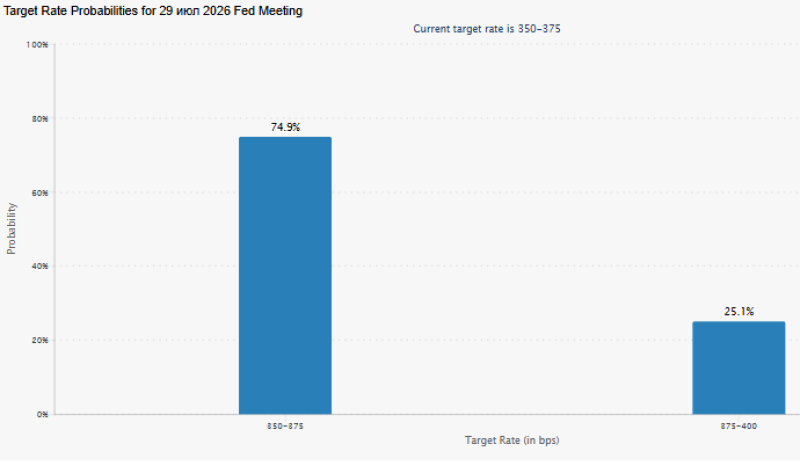
Futures markets overwhelmingly expect the Federal Reserve to leave interest rates unchanged at the July meeting.
Current rate expectations reinforce that view. CME FedWatch data show a 74.9% probability that the Federal Reserve will maintain its target range at 3.50%–3.75% on July 29, while the probability of a 25-basis-point increase to 3.75%–4.00% stands at 25.1%. With markets assigning only a limited chance of another hike, intermediate-term Treasury yields increasingly look attractive to investors seeking stable returns.
Instead of demanding higher yields to compensate for policy uncertainty, buyers appear willing to secure current income levels, suggesting confidence that the tightening cycle is approaching its end.
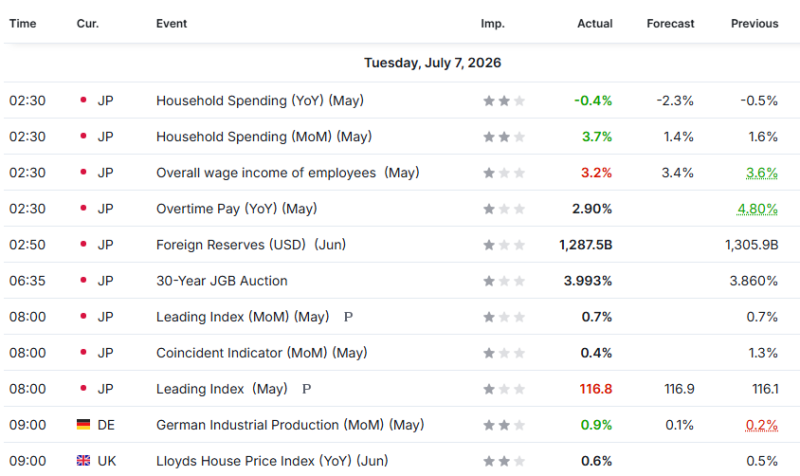
Tuesday's economic releases produced few surprises capable of shifting interest-rate expectations.
Economic data released during the session did little to challenge that outlook. In Japan, household spending increased 3.7% month-over-month, well above the 1.4% forecast, while the annual decline slowed to 0.4%, outperforming expectations for a 2.3% contraction. At the same time, wage growth eased to 3.2% year-over-year from 3.6%, pointing to a gradual moderation in income growth.
European data delivered a positive surprise as German industrial production rose 0.9% in May, far exceeding the 0.1% consensus forecast and recovering from the previous month's 0.2% decline. Although the report signaled improving manufacturing activity, it was not strong enough to materially alter global interest-rate expectations.
With macroeconomic news offering little direction, investor attention returned to Treasury financing. The ability of the U.S. government to place new debt without triggering a sustained jump in yields remains one of the market's most closely watched indicators. Continued strong auction demand would suggest investors remain willing to finance expanding federal borrowing at current rates, easing concerns about supply-driven pressure across the Treasury market.
Upcoming inflation figures, Federal Reserve communications, and the next round of Treasury auctions will determine whether this demand remains durable. For now, the latest sale indicates that investors see current Treasury yields as sufficiently attractive to increase exposure, even before the Fed formally signals the next phase of monetary policy.
 Marina Lubimova