Sergey Diakov

Roughly $6 billion of municipal refinancing transactions have been delayed or put on hold. Benchmark 30-year municipal bond yields recently reached about 5.26%, the highest level since at least 2011.
Major Deals Being Delayed
Several large issuers have already postponed refinancing plans.
| Borrower | Planned refinancing | Status |
| New Jersey Transportation Trust Fund Authority | About $1.7 billion | Postponed |
| Philadelphia | About $450 million | Delayed |
| New York MTA | About $1 billion | Depends on market conditions |
| Broader municipal market | Roughly $6 billion | Delayed or on hold |
New Jersey postponed a roughly $1.7 billion refunding. Philadelphia delayed a $450 million deal. New York’s MTA is considering about $1 billion of refinancing if yields improve.
Why Higher Yields Kill a Refinancing
Municipal refunding works only when new debt is cheaper than existing debt. Assume an issuer has $1 billion of bonds carrying a 5.00% coupon.
Previous refinancing environment
If replacement debt could be issued at 3.50%:
$1 billion × (5.00% − 3.50%) = $15 million
That equals roughly $15 million in annual gross interest savings before fees and other costs.

Current environment
If replacement debt costs around 5.0% or more, most of the savings disappear.
A refunding is economical only when the present value of debt-service savings exceeds transaction costs and the issuer’s minimum savings threshold.
The basic calculation is:
NPV savings = PV of old debt service − PV of new debt service − transaction costs
If savings are too low, the issuer delays the deal.
Current Market vs. Previous Refinancing Model
| Variable | Previous lower-yield environment | Current environment |
| Long-term muni yields | Lower | 30-year benchmark around 5.26% |
| Rate advantage on refunding | Often wide | Narrow or negative |
| NPV savings | Often attractive | Often insufficient |
| Incentive to refinance | High | Low |
| Typical strategy | Refinance and lock in savings | Wait for lower yields |
The shift is simple: refinancing is no longer attractive unless the rate differential is large enough to produce measurable savings.
Why 5.26% Matters
The key variable is the gap between the existing borrowing cost and the cost of new debt.
Example:
- Existing debt cost: 5.50%
- New financing cost: 4.00%
- Rate advantage: 150 basis points
At that spread, refinancing can generate meaningful savings.
If the new financing cost rises to 5.25%, the advantage falls to only 25 basis points before underwriting, legal and other transaction costs. That can make a refunding uneconomic.
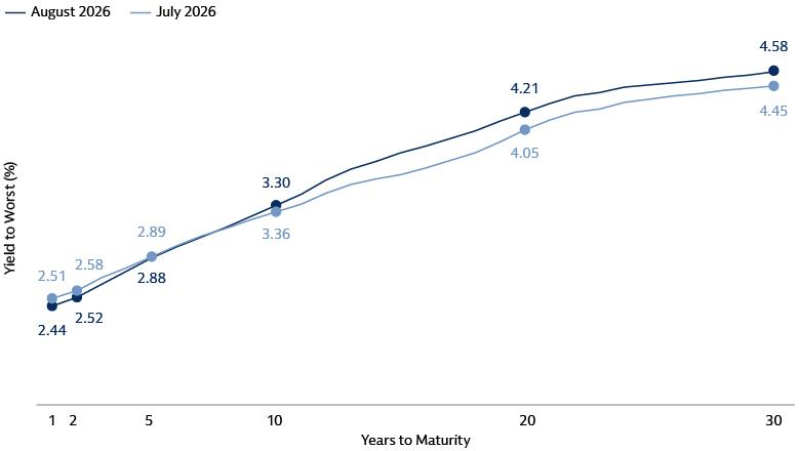
U.S. Municipal Bond Yield Curve / 30-Year Municipal Bond Yield, 2026
The benchmark 30-year municipal bond yield moved from roughly the 4% area earlier in 2026 to above 5% by October, reducing the savings available from refinancing existing debt.
Borrowers Can Wait — But Waiting Carries Risk
Optional refundings can usually be postponed. If yields fall, issuers can return to the market and refinance at lower rates. If yields remain elevated, the refinancing window stays closed.
New-money issuance is different. Borrowers may still issue bonds to finance infrastructure and other projects even when refinancing existing debt is unattractive. New-money borrowing is driven by funding needs. Refunding is driven by savings.
 Sergey Diakov