Artem Voloskovets

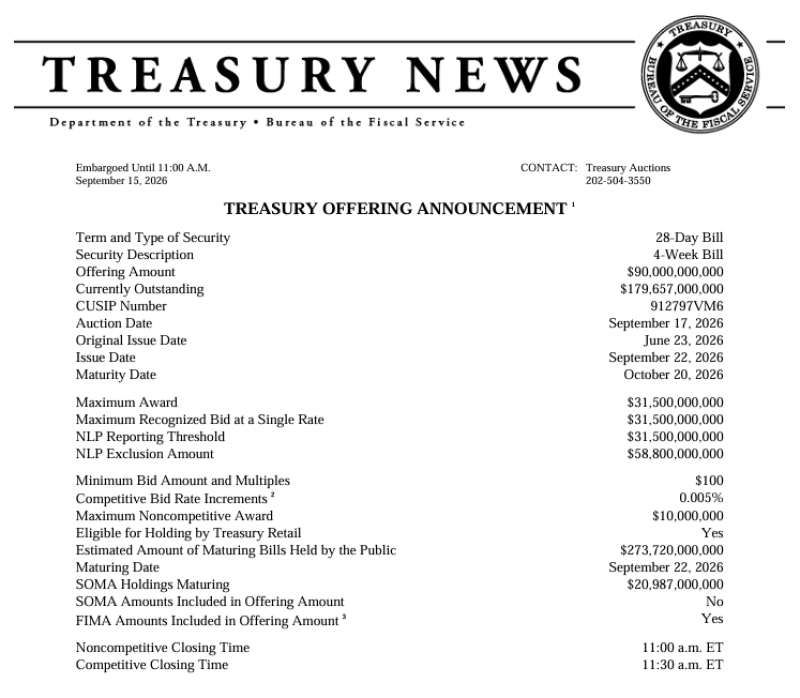
The auction adds another large block of ultra-short U.S. government debt to the market. At $90 billion, the transaction is significant even by Treasury bill standards, where large and frequent issuance is used to manage the government's short-term financing needs and cash balance.
Auction at a Glance
| Item | Details |
| Security | 4-Week Treasury Bill |
| Offering size | $90 billion |
| Auction date | September 17 |
| Settlement date | September 22 |
| Issuer | U.S. Treasury |
| Maturity | 4 weeks |
The short time until the debt expires is significant for fund managers, banking institutions and other entities that invest capital - those purchasers utilize Treasury bills as assets that they can convert into cash quickly for the storage of funds over a brief period. The level of interest during the sale is a practical sign of the financial state within the section of the United States market for early interest rates. There are many investors who rely on those auctions to manage their liquidity.
What the Auction Will Show
The headline number after the sale will be the high rate, which determines where the $90 billion offering clears. That result can be compared with prevailing secondary-market yields immediately before the auction to see whether investors demanded a concession to absorb the new supply.
The bid-to-cover ratio is a calculation that indicates the total amount of currency that participants submit for every unit of currency that the government offers. Information regarding the identities of buyers is a secondary indicator of market conditions. In this category indirect bidders are usually foreign central banks or professional investment managers - but direct bidders are the institutions that submit their offers immediately to the Treasury Department.
The combination matters more than any single number. A high bid-to-cover ratio accompanied by strong indirect demand would point to solid appetite for short-term Treasuries. A higher-than-expected clearing rate and softer bidding would indicate that the market required more yield to take down the $90 billion supply.
$90 Billion Moving Into the Market
The settlement date is September 22 - the buyers pay money for the securities on this day. The Treasury receives the payment on this day as well. It is because of those payments that the settlement date is the relevant time for the movement of cash and liquid assets. To understand the flow of short term funds, the settlement date is more important than the auction on September 17. There are specific changes in the availability of cash when the actual exchange of money occurs.
Because the bills mature only four weeks later, pricing is concentrated heavily around expectations for near-term Federal Reserve policy and money-market rates, rather than the longer-term inflation and growth assumptions that drive 10- or 30-year Treasury yields.
The September 17 auction will therefore give markets a direct test of how much demand exists for $90 billion of new 4-week government paper and at what rate investors are willing to absorb it.
 Artem Voloskovets