Artem Voloskovets

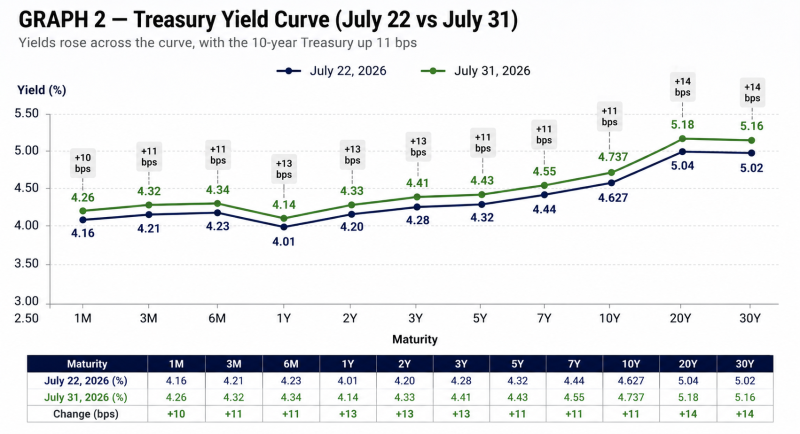
The benchmark 10-year Treasury yield climbed to 4.737%, its highest intraday level since January 2025. The move followed a broad selloff across government bonds as investors reduced expectations for near-term rate cuts and repriced the entire Treasury curve.
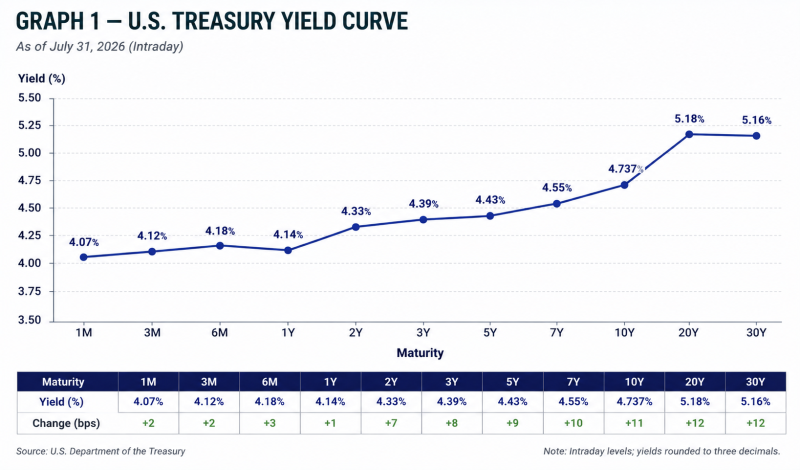
The Treasury curve has shifted sharply higher over the past two weeks. The 10-year yield has risen roughly 11 basis points since July 22, while the 30-year bond has moved above 5.15%, levels not seen for several years.
Three Fed Officials Wanted Another Rate Hike
Wednesday's FOMC meeting ended with the federal funds rate unchanged at 3.50%–3.75%, but the vote exposed an unusually divided committee. Three policymakers — Lorie Logan, Beth Hammack and Neel Kashkari — supported an immediate 25-basis-point increase, arguing that inflation remains inconsistent with the Federal Reserve's 2% target.
The dissent was more important than the policy decision itself. Markets now have to price not only the possibility that rates remain elevated into 2027, but also that another hike has not been ruled out.

Treasury Market Is Repricing Higher Rates
Friday's move was broad rather than concentrated in a single maturity.
| Maturity | Yield |
| 1-Year | 4.14% |
| 2-Year | 4.33% |
| 5-Year | 4.43% |
| 7-Year | 4.55% |
| 10-Year | 4.737% |
| 20-Year | 5.18% |
| 30-Year | 5.16% |
The increase pushed long-term borrowing costs back toward the highs reached during the 2025 tightening cycle.
A higher Treasury curve affects far more than government financing. U.S. Treasuries serve as the benchmark for mortgages, investment-grade corporate bonds, commercial real estate financing and equity valuation models.
Financing Costs Continue to Rise
The rise in Treasury yields immediately feeds through to private borrowing costs.
| Market | Typical Effect |
| 30-year mortgages | Higher mortgage rates |
| Corporate bonds | More expensive refinancing |
| Commercial real estate | Higher capitalization rates |
| Consumer lending | Rising loan costs |
Mortgage rates have remained around 6.5–7.0%, while investment-grade corporate bond issuance has become progressively more expensive as Treasury yields climb. For companies planning to refinance debt over the next 12–24 months, each additional 25 basis points increases annual interest expenses and reduces free cash flow.
Debt Servicing Is Becoming More Expensive
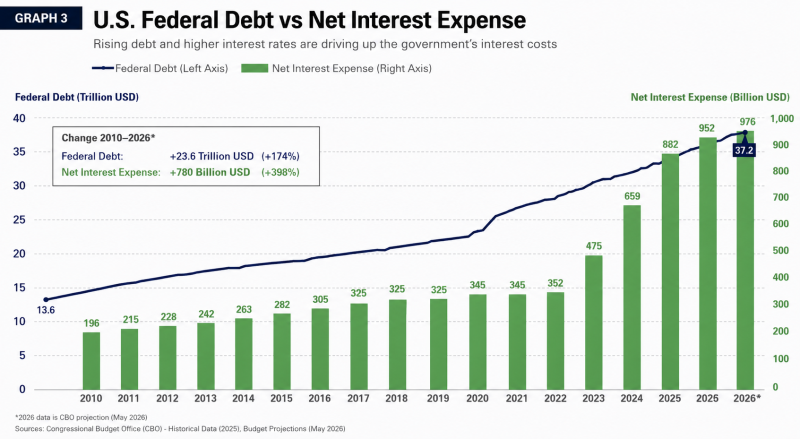
The Treasury selloff also has fiscal consequences. U.S. federal debt now exceeds $37 trillion. As maturing securities are refinanced at today's higher yields, interest payments continue to increase.
According to Congressional Budget Office projections, net interest spending is already among the fastest-growing categories of federal expenditure. Sustained Treasury yields above 4.5% would accelerate that trend as older low-coupon debt rolls off.
Higher Discount Rates Pressure Equity Valuations
The impact extends beyond fixed income. Higher Treasury yields increase the discount rate used to value future corporate earnings, reducing the present value of long-duration assets. Growth sectors — including technology, software and AI — are typically the most sensitive because a large share of expected cash flows lies years into the future.
Historically, periods in which the 10-year Treasury trades above 4.5% have coincided with lower valuation multiples across growth equities and tighter financing conditions in credit markets.
Markets Now Need Stronger Evidence That Inflation Is Cooling
The latest selloff reflects a change in expectations rather than new economic data. Investors are reassessing whether inflation is slowing quickly enough for the Federal Reserve to begin easing policy. As long as labor markets remain resilient and price growth stays above target, Treasury yields are likely to remain under upward pressure.
The next major catalysts will be inflation data, employment reports and additional guidance from Federal Reserve officials. If incoming figures continue to show economic resilience, the 10-year Treasury yield could test the 4.8% level, last reached during the previous tightening cycle. A weaker macroeconomic backdrop would instead support demand for government bonds and ease pressure on long-term yields.
 Artem Voloskovets