Alex Dudov

- The $14.6 Billion Plan
- The Purchases Are Focused on Treasury Bills
- How Reinvestments Were Distributed in 2025
- Purchase Parameters
- How the Purchases Are Executed
- Why This Is Not New QE
- $14.6 Billion Versus the Fed’s Treasury Portfolio
- Fed Purchases Have Shifted Since Early 2026
- Market Implications
- Reserve Purchases Matter More Than the Headline
That is below the $15.6 billion scheduled for September 15–October 14.
Desk plans to conduct approximately $14.6 billion in reinvestment purchases between Oct. 15 to Nov. 13.
The $14.6 Billion Plan
| Metric | Oct. 15–Nov. 13 | Previous period |
| Reinvestment purchases | $14.6B | $15.6B |
| Change | -$1.0B | — |
| Percentage change | -6.4% | — |
| Reserve management purchases | None indicated | $0 |
| Main securities targeted | Treasury bills | Treasury bills |
| Market | Secondary Treasury market | Secondary Treasury market |
Recent reinvestment plans:
- Aug. 14–Sep. 14: $17.0B
- Sep. 15–Oct. 14: $15.6B
- Oct. 15–Nov. 13: $14.6B
The latest amount is down about 14% from the August–September period.
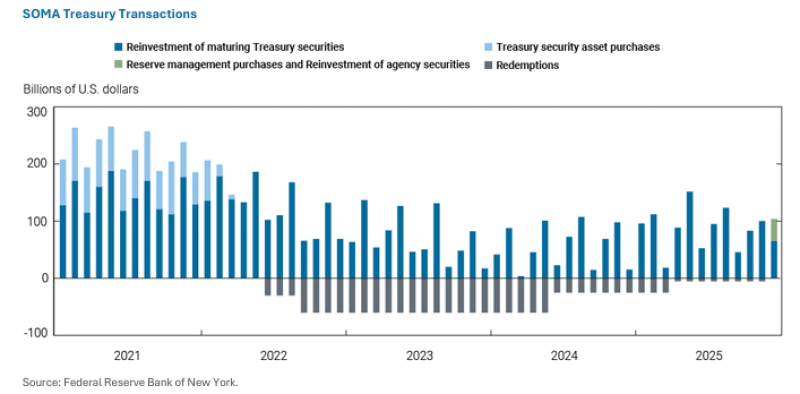
The chart shows a clear break after 2022. Earlier periods included much larger positive Treasury transactions, often above $100 billion per month.
From 2022 onward, redemptions became a persistent negative component while reinvestments continued at a much smaller scale. The current $14.6 billion program is small compared with pandemic-era purchase volumes.
The Purchases Are Focused on Treasury Bills
The purchases are funded by principal payments from:
- agency debt;
- agency MBS;
- agency CMBS.
Those proceeds are reinvested into Treasury bills in the secondary market.
How Reinvestments Were Distributed in 2025
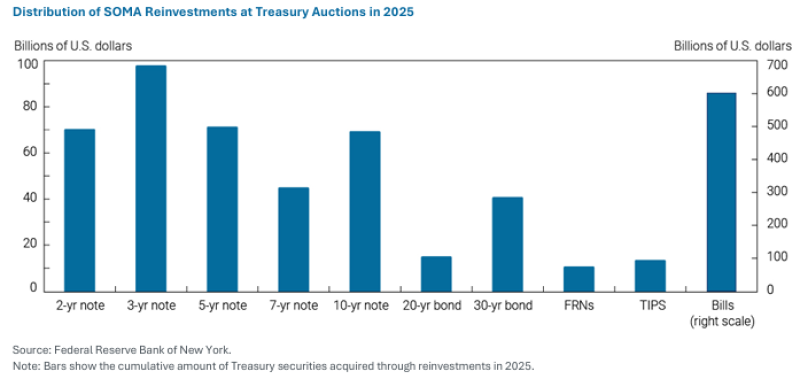
Among coupon securities, cumulative reinvestments were roughly:
- $100B in 3-year notes;
- $70B in 2-year notes;
- $70B in 5-year notes;
- just under $70B in 10-year notes;
- about $45B in 7-year notes;
- about $40B in 30-year bonds.
Treasury bills were much larger, at roughly $600 billion on the chart’s separate right-hand scale.
Purchase Parameters
| Treasury bill sector | Approximate allocation |
| 1–4 months | 75% |
| 4–12 months | 25% |
The Desk generally excludes:
- securities with four weeks or less to maturity;
- when-issued securities;
- cash management bills;
- securities showing elevated scarcity in repo markets.
SOMA holdings generally cannot exceed 70% of an individual Treasury security outstanding.
How the Purchases Are Executed
The New York Fed uses FedTrade Plus.
Key operating terms:
- counterparties: primary dealers;
- auction type: competitive, multiple-price;
- minimum offer: $1 million;
- increments: $1 million;
- maximum: nine offers per security;
- settlement: typically T+1.
Why This Is Not New QE
These purchases are reinvestments, not a new large-scale asset-purchase program. The Fed is using cash from securities already on its balance sheet to buy replacement assets. That differs from QE, where the Fed deliberately expands securities holdings to ease financial conditions.
It also differs from reserve management purchases, which are used to maintain an ample level of banking-system reserves.
$14.6 Billion Versus the Fed’s Treasury Portfolio
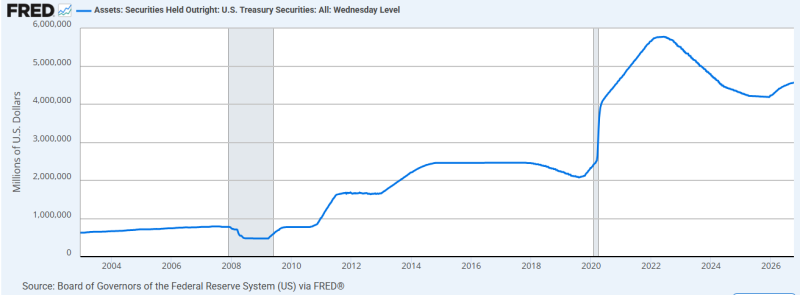
Fed Treasury holdings rose from roughly $2.4 trillion in early 2020 to around $5.7 trillion in 2022. They then declined toward roughly $4.1 trillion by 2025 before turning higher again in 2026, toward about $4.5 trillion.
Against that balance-sheet size, $14.6 billion is less than 0.5% of total Treasury holdings.
Fed Purchases Have Shifted Since Early 2026
| Period | Reinvestments | Reserve management purchases |
| Feb. 13–Mar. 12 | $13.4B | $40B |
| Mar. 13–Apr. 13 | $13.8B | $40B |
| Apr. 14–May 13 | $15.5B | $25B |
| May 14–Jun. 11 | $16.3B | $10B |
| Jun. 12–Jul. 13 | $16.5B | $10B |
| Jul. 14–Aug. 13 | $17.6B | $10B |
| Aug. 14–Sep. 14 | $17.0B | $0 |
| Sep. 15–Oct. 14 | $15.6B | $0 |
| Oct. 15–Nov. 13 | $14.6B | None announced |
The larger change is not the decline from $15.6 billion to $14.6 billion. It is the disappearance of reserve management purchases, which were as high as $40 billion per month earlier in 2026.
Market Implications
The operation adds demand for Treasury bills, but its scale is limited.
The key signals are:
- Reinvestments have declined from $17.0B to $15.6B to $14.6B.
- Reserve management purchases remain absent.
- Purchases are concentrated at the short end of the Treasury curve.
- The operation is small relative to the Fed’s multi-trillion-dollar Treasury portfolio.
Reserve Purchases Matter More Than the Headline
The New York Fed will buy approximately $14.6 billion in Treasuries between October 15 and November 13. The amount is down $1 billion from the previous period. The important distinction is that these are reinvestments funded by principal payments from existing holdings.
Without a renewed increase in reserve management purchases, the announcement does not amount to a new QE program.
 Alex Dudov