
⬤ The US labor market has gone through a long-term structural overhaul. Manufacturing and construction now account for roughly 15% of total jobs, the lowest share in at least 175 years. That is a drop of about 25 percentage points since 1950, marking a steady retreat from production-based employment.
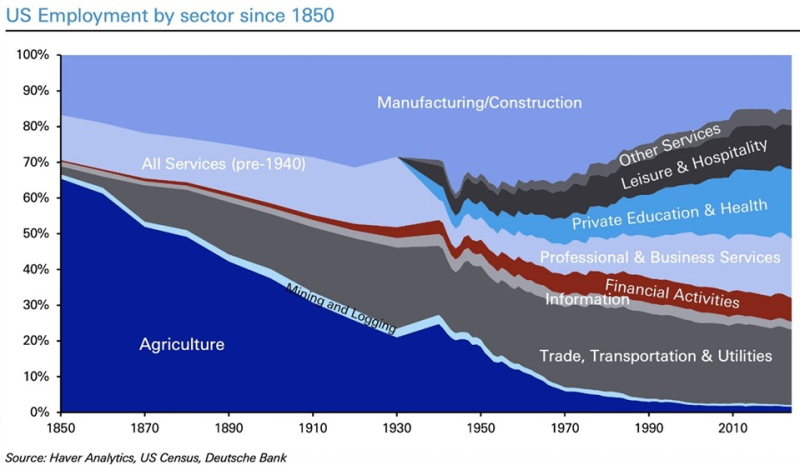
⬤ Traditional sectors have been in persistent decline. Agriculture, which once dominated US employment in the 19th century, has fallen to just around 2% of total jobs, roughly 18 percentage points lower than in 1950 and the weakest level on record. Bureau of Labor Statistics data confirms the trend has continued uninterrupted across decades.
⬤ Service sectors have expanded sharply to fill the gap. Private education and health services now make up around 20% of total employment. Professional and business services account for about 16%, and leisure and hospitality roughly 12%. All three sat near 5% back in 1950.
⬤ Trade, transportation, and utilities hold relatively steady at around 20%, while financial activities and information sectors have grown to approximately 10%, up from roughly 5% at mid-century. Together, these figures paint a clear picture: the American workforce is now overwhelmingly service-driven, with production roles a fraction of what they once were.