
 Artem Voloskovets
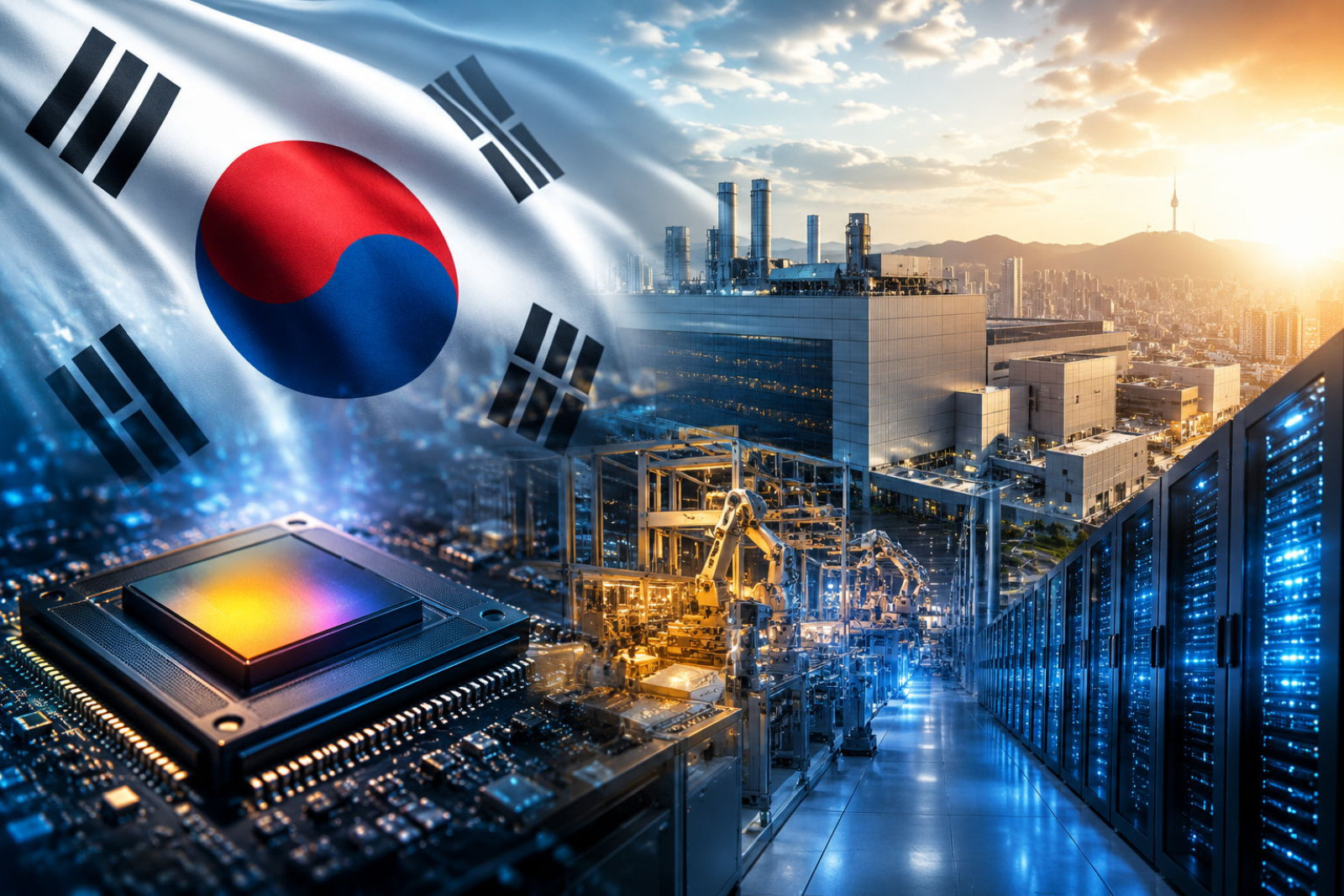
South Korea's new ₩800 trillion ($518 billion) AI initiative suggests the industry's priorities are shifting. The investment is not aimed at building a better language model. It targets semiconductor fabrication plants, advanced memory, chip packaging and AI data centers—the industrial systems that determine how much computing power the world can actually deploy.
The next stage of AI competition will be shaped less by software releases and more by manufacturing capacity.
The Center of Gravity Is Moving
The AI boom has already gone through two distinct phases. The first rewarded software companies capable of building large language models. The second favored GPU designers as demand for accelerated computing exploded. The next constraint is emerging elsewhere. Memory, semiconductor fabrication, advanced packaging, electricity, and data centers are becoming the resources that determine how quickly AI can scale.
That explains why President Lee described AI as a competition between nations rather than companies. His government's priority is not another consumer application; it is securing the industrial base required to support future AI growth.
Memory Is Becoming Strategic Infrastructure
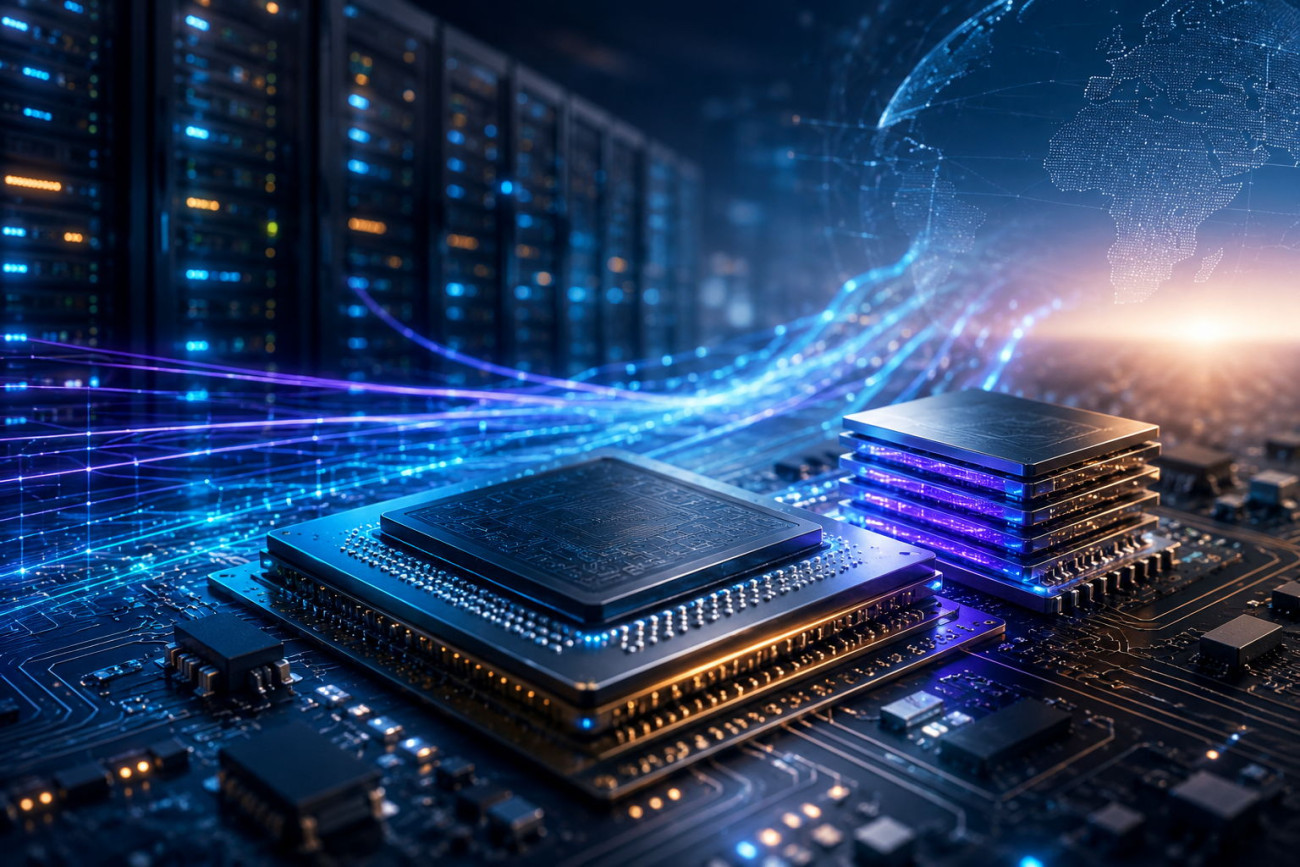
Graphics processors dominate most AI discussions, yet they cannot operate efficiently without high-performance memory. High-bandwidth memory (HBM), built by stacking multiple DRAM layers, allows AI accelerators to process enormous datasets at the speed required by modern foundation models. As models become larger, memory bandwidth increasingly limits overall system performance.
South Korea already occupies a dominant position in this market. According to Counterpoint Research, Samsung accounts for 38% of global DRAM revenue, while SK Hynix holds 29%. Together, they control roughly 67% of the market, compared with Micron's 22% and 11% for all remaining suppliers combined.
- Samsung — 38%
- SK Hynix — 29%
- Micron — 22%
- Others — 11%
The government's response is to reinforce that advantage before supply becomes a constraint. Alongside the new fabs, Seoul plans to invest ₩30 trillion ($19.4 billion) in next-generation memory technologies and double national DRAM output over the coming years.
Rather than waiting for shortages to emerge, the country is expanding production capacity in advance.
AI Requires Industrial Scale
The investment package extends far beyond semiconductor manufacturing. South Korea plans to build 18.4 gigawatts of AI-focused data center capacity by 2035, while expanding packaging facilities and supporting semiconductor clusters across the country.
None of these projects will produce a new AI model. Their purpose is to increase the amount of compute that can be manufactured, assembled and operated domestically.
This reflects a broader change across the industry. Training and serving AI systems now depend as much on factories, electricity, cooling systems, and logistics as it does on software engineering. The competitive advantage is shifting from algorithms alone to the ability to deploy infrastructure at scale.
Building Capacity Outside Seoul
The government also wants future expansion to happen beyond the country's existing semiconductor hubs.
New fabrication plants are planned for Gwangju and South Jeolla Province, regions with available land and underutilized electricity resources. Existing clusters around Yongin and Pyeongtaek are approaching practical infrastructure limits, making geographic diversification increasingly necessary.
The challenge is execution.
Semiconductor clusters require suppliers, transportation networks, stable power, water resources, and highly specialized labor. Samsung Chairman Jay Y. Lee noted that developing the Yongin ecosystem took nearly a decade, underscoring how difficult these industrial networks are to replicate.
Capital alone cannot accelerate every part of the process.
Expansion Carries Its Own Risks
Large-scale semiconductor investment is inherently cyclical.
Several analysts have warned that accelerating memory capacity could eventually create an oversupply if AI demand grows more slowly than expected. Professor Lee Jong-ho of Seoul National University made a similar point, arguing that the investment assumes strong AI demand for decades, an outcome that remains uncertain.
The concern is not whether AI will continue expanding, but whether supply could outpace commercial demand during parts of the cycle.
That uncertainty is the price of building infrastructure years before it is fully needed.
Manufacturing Is Becoming AI's Competitive Advantage
South Korea's announcement highlights a broader shift taking place across the global AI industry. The question is no longer only who develops the most capable models. Increasingly, it is who can manufacture more chips, produce more advanced memory, assemble more systems, and operate more computing capacity.
Software remains the visible layer of artificial intelligence. The infrastructure beneath it is becoming the decisive one. South Korea's $518 billion initiative reflects that transition. It is a long-term investment in the physical systems that every future AI model, regardless of who develops it, will require.
 Artem Voloskovets


