
 Artem Voloskovets

The latest Lazard Levelized Cost of Energy (LCOE) report shows that the cost of new utility-scale solar projects rose 18% year over year, onshore wind also became more expensive, and combined-cycle natural gas generation reached its highest cost in 15 years. The increase comes as utilities prepare for one of the strongest demand cycles in decades, fueled by AI data centers, domestic manufacturing and transport electrification.
The Cost Gap Between Energy Sources Is Narrowing
Renewables remain the most economical option for building new generation, but their long-running decline in costs has stalled.
Utility-scale solar increased to $40–98/MWh, compared with $38–92/MWh a year earlier. Onshore wind climbed to $37–99/MWh from $37–86/MWh, while new combined-cycle natural gas plants reached $51–129/MWh, the highest range recorded since 2011.
Higher financing costs, import tariffs, persistent inflation and more expensive equipment have all pushed project economics in the same direction. Instead of one technology becoming cheaper while another grows more expensive, developers are facing higher capital costs across the board.
[INSERT GRAPH 1 HERE – Lazard LCOE Comparison: Solar, Wind and Natural Gas]
Demand Is Growing Faster Than Utilities Expected
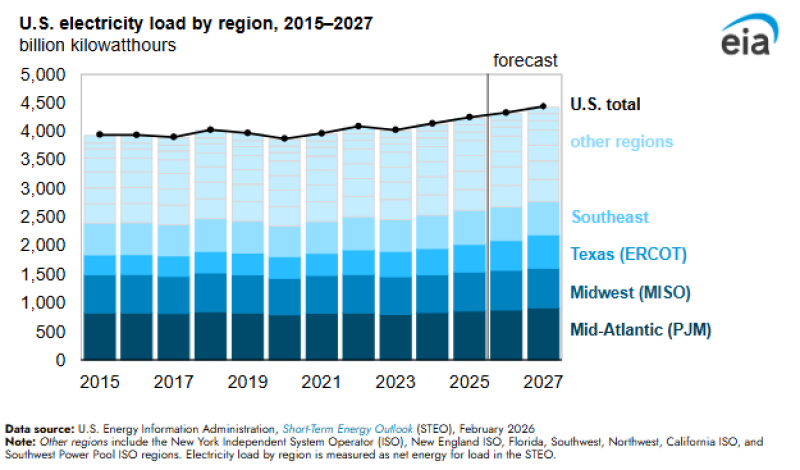
Construction costs are rising just as electricity consumption begins a sustained upswing. According to the U.S. Energy Information Administration, nationwide electricity demand hovered around 4.0 trillion kilowatt-hours for most of the past decade. The outlook now changes sharply. Consumption is projected to exceed 4.2 trillion kWh in 2025, rise to roughly 4.35 trillion kWh in 2026, and approach 4.45 trillion kWh in 2027.
Much of that growth is concentrated in Texas (ERCOT) and the Mid-Atlantic (PJM), where utilities are connecting large industrial projects and hyperscale data centers to the grid.
Unlike previous demand cycles, this increase is not primarily tied to population growth or household consumption. It reflects a structural expansion of electricity-intensive industries.
AI Has Become a Meaningful Source of Grid Growth
The fastest-growing customer on the grid is no longer heavy manufacturing—it's artificial intelligence. Berkeley Lab estimates U.S. data centers consumed 58 TWh of electricity in 2014. By 2023, consumption had reached 176 TWh, more than tripling in less than a decade.
The pace is expected to accelerate. Annual electricity use by data centers is projected to reach 325–580 TWh by 2028, increasing their share of total U.S. electricity demand from 4.4% to between 6.7% and 12%. The shift reflects the rapid deployment of AI servers, whose advanced processors and cooling systems require far more electricity than traditional cloud infrastructure.
More Than Fuel Prices Are Driving Costs Higher
The rise in generation costs cannot be explained by natural gas prices alone. Developers are paying more for financing, electrical equipment, turbines, transformers and grid connections, while utilities are investing heavily in substations and transmission networks needed to serve new demand.
These pressures arrive simultaneously, leaving fewer opportunities to reduce project costs by switching technologies or delaying construction.
Utilities Have Fewer Low-Cost Options
Utilities still need to expand generating capacity, but every available pathway has become more expensive. Natural gas remains attractive because it provides reliable, around-the-clock generation, yet new plants are significantly costlier than they were only a few years ago. Renewable projects continue to offer the lowest lifetime cost of electricity, but rising capital expenses have narrowed their economic advantage.
As demand continues to climb, utilities are increasingly choosing between projects that are all more expensive than they were at the beginning of the decade.
The Next Constraint Is Cost, Not Capacity
The U.S. power sector is entering a new phase in which generating enough electricity is no longer the only challenge.
Meeting AI-driven demand now requires expanding the grid while financing more expensive power plants, transmission lines and supporting infrastructure. The result is a market where electricity supply can continue growing, but doing so is becoming increasingly costly.
 Artem Voloskovets


