Artem Voloskovets
The key issue is whether that price is justified by HEA’s fleet growth, backlog and future EBITDA.
A fleet built around specialized offshore work
HEA operates self-elevating support vessels (SESVs) and offshore support vessels (OSVs).
Its run-rate operating base includes 29 barges and vessels:
| Fleet category | SESVs | OSVs | Total |
| Barges / vessels | 14 | 15 | 29 |
| Asset value | $920m | $382m | $1.302bn |
| RR 2026 EBITDA | $211m | $60m | $271m |
| Share of RR EBITDA | 78% | 22% | 100% |
| Average age | 4.7 years | 1.3 years | 3 years |
| 3-year average utilization | 75% | 94% | 84% |
| Average year built | 2021 | 2024 | 2023 |
SESVs account for 78% of run-rate 2026 EBITDA, despite representing fewer vessels than OSVs.
Fleet specifications
| Specification | Harsh-weather SESVs | Shallow-water SESVs | OSVs |
| Operating depth | 45–70 m | 55 m | N/A |
| Crane capacity | 300–1,000 MT | 100 MT | 25–110 MT |
| Deck space | 900–2,500 sqm | 1,000 sqm | 350–1,600 sqm |
| Deck loading | 5–10 MT/sqm | 5 MT/sqm | 7.5–13 MT/sqm |
| Persons on board | 80–300 | 150–250 | 48–350 |
These specifications determine which offshore contracts each vessel can serve and directly affect day rates and utilization.
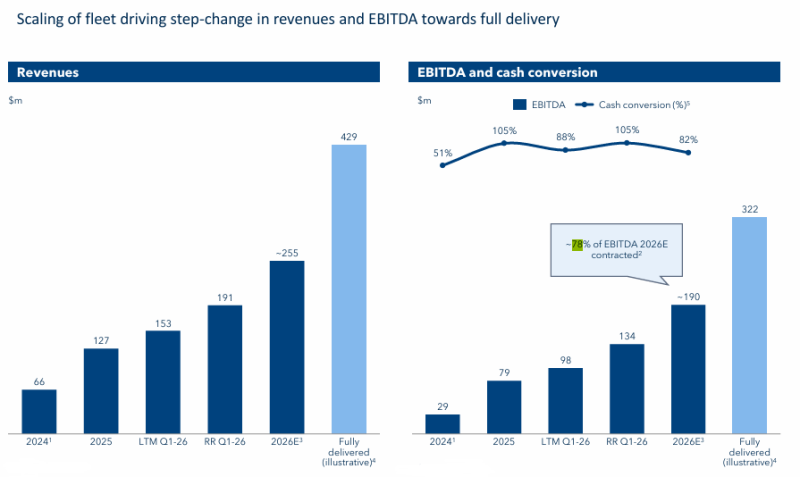
Caption: HEA’s 14 SESVs represent $920 million of asset value and 78% of run-rate 2026 EBITDA.
Earnings rise sharply as the fleet is delivered
HEA’s investor materials show a steep increase in revenue and EBITDA as new vessels enter service.
| Period | Revenue | EBITDA |
| 2024 | $66m | $29m |
| 2025 | $127m | $79m |
| LTM Q1 2026 | $153m | $98m |
| Q1 2026 run rate | $191m | $134m |
| 2026E | ~$255m | ~$190m |
| Fully delivered fleet — illustrative | $429m | $322m |
From 2026E to full fleet delivery:
- revenue rises from about $255 million to $429 million;
- EBITDA rises from about $190 million to $322 million;
- implied EBITDA growth is about 69%.
Around 78% of 2026E EBITDA was already contracted. Cash conversion shown in HEA’s presentation ranged from 51% to 105% across the periods presented.
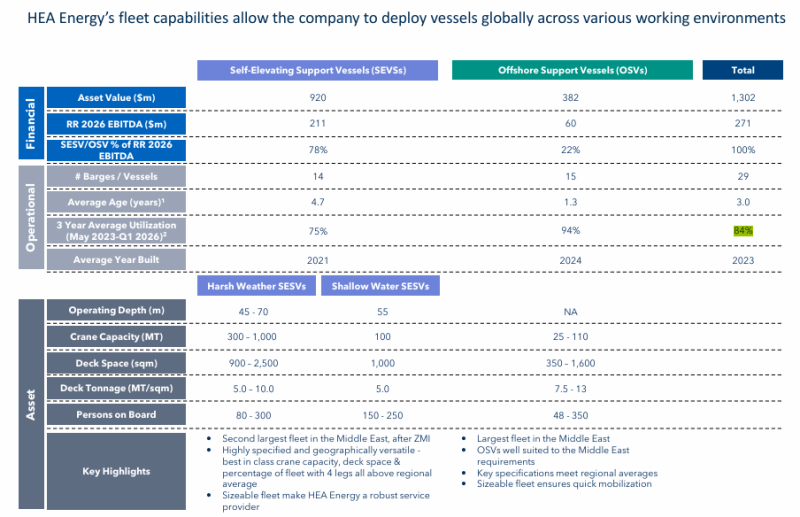
Caption: HEA illustrates EBITDA rising from about $190 million in 2026 to $322 million once the fleet is fully delivered.
The $3 billion valuation depends on which EBITDA you use
If the reported $3 billion valuation represents enterprise value, the implied multiple changes materially depending on the earnings base.
| EBITDA basis | EBITDA | Implied EV/EBITDA |
| 2026E | $190m | 15.8x |
| RR 2026 | $271m | 11.1x |
| Fully delivered fleet | $322m | 9.3x |
This is the core valuation issue. On current earnings, HEA looks expensive. On fully delivered fleet EBITDA, the multiple falls substantially.
The $3 billion figure has not been confirmed as enterprise value, so these are scenario calculations rather than confirmed deal multiples.

Backlog is concentrated in offshore wind
At March 31, 2026, HEA reported approximately $570 million of backlog, including firm contracts and options.
Backlog by client
- Ørsted: 69%
- ADNOC L&S / ZMI-related contracts: 12%
- NMDC Energy: 11%
- Cadeler: 8%
Backlog by sector
- Offshore wind: 77%
- Oil and gas: 23%
Historical revenue from major customers between 2024 and Q1 2026 included:
- Ørsted — $88.5 million
- NMDC Energy — $67.7 million
- SSE — $19.7 million
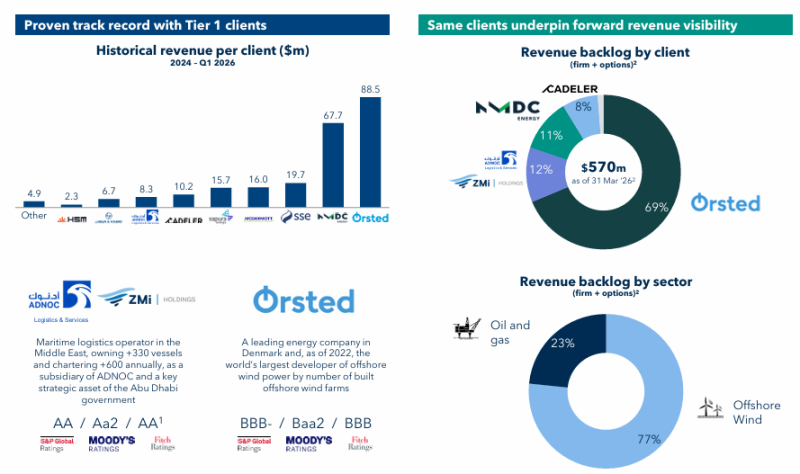
Caption: Ørsted represented 69% of HEA’s $570 million backlog at March 2026, while offshore wind accounted for 77%.
The backlog supports near-term utilization, but concentration is a risk. A delay in major Ørsted or offshore-wind projects could affect vessel demand and earnings.
ADNOC L&S previously acquired an initial 80% stake in Navig8 in a transaction implying about $2 billion of enterprise value and approximately 4.9x 2023 EBITDA.
| HEA Energy | Navig8 | |
| Core business | Offshore marine services | Tanker shipping |
| Main assets | SESVs, OSVs | Tankers |
| Valuation | Up to $3bn | ~$2bn EV |
| EBITDA reference | ~$190m 2026E | >$400m 2023 |
| Headline multiple | ~15.8x* | 4.9x |
| Fully delivered multiple | ~9.3x | *4.9x |
| Main exposure | Offshore wind, oil & gas | Tanker shipping |
*Assuming $3 billion is enterprise value.
HEA is more expensive on EBITDA, but it is also still adding vessels and earnings capacity.
Why HEA fits ADNOC L&S
The strategic fit is straightforward:
- HEA adds specialized offshore vessels rather than conventional shipping capacity;
- 77% of its March 2026 backlog was tied to offshore wind;
- SESVs provide high-value lifting, accommodation and offshore support capabilities;
- ADNOC L&S is already part of HEA’s customer base.
The acquisition would broaden ADNOC L&S beyond tanker shipping into higher-value offshore services.
Main risks
Three numbers matter most:
- 69% — share of backlog linked to Ørsted.
- 77% — share of backlog linked to offshore wind.
- 75% — three-year average utilization for SESVs, below the 94% recorded by OSVs.
The valuation case weakens if new vessels are delayed, utilization falls or contracted projects do not convert into operating days.
The key question
HEA generated $79 million of EBITDA in 2025 and expects about $190 million in 2026, but its fully delivered fleet is illustrated at $322 million of EBITDA.
That gap explains much of the reported valuation. At $3 billion, HEA looks expensive on 2026 earnings at roughly 15.8x EBITDA. On fully delivered fleet earnings, the multiple falls to about 9.3x.
For ADNOC L&S, the deal therefore depends less on HEA’s current results than on whether the new fleet can deliver the projected EBITDA.
 Artem Voloskovets