Artem Voloskovets

Brent crude reversed earlier losses and was last up 0.15%, while WTI gained 1.5%.
The move followed a weaker session in which Brent fell to $108.14 per barrel and WTI to $100.54. The new catalyst shifted attention back from supply recovery to infrastructure risk.
Market Reaction
| Benchmark | Latest move | Previous level |
| Brent | +0.15% | $108.14/bbl |
| WTI | +1.5% | $100.54/bbl |
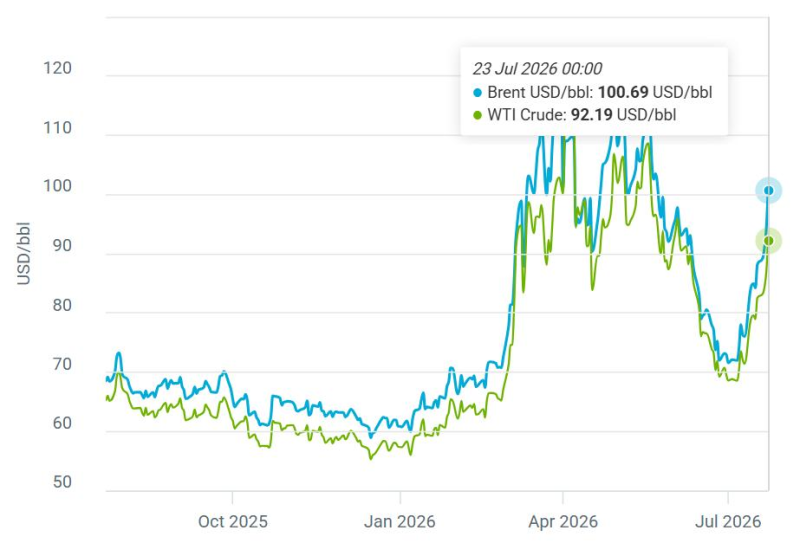
WTI is outperforming Brent, continuing a pattern seen in recent sessions. On July 23, Brent traded at $100.69, while WTI stood at $92.19, leaving a spread of $8.50 per barrel.
Why Saudi Infrastructure Matters
Saudi Arabia’s oil system depends on pipelines, refineries and export terminals as well as production fields.
The East-West Pipeline is one of the key assets. It can move up to 7 million barrels per day from eastern Saudi Arabia to the Red Sea coast.
Other relevant assets include:
| Asset | Capacity |
| East-West Pipeline | 7 million bpd |
| Jazan refinery | 400,000 bpd |
| Jazan IGCC power plant | 3.8 GW |
A confirmed disruption to these assets would affect physical oil flows rather than only market sentiment.
2026 Oil Price Context
Brent has already experienced several major repricings this year.
Weekly EIA data show Brent rising from $71.36 on February 27 to $124.61 on April 10, an increase of roughly 75%.
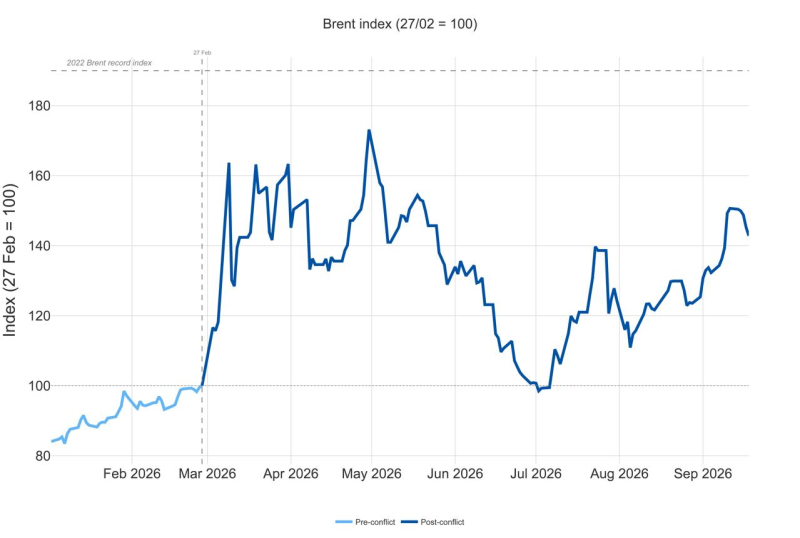
EIA weekly Brent prices:
| Date | Brent |
| Feb. 27 | $71.36 |
| Mar. 6 | $85.28 |
| Mar. 13 | $96.16 |
| Mar. 20 | $111.40 |
| Apr. 3 | $123.94 |
| Apr. 10 | $124.61 |
The current 0.15% gain in Brent is small compared with those moves.
Why WTI Is Rising Faster
WTI is receiving support from two factors:
- geopolitical risk in the Middle East;
- tighter U.S. crude inventories.
Recent U.S. inventory data showed a large crude draw, supporting WTI independently of Brent. That helps explain the current difference between WTI +1.5% and Brent +0.15%.
What Matters Next
The market now needs confirmation of actual damage.
The main indicators are:
- Saudi crude production;
- East-West Pipeline throughput;
- refinery utilization;
- export terminal activity;
- tanker traffic;
- freight and insurance costs.
If operations remain normal, part of the risk premium may fade. If production or export capacity is reduced, oil prices could move substantially higher.
Bottom Line
The current move is a geopolitical risk adjustment, not yet a confirmed supply shock. Brent is up only 0.15%, while WTI is up 1.5%. The key variable is no longer the Houthi claim itself, but whether Saudi production, pipelines or export infrastructure were actually disrupted.
 Artem Voloskovets