Artem Voloskovets

Leonardo's latest strategic plan makes that shift explicit. The company is investing not only to build more defense systems but to redesign the digital infrastructure behind them.
The Real Bottleneck Is No Longer Manufacturing
Leonardo's 2026–2030 Industrial Plan argues that modern security threats are evolving faster than traditional defense organizations. Hypersonic weapons, drones and cyberattacks have expanded the battlefield beyond military installations to include energy networks, transport systems, manufacturing, finance and other critical infrastructure.
That broader threat landscape is expected to reshape spending. Leonardo estimates the global security market will grow from roughly $400 billion annually in 2020 to more than $1 trillion by 2030. During the same period, the economic damage caused by cybercrime could rise from approximately $1 trillion per year to $1 trillion every month.
Viewed through that lens, the Accenture contract is not an isolated consulting engagement. It supports Leonardo's effort to strengthen the digital capabilities needed to operate in a security environment where software increasingly determines operational effectiveness.
Scaling the Business Requires Digital Capacity
Leonardo's industrial strategy combines portfolio optimization, international partnerships, acquisitions and digital transformation into a single growth plan. The objective is straightforward: produce more sophisticated systems faster while managing greater operational complexity.
That requires technologies extending well beyond manufacturing. Cloud platforms connect engineering teams across multiple countries. Digital twins shorten development cycles before physical production begins. Artificial intelligence improves maintenance planning, while cybersecurity protects industrial systems and classified data throughout the supply chain.
These capabilities are becoming core industrial assets rather than optional technology upgrades, making digital partners an increasingly important part of the defense ecosystem.
Growth Targets Support the Strategy
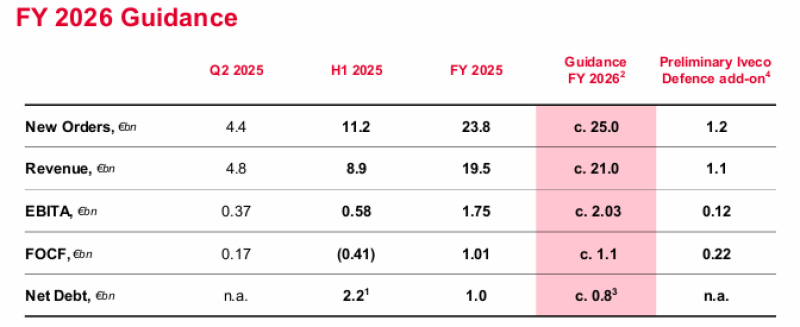
Leonardo's financial outlook indicates that management expects demand to remain strong over the coming year.
For FY2026, the company projects:
- New orders: approximately €25 billion, compared with €23.8 billion in FY2025.
- Revenue: around €21 billion, versus €19.5 billion last year.
- EBITA: approximately €2.03 billion, up from €1.75 billion.
- Free Operating Cash Flow: roughly €1.1 billion.
- Net debt: declining toward €0.8 billion.
The recently completed acquisition of IDV Defence is expected to add another €1.2 billion in orders, €1.1 billion in revenue, €120 million in EBITA and €220 million in free operating cash flow during 2026. Those projections suggest Leonardo is investing ahead of growth rather than reacting to it.
Why Accenture Matters
The agreement places Accenture inside one of Europe's largest defense modernization programs at a time when digital capabilities are becoming central to industrial competitiveness.
For defense manufacturers, software increasingly determines how quickly products can be designed, tested, certified and maintained. Engineering workflows, supply-chain visibility, predictive maintenance and cyber resilience all depend on integrated digital platforms.
The relationship is not entirely new. Leonardo has previously collaborated with Accenture and Microsoft on secure cloud infrastructure designed to support defense engineering and classified workloads. The new agreement appears to extend that foundation across a broader part of Leonardo's operations.
Management Is Investing Into Strength
Leonardo's latest earnings commentary reinforces the outlook presented in its guidance. Management said the positive momentum seen during the first quarter continued throughout the second quarter, while describing the commercial environment as supportive. The company also reaffirmed its FY2026 targets of €25 billion in orders, €21 billion in revenue, €2.03 billion in EBITA and approximately €1.1 billion in free operating cash flow.
The message is notable because the company is expanding digital investment from a position of strength rather than in response to weakening demand.
Beyond One Contract
The estimated €200 million agreement represents a relatively small commitment compared with Leonardo's annual revenue, yet its strategic importance is considerably larger.
Europe's defense expansion is creating demand for a second layer of suppliers that do not manufacture aircraft, helicopters or missile systems. Instead, they provide the digital infrastructure that allows those programs to scale efficiently, remain cyber-secure and operate across increasingly connected defense networks.
As military platforms become more software-defined, the companies building cloud architecture, AI systems and cybersecurity capabilities are likely to become as strategically important as many traditional industrial suppliers. Accenture's agreement with Leonardo is another sign that this transition is already underway.
 Artem Voloskovets