Artem Voloskovets

Dollar Tree raised its fiscal 2026 guidance after posting stronger-than-expected first-quarter results, adding another signal that U.S. consumers continue shifting spending toward value retail amid persistent pressure on household budgets.
The company reported a 7.2% increase in net sales for the quarter, while comparable store sales rose 3.5%. Adjusted diluted earnings per share climbed 38% to $1.74, supported by expanding margins and continued traffic strength across stores.
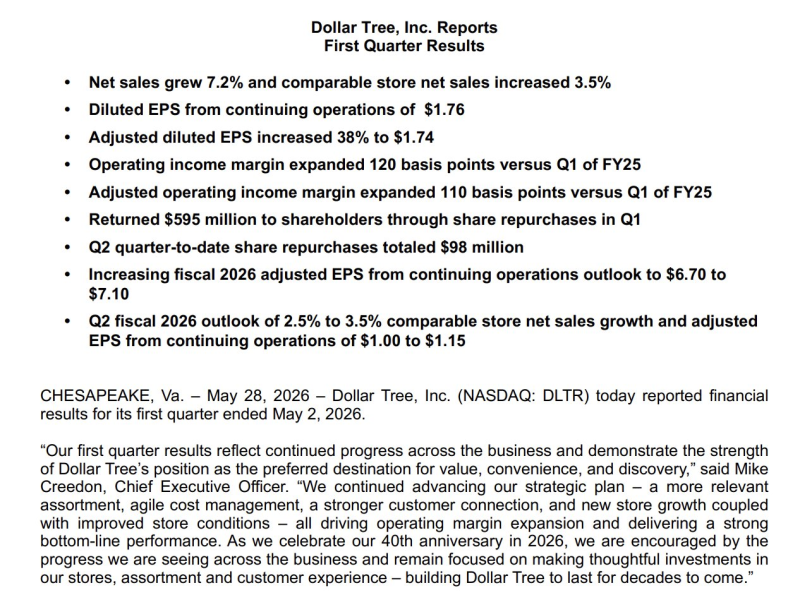
More important than the headline growth was the improvement in profitability. Dollar Tree said operating income margin expanded by 120 basis points year-over-year, while adjusted operating margin increased by 110 basis points. For discount retailers, margin expansion during a period of cautious consumer spending is closely watched because it suggests pricing discipline and inventory control are improving simultaneously.
Dollar Tree Q1 FY2026 Snapshot
| Metric | Q1 FY2026 | YoY Change |
| Net Sales Growth | 7.2% | ↑ |
| Comparable Store Sales | 3.5% | ↑ |
| Adjusted Diluted EPS | $1.74 | +38% |
| Reported EPS | $1.76 | ↑ |
| Operating Margin Expansion | +120 bps | ↑ |
| Adjusted Operating Margin | +110 bps | ↑ |
| Share Repurchases (Q1) | $595M | — |
| Q2 Share Repurchases | $98M | — |
| FY2026 Adjusted EPS Guidance | $6.70–$7.10 | Raised |
Margin expansion alongside positive comparable sales is becoming increasingly rare across U.S. retail, especially in lower-income consumer segments. That combination is one reason investors reacted positively to the report.
| Quarter | Comparable Sales Growth |
| Q2 FY2025 | 2.0% |
| Q3 FY2025 | 1.8% |
| Q4 FY2025 | 2.5% |
| Q1 FY2026 | 3.5% |
The retailer also returned $595 million to shareholders through buybacks during the quarter and has already repurchased another $98 million in Q2. Management responded by raising its full-year adjusted EPS outlook to a range of $6.70 to $7.10.

That matters beyond one earnings report.
Over the past two years, investors have increasingly treated discount chains as real-time indicators of middle-income financial stress. Stronger performance at value retailers often coincides with softer discretionary spending elsewhere in the retail sector.
Dollar Tree’s updated outlook suggests the “trade-down” effect - where consumers shift from traditional supermarkets and mid-tier retailers toward lower-cost alternatives — remains active heading into the second half of 2026.
CEO Mike Creedon said the company continues to benefit from investments in assortment, store conditions, and customer engagement as the chain approaches its 40th anniversary.
The report also arrives during a period when markets are becoming more selective toward consumer-sector earnings. Retailers capable of protecting margins while maintaining traffic are increasingly being rewarded over companies relying purely on pricing power.
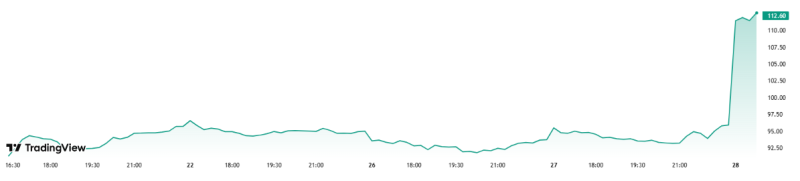
The quarter reinforces a broader theme already visible across U.S. retail earnings this season: defensive consumer names are beginning to regain institutional attention as uncertainty around economic growth and household spending persists.
 Artem Voloskovets