Artem Voloskovets
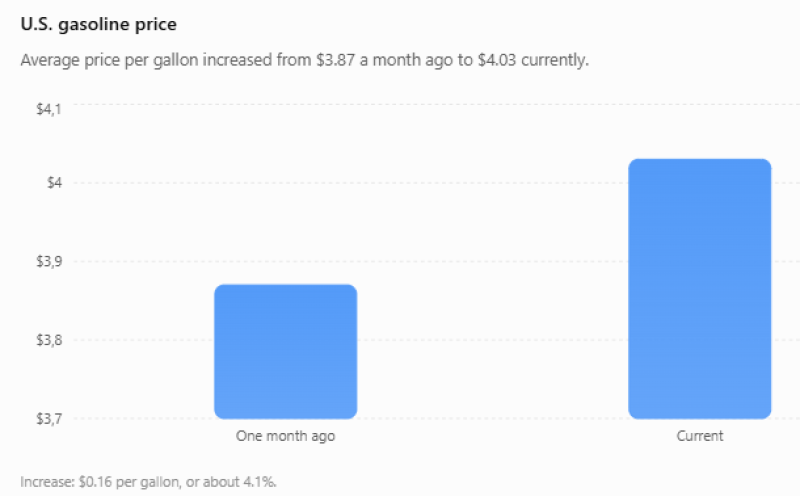
That support is disappearing. U.S. gasoline now averages about $4.03 per gallon, compared with $3.87 a month ago — an increase of roughly 4.1%. Crude prices have risen at the same time that refining margins remain strong, increasing the risk that energy shifts from reducing headline inflation in July to raising it in August.
July's Energy Tailwind
Energy can move headline CPI quickly because gasoline and fuel prices adjust much faster than categories such as shelter and many services.
July benefited directly from that volatility.
| Energy component | July M/M |
| Gasoline | −2.9% |
| Fuel oil | −1.7% |
Those declines reduced the energy component of CPI and helped offset price increases elsewhere. But July's numbers describe prices that have already passed. For August inflation, the relevant signal is what has happened since — and gasoline has moved sharply higher.
From $3.87 to $4.03
The national gasoline average has risen about 16 cents per gallon in a month, from $3.87 to $4.03. That is roughly a 4.1% increase.
Retail gasoline prices and the CPI gasoline index do not move one-for-one. CPI uses its own sampling methodology and seasonal adjustments. But the reversal is large enough to change the direction of energy's contribution.
In July, a 2.9% gasoline decline pulled headline inflation lower. If higher pump prices persist through August, gasoline is likely to work in the opposite direction. The important change is therefore not simply that gasoline costs more than $4. It is the shift from falling prices to rising prices between two consecutive inflation reports.
Refining Margins Add Another Layer
Crude oil is only one component of retail fuel prices. Refining margins — the spread between crude costs and the value of products such as gasoline and diesel — also determine how much of an oil-price move reaches consumers.
When crude rises while refining margins remain elevated, retail fuel prices can increase faster than crude alone would suggest. Refinery utilization, inventories and regional supply constraints can amplify the move.
That combination is now putting upward pressure on U.S. fuel costs. It also means an oil-price stabilization would not necessarily produce an immediate decline at the pump. Refining margins would have to ease as well.
August CPI Faces Different Arithmetic
The contrast between the two months is straightforward:
- July: gasoline −2.9% → energy reduced headline CPI.
- August: gasoline prices rising → energy could increase headline CPI.
The rest of the inflation basket does not need to accelerate for headline inflation to move higher. Simply removing July's energy decline and replacing it with an increase can produce a noticeable month-to-month change. Core CPI would be less directly affected because it excludes food and energy. That creates the possibility of headline inflation accelerating while core inflation remains relatively stable.
For the Federal Reserve, the distinction matters. A temporary gasoline spike carries less information about persistent inflation than accelerating shelter or services prices. For households, it is still a direct increase in living costs.
The Risk Beyond Gasoline
The immediate effect appears in fuel prices. A longer energy increase can spread further. Diesel affects trucking and distribution. Jet fuel affects airlines. Energy is also an input for manufacturing and agriculture. Companies can initially absorb those costs through margins, but sustained increases raise the probability that some of them are eventually passed through to customers.
Timing matters. A brief jump in gasoline could distort one inflation report without changing the broader trend. Several months of higher crude prices and strong refining margins would create a different problem by increasing costs across supply chains. That makes the persistence of the current move more important than any single daily oil or gasoline quote.
Energy Is Back in the August CPI Equation
July inflation benefited from a 2.9% monthly decline in gasoline and a 1.7% drop in fuel oil. Since then, the U.S. gasoline average has moved from $3.87 to $4.03 per gallon. If that increase holds through August, energy will no longer provide the same offset to inflation. It could instead become one of the main reasons headline CPI accelerates from July.
The next inflation report therefore has an unusually visible variable to watch: whether gasoline stays above $4 — and whether the rise in crude prices and refining margins keeps it there.
 Artem Voloskovets