Artem Voloskovets

The latest data point to a labor market that is no longer constrained by rapid labor force growth but by slowing demand for workers.
A Lower Hiring Threshold Hasn't Produced Stronger Employment
One of the clearest ways to assess Canada's labor market is to compare actual job creation with the number of new jobs needed to keep the employment rate unchanged.
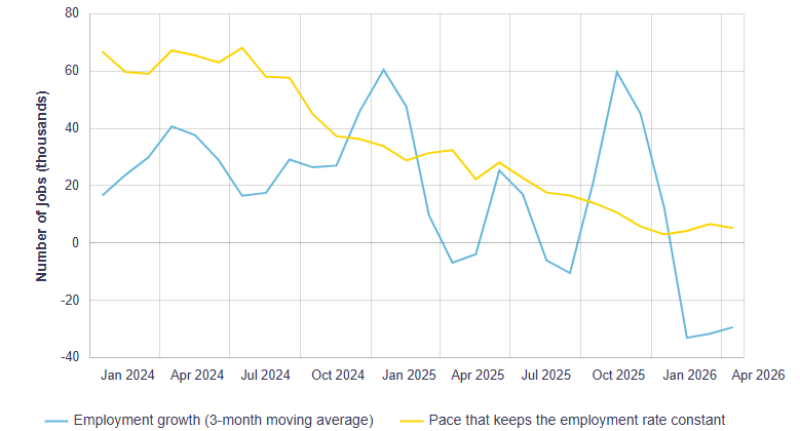
The chart illustrates how dramatically the labor market has changed over the past two years.
At the start of 2024, Canada needed roughly 65,000–70,000 new jobs each month to offset rapid population growth. By early 2026, that requirement had fallen to about 5,000, as slower population growth reduced pressure on the labor force.
Employment growth failed to keep pace with that shift. The three-month moving average of job creation moved from gains of 40,000–60,000 jobs during parts of 2024 to losses of roughly 30,000 by early 2026. Temporary rebounds proved short-lived, and the broader direction remained negative. The implication is straightforward: employers are hiring less despite facing a much lower demographic hurdle.
Demographics Are No Longer Driving the Weakness
For much of 2023 and 2024, Canada's labor market struggled to absorb an unusually fast expansion of the labor force. Population growth required businesses to create record numbers of new positions simply to keep employment rates from falling.
That pressure has largely disappeared. Hiring, however, has continued to soften. Businesses remain cautious as high borrowing costs, slower domestic demand and trade uncertainty weigh on investment decisions. The slowdown has shifted from a demographic challenge to a demand-driven one.
This distinction matters because weaker population growth should have made labor market conditions easier to sustain. Instead, hiring has slowed even faster.
Hiring Is Slowing Before Layoffs Accelerate
June's unemployment rate offers only a partial view of labor market conditions. Companies often respond to slowing demand by reducing recruitment before cutting existing staff. The result is a gradual deterioration that appears first in hiring data rather than unemployment statistics.
Canada's recent labor market follows that pattern. Businesses continue to retain much of their workforce while limiting new recruitment, making it increasingly difficult for new entrants and job seekers to find employment. The decline in hiring therefore provides an earlier indication of economic weakness than the unemployment rate alone.
Why the Bank of Canada Will Look Beyond the Headline
A lower-than-expected unemployment rate does not materially change the policy picture. The labor market has avoided a sharp deterioration, but sustained weakness in hiring suggests underlying demand remains subdued. That combination supports a cautious approach from the Bank of Canada, which must balance slowing growth against inflation that has yet to fully return to target.
Unless hiring begins to recover, policymakers are unlikely to interpret June's data as evidence that economic momentum has strengthened.
The Trend Matters More Than the Monthly Surprise
A one-tenth percentage point improvement in unemployment attracted immediate attention because it exceeded market expectations.
The longer-term employment trend tells a different story. Canada now requires only a fraction of the monthly job creation it needed a year ago, yet actual hiring has deteriorated even more rapidly. The labor market is no longer being stretched by population growth — it is being held back by weaker demand for workers.
That shift is likely to have a greater influence on Canada's economic outlook than June's modest upside surprise in the unemployment rate.
 Artem Voloskovets