Artem Voloskovets

The revision is narrow but points to a slightly stronger growth path without a corresponding improvement in the inflation outlook.
A 0.1-Point Upgrade
| 2026 forecast | July poll | Latest poll | Change |
| GDP growth | 1.0% | 1.1% | +0.1 pp |
| Average inflation | 3.1% | 3.1% | — |
UK GDP growth forecast: 1.0% → 1.1%. Inflation: 3.1% → 3.1%.
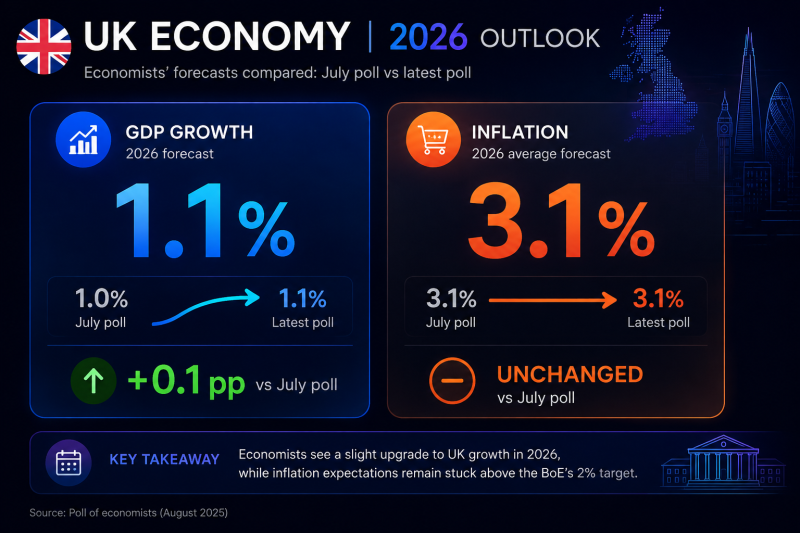
The GDP revision amounts to 0.1 percentage point, or a 10% increase relative to the previous 1.0% growth estimate. It does not, however, change the broader picture of low-single-digit economic expansion.
At 1.1%, growth would leave limited room for a rapid acceleration in household consumption, business investment or tax receipts.
The 3.1% Number Matters More
Inflation is still expected to average 3.1% in 2026, leaving it 1.1 percentage points above the Bank of England's 2% target. That gap is more consequential for monetary policy than the small upward revision to GDP.
Persistent inflation reduces the scope for lower interest rates. For households, it means continued pressure on real purchasing power unless wages rise at a comparable pace. For companies, higher input and labour costs remain a margin risk, particularly where weak demand limits pricing power.
The forecasts therefore imply an unusual imbalance: GDP growth has been revised higher, but the inflation constraint has not eased.
What 3.1% Inflation Means for Rates
The GDP revision alone provides little reason for a major change in the Bank of England's policy path. The inflation forecast does. With average inflation at 3.1%, policymakers would need evidence that underlying price pressures are declining before moving more aggressively toward easier monetary conditions.
A faster fall in inflation would create more room for lower borrowing costs. If price growth remains close to 3%, restrictive rates could persist even with GDP expanding only around 1%.
This makes inflation data, particularly measures of underlying domestic price pressure, more important than a 0.1-point change in the annual growth forecast.
Better Growth, Same Constraint
The latest poll changes one side of the UK's 2026 equation:
GDP: 1.0% → 1.1%Inflation: 3.1% → 3.1%
The growth outlook has improved at the margin, but the inflation forecast has not moved.
For markets, the important question is no longer whether the UK can generate an extra tenth of a percentage point of GDP growth. It is whether inflation can move sufficiently closer to 2% to give monetary policy more room to support the economy.
Until that happens, 1.1% growth alongside 3.1% inflation leaves the UK with a modest expansion constrained by persistent price pressures.
 Artem Voloskovets