Marina Lubimova

The study tested intismeran autogene (V940/mRNA-4157) with Merck’s Keytruda in 1,137 patients with stage IIB-IV melanoma following surgery.
The combination beat Keytruda alone on recurrence-free survival and met the key secondary endpoint for distant metastasis-free survival. The companies reported no new safety signals.
A Phase 3 Result Against a Much Smaller Revenue Base
The scale of Moderna’s stock move is easier to understand against its current financial position.
In Q2 2026, Moderna generated roughly $0.1 billion in revenue and posted a $0.8 billion GAAP net loss, or $1.97 per share. It expects to finish the year with $4.7-$5.2 billion in cash.
| Metric | Q2 2026 |
| Revenue | ~$0.1 |
| BGAAP net loss | ~$0.8 |
| BLoss per share | $1.97 |
| Expected year-end cash | $4.7–$5.2B |
V940 therefore does not need to approach Keytruda’s scale to become material for Moderna. A multi-billion-dollar oncology franchise would represent a substantial new revenue stream relative to the company’s current base.
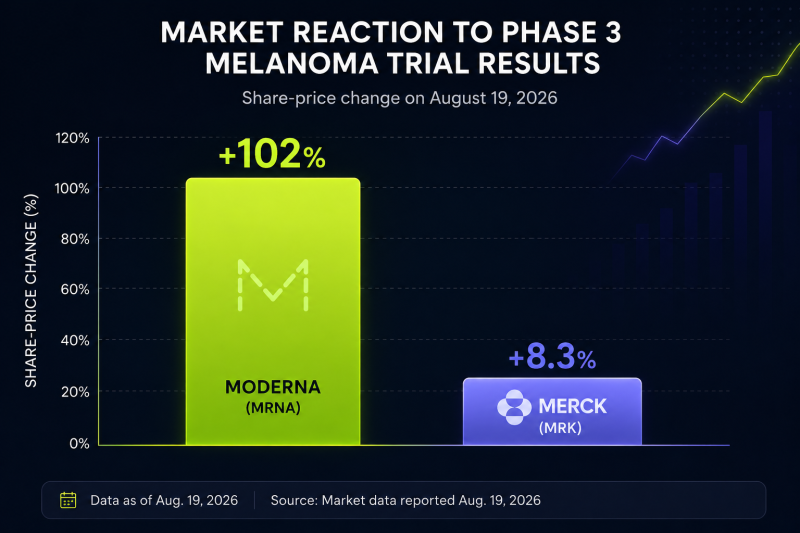
The 102% versus 8.3% stock reaction captures that difference. Merck is adding another potentially valuable asset to a large oncology portfolio; Moderna is gaining Phase 3 evidence that its mRNA technology can support a business outside infectious-disease vaccines.
Merck Has a Different Problem to Solve
Keytruda is expected to reach roughly $35 billion in peak annual sales by 2028, making it one of the pharmaceutical industry's largest products.
That scale also creates concentration risk as Keytruda approaches major patent expirations later this decade.
V940 could help Merck preserve more of the economics surrounding Keytruda by creating a combination regimen that extends into personalized cancer treatment. An 8.3% move in Merck shares indicates that investors see the trial as material even relative to its much larger existing business.
Melanoma Is Only the First Revenue Test
V940 is manufactured individually. Tumor mutations are identified for each patient and used to create an mRNA treatment designed to direct the immune system toward those specific cancer targets.
The commercial case becomes considerably larger if the approach works outside melanoma.
Moderna and Merck are already studying the technology in additional cancers, including non-small-cell lung cancer. Estimates cited following the Phase 3 result put potential V940 sales at around $3 billion annually by 2035, before accounting for substantial upside from additional successful indications.
Manufacturing remains the key constraint. Unlike a conventional drug produced in standardized batches, every V940 treatment must be designed and manufactured for one patient. Turnaround time, capacity and cost per treatment will therefore directly affect margins and adoption.
 Marina Lubimova