Marina Lubimova
The latest market data suggests that positioning is changing rapidly. Foreign investors are withdrawing capital at a record pace while selling pressure has spread across the broader equity market. Together, the data points to a shift in portfolio strategy rather than a sudden deterioration in Korea's economy. Investors appear to be reducing exposure to one of the market's most crowded AI trades after an extended rally. Reuters has also reported a sharp rise in foreign selling across Asian AI-related equities during recent portfolio rebalancing.
Foreign Investors Have Moved From Buying to Liquidation
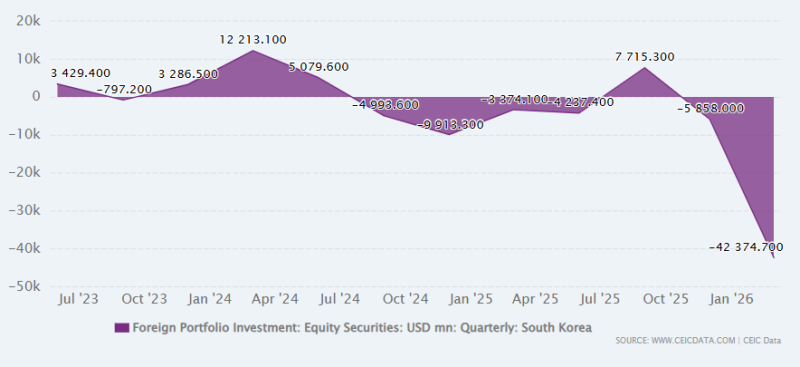
The change in capital flows is unusually abrupt. Foreign portfolio investment peaked at +$12.2 billion in early 2024 before turning negative later that year. Outflows accelerated from -$5.0 billion to -$9.9 billion, eventually reaching -$42.4 billion in the latest quarter.
The magnitude matters more than the direction. Previous periods of selling unfolded gradually. This time, the market experienced a single-quarter withdrawal that exceeded every earlier decline on the chart, indicating that investors were cutting exposure aggressively instead of simply taking profits.
Reuters estimates that South Korea recorded roughly $70.8 billion in foreign equity outflows during the first half of 2026, the largest total among Asian equity markets.
The Selling Is No Longer Limited to Technology Stocks
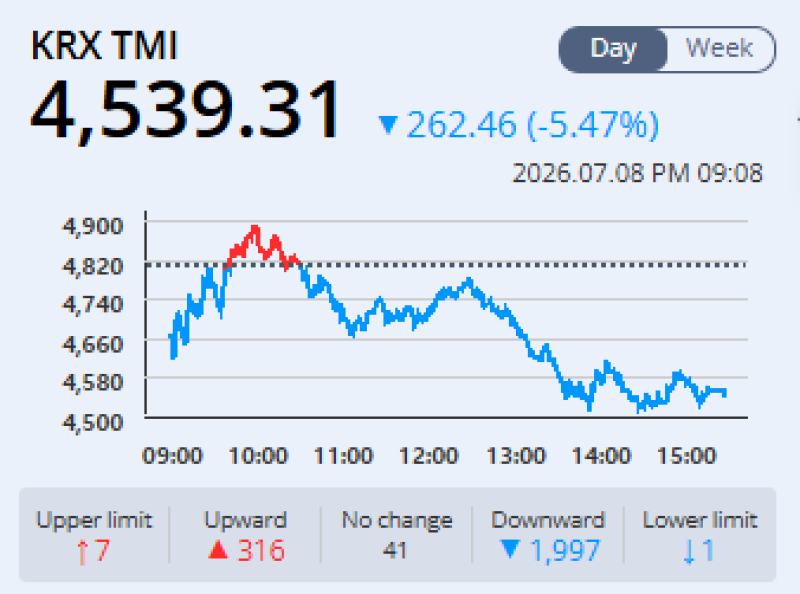
The decline in capital flows is now visible across the broader market. The KRX TMI Index dropped 262.46 points, or 5.47%, ending the session at 4,539.31. Market breadth deteriorated sharply. Only 316 stocks advanced, while 1,997 declined, showing that weakness extended far beyond the largest semiconductor companies. When nearly the entire market moves lower together, investors are typically reducing country exposure rather than reallocating within sectors.
Korea Has Become a Single-Theme Market
South Korea's equity market has become increasingly dependent on one global narrative. Memory chips, AI servers and cloud infrastructure account for much of the enthusiasm surrounding Korean equities. Samsung Electronics and SK Hynix have become proxies for global AI spending, making the country's benchmark indices more sensitive to changes in technology sentiment than in domestic economic conditions.
That concentration amplified returns during the AI rally. It also increased downside risk once global funds began trimming positions. A market dominated by a single investment theme tends to experience larger swings when institutional investors rebalance portfolios.
Capital Is Reacting Faster Than the Economy
The recent outflows do not necessarily imply weaker corporate fundamentals. South Korea remains one of the world's largest semiconductor exporters, while demand for advanced memory continues to benefit from long-term AI infrastructure investment.
Portfolio managers, however, respond first to liquidity, positioning and risk concentration.
Markets that attract the strongest inflows during periods of optimism often experience the fastest reversals once investors begin reducing exposure. Reuters notes that foreign selling has also pressured the Korean won despite resilient exports and a strong current-account surplus.
A Test for the Next Phase of the AI Cycle
The two charts describe the same process from different angles. One shows record capital leaving the market. The other shows that selling has spread across nearly every segment of Korean equities. The question is no longer whether South Korea remains central to the global semiconductor industry. That position is well established.
The next test is whether investors continue treating Korean equities as a long-term AI allocation or whether they become a market that global funds trade opportunistically as enthusiasm around the AI cycle becomes more selective.
 Marina Lubimova