Marina Lubimova

The latest data from Artificial Analysis suggests that question may already be outdated. US frontier models remain ahead, with the country's leading systems reaching an Artificial Analysis Intelligence Index above 60 by mid-2026. China's strongest models still trail, finishing in the mid-50s range.
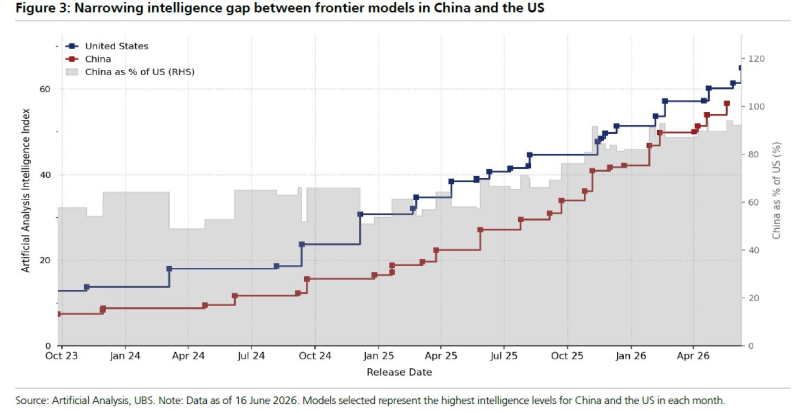
Yet the more revealing trend is not the remaining gap. It is the speed at which that gap has narrowed.
In late 2023, China's best models operated at roughly half the capability level of their US counterparts. By June 2026, that figure had climbed to nearly 90%. The distance between the two ecosystems has not disappeared, but it has compressed far faster than many expected.
That shift changes the economics of AI. Technology markets tend to reward leaders disproportionately when performance differences are large. Once competing products become "good enough," advantages increasingly depend on distribution, infrastructure, pricing, developer ecosystems, and enterprise adoption rather than raw technical superiority.
AI may be approaching that transition point.
The past two years have been defined by a race for intelligence. The next phase could be defined by a race for monetization.
A shrinking performance gap creates pressure across the industry. Model providers face greater competition. API pricing becomes harder to defend. Enterprises gain more alternatives when selecting foundation models. Regional providers become increasingly viable options rather than secondary choices.
The trend is also notable because it has emerged despite ongoing restrictions on advanced semiconductor exports to China.
Those controls were designed to preserve America's technological lead by limiting access to the most advanced AI hardware. The data does not suggest those efforts have failed, but it does indicate that hardware restrictions alone have not prevented Chinese labs from moving closer to the frontier.
That reality may force policymakers and investors to rethink how AI leadership is measured.
For much of the current cycle, market attention has focused on which company released the most capable model. The next question could prove more important: who can build the largest and most profitable ecosystem around increasingly comparable intelligence.
The answer will determine where long-term value is created. America still leads the frontier. The latest numbers leave little doubt about that.
What is becoming harder to ignore is that the conversation is no longer about whether China can compete. It is about what happens when the performance gap becomes too small to remain the industry's defining feature.
 Marina Lubimova