Artem Voloskovets

- Amazon's Profit Mix Looks Very Different Today
- AWS Is Selling the Picks and Shovels
- Capital Spending Is Starting to Look Different
- Advertising Keeps Improving Margins
- Retail Has Become an Efficiency Business
- Why Investors Repriced Amazon
- The AI Cycle Is Moving Into Commercialization
- The Feedback Loop
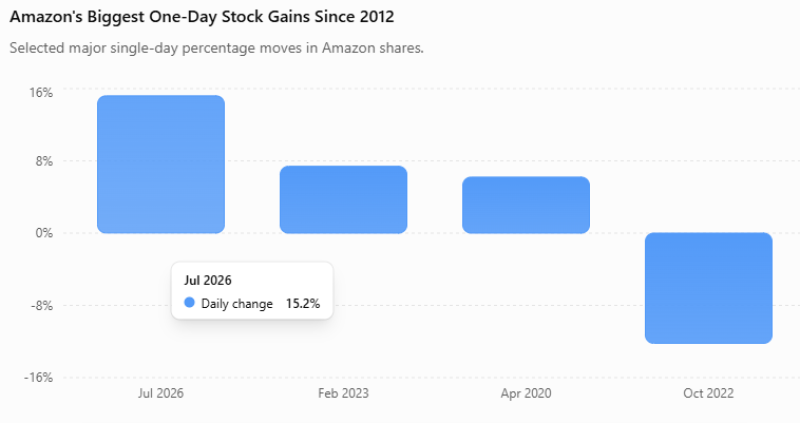
The size of the move tells an important story. Companies of Amazon's scale rarely add more than 15% in a day unless investors materially increase their expectations for future cash flows. This wasn't a reaction to one quarter — it was a reassessment of where Amazon's earnings could be several years from now.
Amazon's Profit Mix Looks Very Different Today
A decade ago Amazon was largely valued as an online retailer with a fast-growing cloud division. Today its earnings come from several businesses with very different economics.
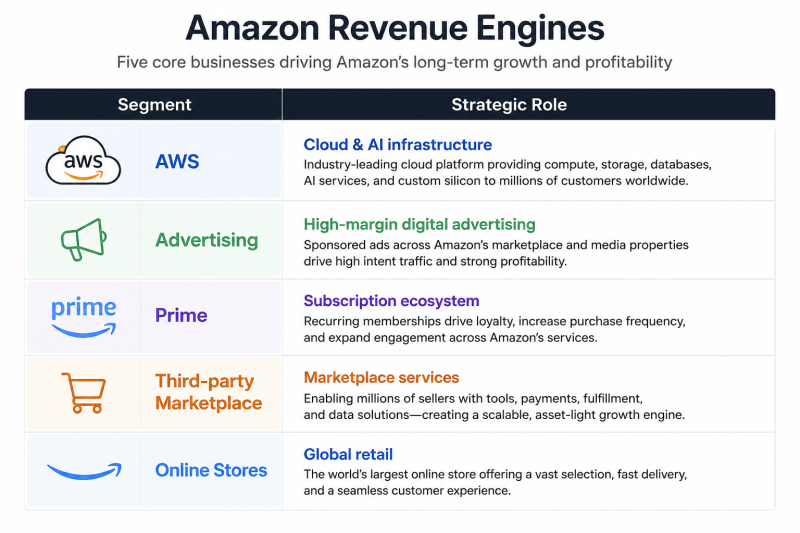
Retail remains Amazon's largest business by revenue, but AWS and advertising generate a disproportionate share of operating income. As those segments expand faster than commerce, the overall business becomes structurally more profitable.
AWS Is Selling the Picks and Shovels
Most AI companies are competing to build better models. Amazon is selling them the infrastructure.
Every foundation model requires computing power for training, inference, storage and networking. Whether enterprises use Anthropic, OpenAI, their own internal models or open-source alternatives, someone still has to provide the underlying cloud infrastructure.
That is where AWS sits. Instead of betting on a single AI winner, Amazon monetizes demand across the entire ecosystem.
Capital Spending Is Starting to Look Different
Over the past two years Amazon dramatically increased investment in AI infrastructure:
- new data centers
- custom AI chips
- networking equipment
- electricity capacity
- warehouse automation
The spending initially raised concerns because capital expenditures were growing much faster than reported profits. The latest quarter shifted that discussion. Higher cloud utilization and continued enterprise AI adoption suggest those assets are beginning to generate meaningful returns rather than simply absorbing cash.
The same pattern is visible across the industry.
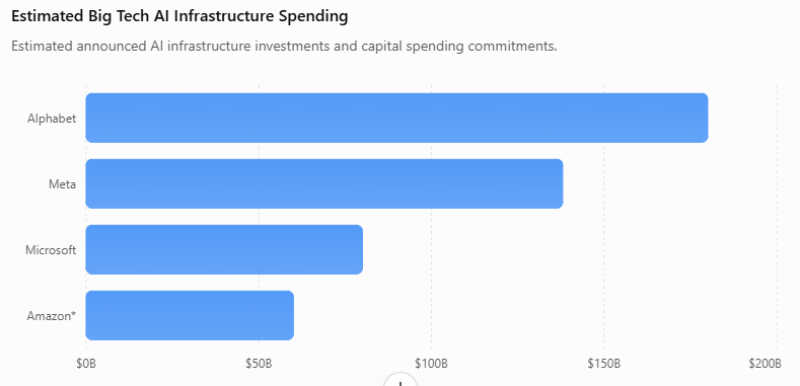
The market increasingly views these investments as capacity expansion instead of speculative spending.
Advertising Keeps Improving Margins
Amazon's advertising business receives far less attention than AWS despite becoming one of the company's fastest-growing profit centers. Every sponsored product shown on Amazon's marketplace requires almost no additional operating cost after the platform has been built. That makes advertising significantly more profitable than traditional retail.
| Business | Margin Profile |
| Advertising | Very High |
| AWS | High |
| Prime | Medium-High |
| Retail | Lower, improving |
The combination of AWS and advertising means a growing share of Amazon's revenue now comes from businesses with much higher margins than e-commerce.
Retail Has Become an Efficiency Business
For years Amazon expanded by building more warehouses, hiring more workers and offering faster delivery. Today the focus is different. Regional fulfillment networks shorten shipping distances. Warehouse robotics reduce labor intensity. AI forecasts inventory before demand appears. Delivery routes continue to improve through automation.
Each operational improvement may seem incremental, but across billions of annual shipments the savings compound into meaningful margin expansion. Retail is no longer the business investors worry about. It has become another contributor to earnings growth.
Why Investors Repriced Amazon
The latest rally reflects a change in what investors believe Amazon can earn over the next decade. Until recently, AI infrastructure was treated primarily as an expense. Now it is increasingly viewed as a revenue-generating asset.
That distinction matters because infrastructure businesses become more profitable as utilization rises. Once data centers are built, each additional workload improves returns on invested capital. Amazon appears to be entering that phase earlier than many investors expected.

The AI Cycle Is Moving Into Commercialization
Amazon's results also carry implications beyond the company itself. Demand for AI infrastructure continues to absorb enormous investments from hyperscalers.
If enterprise adoption maintains its current pace, the beneficiaries extend across the supply chain:
- semiconductor manufacturers
- networking companies
- data center operators
- power infrastructure providers
- cooling equipment manufacturers
- enterprise software vendors
The conversation is gradually shifting away from "How much are hyperscalers spending?" toward "How quickly can they monetize what they've already built?"
The Feedback Loop
Amazon increasingly operates as a connected system rather than a collection of independent businesses.
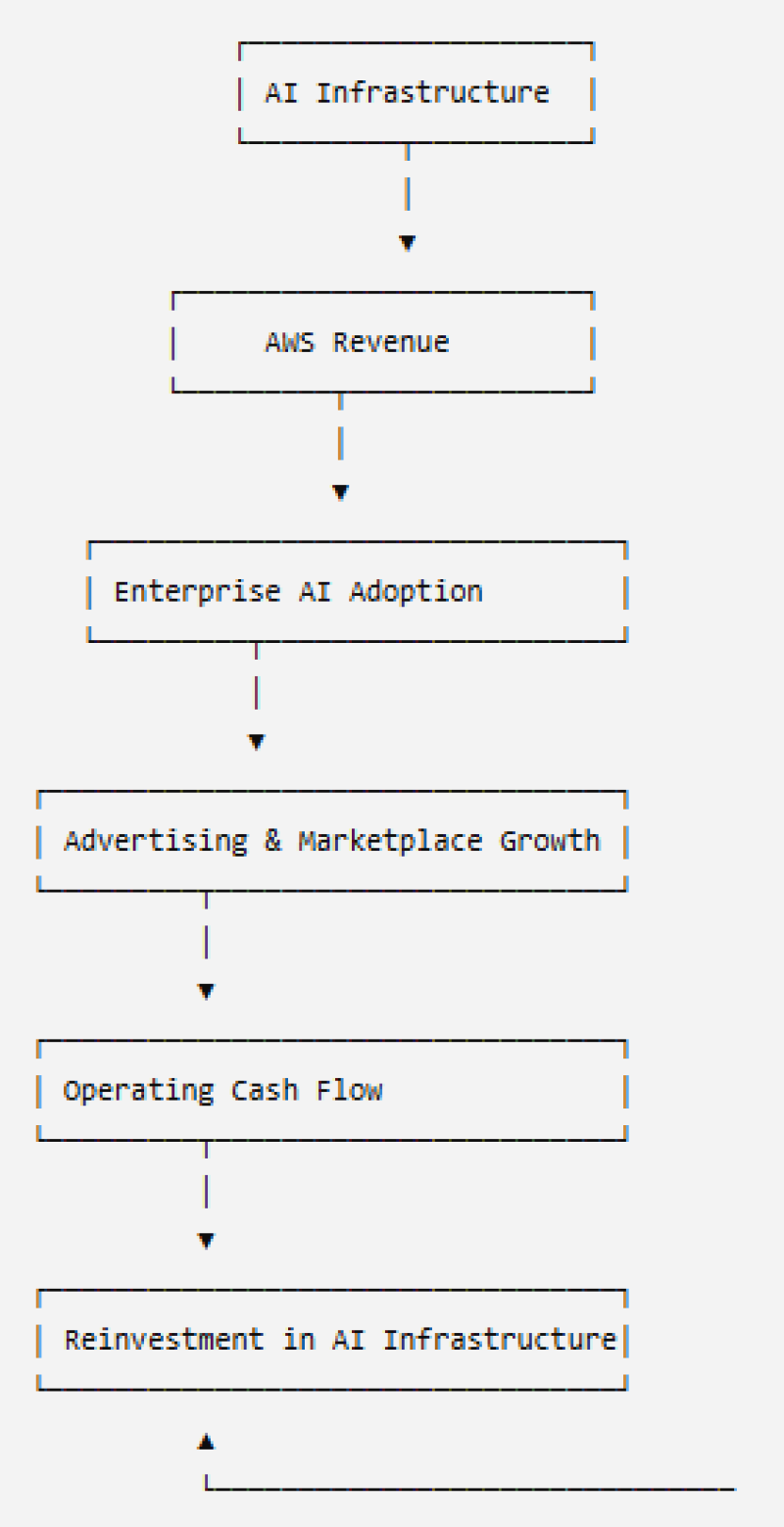
Every new enterprise AI workload strengthens AWS. Higher AWS profits finance additional infrastructure. That infrastructure attracts more enterprise customers, who also spend on advertising and marketplace services.
The latest rally suggests investors now expect this cycle to accelerate. The earnings report confirmed strong execution, but the stock's 15.2% jump reflected something larger: Wall Street has begun valuing Amazon less as an online retailer and more as one of the core infrastructure companies powering the AI economy.
 Artem Voloskovets