Artem Voloskovets

The revenue trend now suggests the opposite. Advertising is no longer a supporting business. It is becoming one of Amazon's strongest competitive advantages not because the company displays more ads, but because it controls the final step before a purchase is made.
Amazon Found a New Way to Monetize Its Marketplace
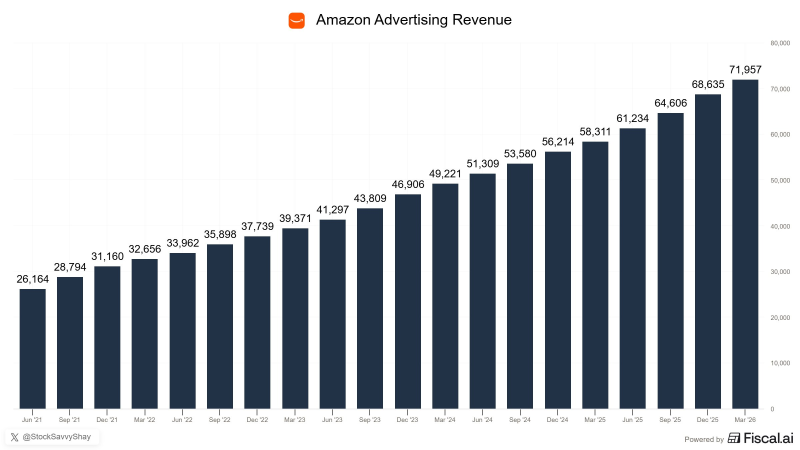
The numbers tell a simple story. Annual advertising revenue climbed from $26.2 billion in June 2021 to $72.0 billion by March 2026, nearly tripling in less than five years. More revealing than the absolute increase is the consistency. Every point on the chart establishes a new high.
Revenue passed:
- $37.7B in late 2022,
- $46.9B in late 2023,
- $56.2B in late 2024,
- before approaching $72B in early 2026.
This isn't the profile of a young business expanding from a small base. It is a mature platform continuing to compound at scale.
Intent Has Become More Valuable Than Attention
Digital advertising has traditionally revolved around capturing attention. Amazon operates at a different stage of the customer journey. People rarely visit Amazon to browse. They arrive with a product in mind and a willingness to spend. That changes the economics. Instead of paying for visibility that may eventually lead to a purchase, advertisers pay to influence decisions that are already being made. For many consumer brands, the return on that investment is easier to measure and often easier to justify.
Every New Seller Expands the Advertising Business
The revenue curve reflects more than growing advertiser budgets. Every merchant joining Amazon Marketplace immediately enters a competitive environment where visibility directly affects sales. The simplest way to improve visibility is through advertising. As the marketplace grows, the advertising business expands automatically.
Unlike traditional media companies that must constantly acquire new audiences, Amazon increases advertising demand by increasing marketplace activity. That creates a growth engine embedded inside the platform itself.

Competition Has Become Amazon's Product
The marketplace used to reward pricing, selection, and fulfillment. Today, sponsored placement is often part of the competitive equation. Brands compete for premium positions in search results, category pages, and product recommendations. Amazon benefits regardless of which seller wins. Each additional competitor increases demand for advertising inventory, allowing the company to monetize competition rather than simply facilitate it. This dynamic becomes stronger as more brands enter the ecosystem.
A Flywheel That Keeps Accelerating
The acceleration between March 2024 ($49.2B) and March 2026 ($72.0B) illustrates how the model reinforces itself. Higher advertising revenue provides additional capital for logistics, AI-powered shopping tools, fulfillment infrastructure, and Prime services. A better shopping experience attracts more customers. More customers attract more sellers. More sellers increase competition. Competition fuels advertising demand. The result is a self-reinforcing cycle that becomes more valuable as the marketplace expands.
The Real Story Behind the Chart
The chart does not simply show advertising revenue increasing from $26.2 billion to nearly $72 billion. It shows Amazon gradually changing what its marketplace produces. The platform no longer generates revenue only when products are sold. It also generates revenue from the competition required to sell those products. Google monetized search. Meta monetized attention. Amazon is increasingly monetizing purchase decisions themselves. That may prove to be the company's most durable competitive advantage over the next decade.
 Artem Voloskovets