Artem Voloskovets

Labor-force participation among Americans aged 55 and older fell to 36.9% in July, down from above 40% before the pandemic. Bank of America economists Stephen Juneau and Aditya Bhave point to rising household wealth as one factor behind the decline.
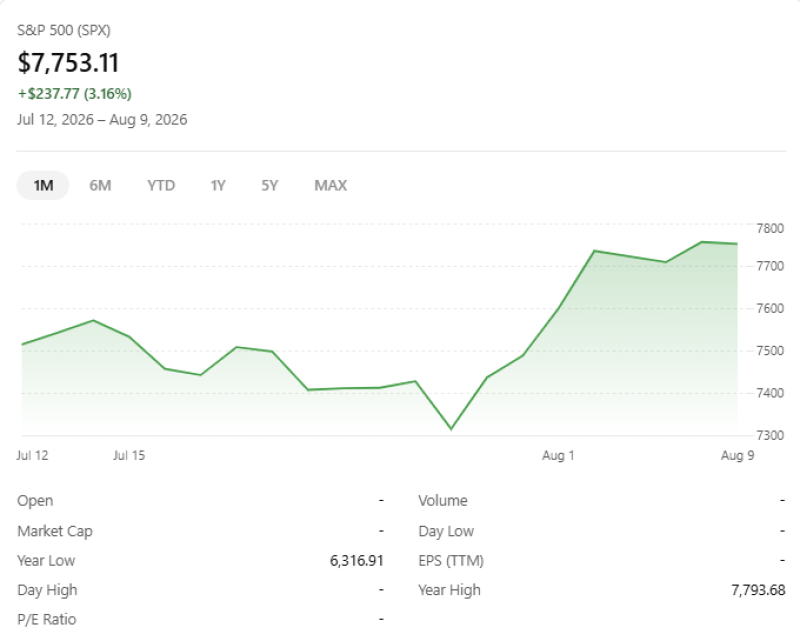
The S&P 500 has gained nearly 40% over the past two years, lifting retirement accounts and investment portfolios just as millions of Americans approach the end of their careers. For workers already close to their retirement target, those gains can change the calculation between another year of salary and leaving the workforce.
That means the wealth effect may now be showing up not only in consumer spending, but in labor supply.
A 40% Rally Can Move the Retirement Date
Retirement decisions are particularly sensitive to market gains because workers near the end of their careers often have their largest-ever investment balances. A 58-year-old with $500,000 invested would gain $200,000 from a 40% increase in a simplified scenario with no withdrawals or additional contributions. A $1 million portfolio would gain $400,000.
Actual retirement portfolios do not track the S&P 500 one-for-one, and asset allocation, contributions and withdrawals all affect returns. But for someone already close to a retirement target, gains of that magnitude can turn employment from a financial necessity into a choice.
That is the mechanism highlighted by Bank of America: higher stock prices raise the wealth of older households with substantial financial assets, allowing some to retire earlier than they otherwise would.
The amount of money exposed to that mechanism is enormous. Americans held $47.6 trillion in retirement assets at the end of the first quarter of 2026, according to the Investment Company Institute, equivalent to roughly 34% of U.S. household financial assets.
Employer-sponsored defined-contribution plans accounted for $13.8 trillion, while individual retirement accounts held another $18.2 trillion. 401(k) plans alone contained $9.9 trillion.
Equity exposure is substantial. Mutual funds managed $5.7 trillion of 401(k) assets at the end of March, including $3.3 trillion in equity funds. Another $4.2 trillion of IRA assets was held through equity mutual funds.
A rising stock market therefore feeds directly into retirement wealth for millions of households.
The Biggest Balances Sit Near Retirement
Fidelity data covering 25.6 million 401(k) participants show how much capital is already accumulated by workers approaching traditional retirement age.
The average balance for people aged 55 to 59 was $260,800 as of March 31, 2026. Workers aged 60 to 64 averaged $257,400, while those aged 65 to 69 held $258,800.
| Age | Average 401(k) balance |
| 50–54 | $215,700 |
| 55–59 | $260,800 |
| 60–64 | $257,400 |
| 65–69 | $258,800 |
Those numbers cover only 401(k) assets in Fidelity's dataset. They exclude IRAs, brokerage accounts, real estate, cash and traditional pensions. Fidelity reports an average 401(k) balance of $260,300 for baby boomers overall, alongside an average IRA balance of $286,700.
The timing of market gains matters as much as their size. A rally at age 35 primarily increases future retirement wealth. At 60, it can change a decision being made now.
The Rally Doesn't Benefit Everyone Equally
The wealth effect has an obvious limit: stock ownership is heavily concentrated. Federal Reserve data show that households between the 50th and 90th wealth percentiles held about $6.40 trillion in corporate equities and mutual fund shares in the first quarter of 2026, plus roughly $6.29 trillion in defined-contribution pension entitlements.
The bottom half of households held only about $590 billion in corporate equities and mutual funds and $750 billion in defined-contribution pensions.
| Wealth group | Stocks & mutual funds | Defined-contribution pensions |
| 50th–90th percentile | $6.40T | $6.29T |
| Bottom 50% | $0.59T | $0.75T |
The concentration is even greater at the top of the wealth distribution. So a 40% rise in the S&P 500 does not translate into anything close to a 40% improvement in retirement security across the population. A 60-year-old with a seven-figure portfolio may suddenly be able to retire several years earlier. Another worker of the same age with little equity exposure receives almost none of that benefit.
The decline in participation among older workers can therefore coexist with retirement insecurity elsewhere. This is not a universal early-retirement boom. It is more likely a shift concentrated among households that already accumulated enough assets for market performance to change their retirement date.
Wall Street Gains Are Reaching the Labor Market
The implications extend beyond household finances. Overall U.S. labor-force participation fell to 61.4% in July, while the workforce has declined by more than 1 million people over the past year.
Retirement is only part of the story. Demographics, population growth, immigration and labor-market conditions also affect participation. But the decline among workers over 55 introduces another pressure on labor supply.
Baby boomers are already moving through traditional retirement ages. If rising portfolios allow some to leave even one or two years earlier, the supply of experienced workers can contract faster than aging alone would suggest.
This creates a direct connection between two parts of the economy usually analyzed separately: asset prices and labor availability. The traditional wealth effect focuses on spending. When stocks and homes rise, households become wealthier and may consume more.
Older households have another option. They can use higher wealth to stop working. That distinction becomes more important when nearly $10 trillion sits in 401(k) plans and another $18.2 trillion in IRAs while a large generation moves through its final working years.
The stock market does not need to persuade millions of Americans to retire at once to affect labor supply. It only needs to push enough portfolios across the line from "not quite enough" to "enough." For some older workers, that line may have arrived sooner than expected.
 Artem Voloskovets