Peter Smith

Amazon's revenue structure is drawing fresh attention as the gap between its two largest segments continues to widen. Fiscal.ai highlighted the divergence, pointing out that AWS is growing much faster than Online Stores - raising questions about how Amazon's business mix could evolve over the next decade.
Amazon Online Stores vs AWS: A Tale of Two Growth Rates
The numbers tell a straightforward story. Online Stores has scaled to approximately $269 billion in revenue, making it the larger segment by a wide margin. AWS, meanwhile, has reached around $129 billion - but the critical difference lies in how quickly each is growing.
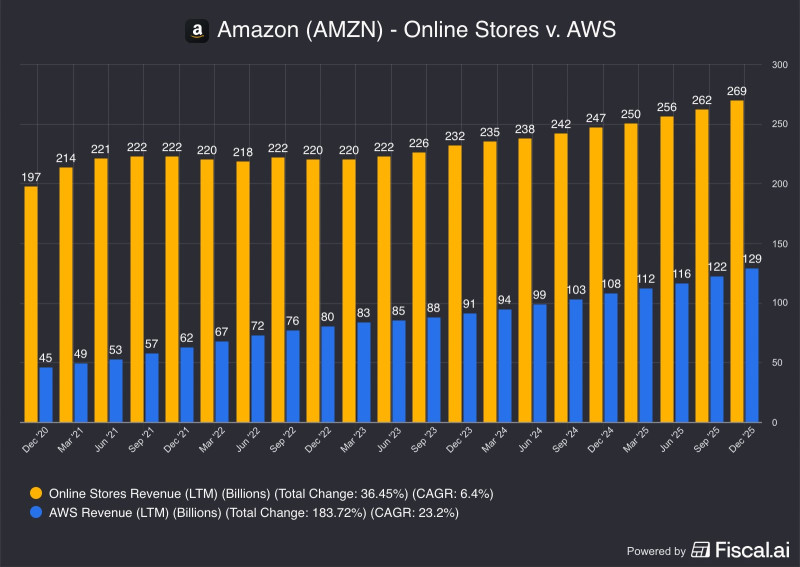
AWS is expanding at a 5-year CAGR of roughly 23%, compared to about 6% for Online Stores. That gap is not a rounding error. It means the cloud business is adding revenue at a pace nearly four times faster than Amazon's retail arm.
AWS CAGR of 23% Signals a Long-Term Shift Inside Amazon
Scale still favors the retail side, but momentum belongs to the cloud. This distinction matters when thinking about where Amazon's incremental revenue is actually coming from year over year.
The segment comparison breaks down as follows:
- Online Stores: $269B with ~6% CAGR
- AWS: $129B with ~23% CAGR
Even though AWS has not yet surpassed Online Stores in absolute size, its contribution to total revenue growth is becoming increasingly difficult to ignore. At these respective growth rates, the gap between the two segments narrows with each passing year.
AWS is contributing a growing share of incremental revenue even before it catches retail in size
AMZN Business Mix: What the Diverging Trajectories Mean
The data does not come with explicit forecasts, but the directional signal is clear. AWS is scaling rapidly along a steep curve, while Online Stores follows a steadier, more gradual upward path.
If current growth patterns persist, AWS's role within Amazon's broader structure is likely to become increasingly central
For investors tracking AMZN's long-term revenue composition, the divergence between these two segments is arguably the most important trend to watch - not just in terms of size, but in terms of where the company's future earning power is being built.
 Peter Smith