Peter Smith

ASML CEO Christophe Fouquet says the chip industry will remain supply-constrained for the foreseeable future as AI infrastructure demand keeps accelerating. The notable part was who he mentioned next.
Fouquet specifically pointed to Elon Musk’s TeraFab ambitions across Tesla, xAI, SpaceX, and Starlink as projects that could further tighten global semiconductor capacity. He also confirmed he has been in direct contact with Musk regarding the plans.
That matters because ASML sits at the center of the advanced chip supply chain. The company produces the EUV lithography systems required to manufacture leading-edge semiconductors. When ASML warns about future shortages, the industry pays attention.
Musk’s broader compute strategy is also becoming difficult to ignore. Tesla’s autonomous systems, xAI model training, robotics, Starlink infrastructure, and SpaceX operations all require massive amounts of compute independently. Combined, they represent one of the largest emerging AI infrastructure pushes outside the traditional hyperscalers.
The pressure is no longer coming only from OpenAI, Microsoft, Google, Meta, and Amazon. A growing number of companies are now trying to secure dedicated AI compute capacity at industrial scale.
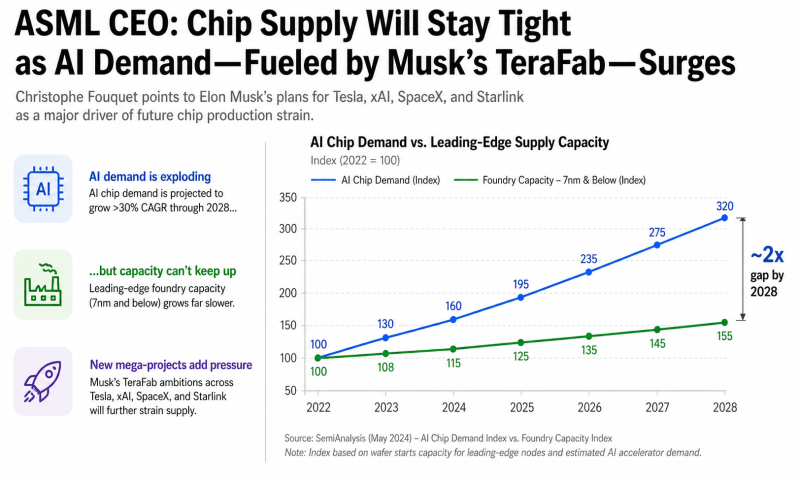
AI compute demand is rising faster than the industry can physically build capacity.
The problem is that semiconductor manufacturing scales slowly. Advanced fabs take years to build, EUV systems remain limited, and packaging and power infrastructure are already under pressure. That is changing the structure of the AI race itself. Access to chips, manufacturing capacity, and energy infrastructure may become more important than marginal differences between AI models.
If projects like TeraFab move forward at scale, the current chip shortage may stop looking cyclical and start looking structural.
 Peter Smith