Marina Lubimova

Fiscal Q4 adjusted EPS reached $2.91, against a $2.42 consensus estimate. Revenue was $63.7 billion, below the $65.16 billion expected, while adjusted operating income reached $935 million, versus roughly $817.8 million expected.
Revenue missed consensus by about 2.2%. Adjusted operating income beat it by roughly 14%, and adjusted EPS by more than 20%.
Part of that EPS surprise came from a one-time tariff-related benefit. Even after stripping it out, however, Cardinal Health still beat expectations. Combined with above-consensus fiscal 2027 guidance, the quarter points to improving earnings power despite modest top-line growth.
Sales Fell Short. Profit Didn't.
Cardinal Health generated $63.7 billion in Q4 revenue, about $1.46 billion below consensus. Revenue still increased roughly 6% from a year earlier, led by Pharmaceutical and Specialty Solutions, where sales also rose about 6%.
The more notable figure was adjusted operating income: $935 million, roughly $117 million above expectations.
For a distributor operating on narrow margins, that gap between sales and profit performance is significant. Cardinal Health generated substantially more operating income than analysts expected without needing an upside surprise in revenue.
There is one caveat. Q4 included roughly $100 million of operating profit from tariff refunds, adding approximately $0.31 per share to adjusted EPS. Without that contribution, adjusted EPS would have been around $2.60 rather than $2.91.
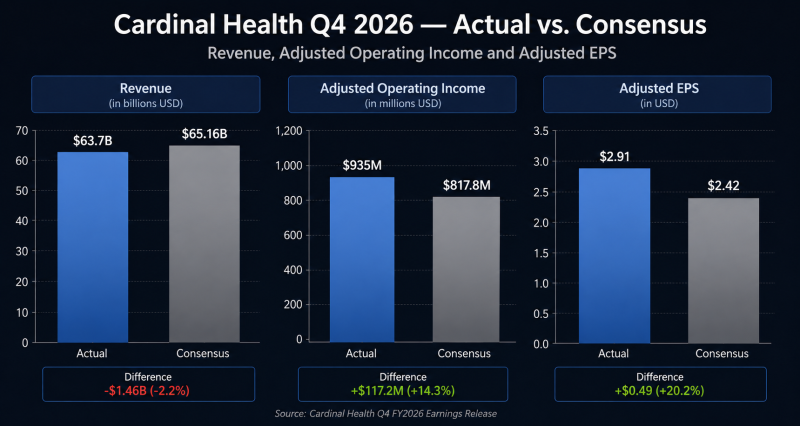
The adjustment changes the size of the beat, but not the result. At roughly $2.60 excluding the tariff benefit, EPS would still have exceeded the $2.42 consensus by about 7%. The underlying quarter was stronger than the headline revenue miss suggests.
Pharma Carried the Quarter
Pharmaceutical and Specialty Solutions remains Cardinal Health's main growth engine. Segment revenue increased approximately 6%, supported by higher volumes from existing customers and strength in generic pharmaceuticals. Specialty pharmaceuticals are also becoming increasingly important as more complex and expensive therapies move through the healthcare supply chain.
Global Medical Products and Distribution moved in the opposite direction. Revenue declined roughly 2%, partly reflecting lower distribution volumes and the accounting impact of expected tariff-refund repayments to customers.
The contrast between the two businesses helps explain why consolidated revenue alone gives an incomplete picture of Cardinal Health's performance. Pharma continued expanding, Medical contracted, yet companywide operating income still finished well above consensus.
That puts more weight on revenue mix and segment profitability than on the consolidated sales growth rate.

$12.50 Is the Number to Watch
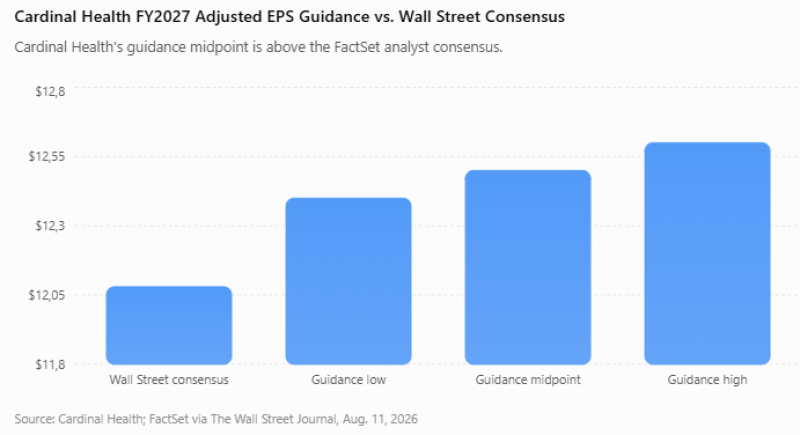
Cardinal Health's fiscal 2027 forecast was stronger than Wall Street expected. Management guided to adjusted EPS of $12.40 to $12.60, putting the midpoint at $12.50. Analysts had been expecting approximately $12.06.
The midpoint is about 3.6% above consensus, while the full guidance range implies roughly 13% to 15% EPS growth.
The revenue assumptions are considerably more modest.
Cardinal Health expects Pharmaceutical and Specialty Solutions revenue to increase 3% to 5% in fiscal 2027. Global Medical Products and Distribution revenue is expected to grow 2% to 4%.
Double-digit EPS growth against low-to-mid-single-digit segment revenue growth would require continued improvement below the top line. That makes margins, business mix and capital allocation more important to the fiscal 2027 outlook than headline revenue growth.
Q4 Extends a Trend Already Visible in Q3
The earnings improvement did not begin in the fourth quarter. In fiscal Q3 2026, Cardinal Health generated $60.9 billion in revenue, up 11% year over year. Adjusted operating earnings increased 18% to $956 million, while adjusted EPS climbed 35% to $3.17.
Management also raised and narrowed its FY2026 adjusted EPS guidance at the time to $10.70-$10.80.
Q4 produced slower revenue growth, but profitability remained strong enough to beat expectations and support another year of double-digit EPS growth guidance. The progression from Q3 into the FY2027 outlook shows the shift clearly: Cardinal Health does not need double-digit revenue growth to target double-digit earnings growth.
Building Outside the Distribution Core
Cardinal Health has also been putting capital into businesses with economics that differ from traditional large-scale distribution.
The company agreed in July to acquire Strive Medical and the diabetes business of AdaptHealth, expanding its at-Home Solutions platform. It has also been increasing its exposure to specialty healthcare.
These moves are relevant because Cardinal Health's core distribution model produces enormous sales volumes but thin margins. Businesses that capture more value per dollar of revenue could gradually improve the company's overall earnings mix.
That transition will not happen in a single quarter. But it provides another route to earnings growth that does not depend on accelerating consolidated revenue.
The Revenue Miss Changes Less Than the Guidance Does
The weak point in Q4 is clear: $63.7 billion of revenue versus $65.16 billion expected. The $2.91 adjusted EPS figure also needs context because roughly $0.31 came from tariff refunds. But after accounting for both, the earnings picture remains stronger than the top-line miss suggests.
Underlying adjusted EPS was still approximately $2.60 versus $2.42 expected. Adjusted operating income beat consensus by about 14%. Pharmaceutical and Specialty Solutions revenue grew around 6%. And management entered fiscal 2027 targeting $12.40-$12.60 in adjusted EPS, above Wall Street's prior forecast.
That guidance is now the more consequential number. If Cardinal Health reaches the $12.50 midpoint while its major businesses grow revenue only in the low-to-mid single digits, fiscal 2027 would reinforce a shift already visible in Q4: earnings are growing considerably faster than sales.
For a company with more than $60 billion in quarterly revenue and structurally thin distribution margins, that gap is more important than a single-quarter revenue miss.
 Marina Lubimova