Artem Voloskovets
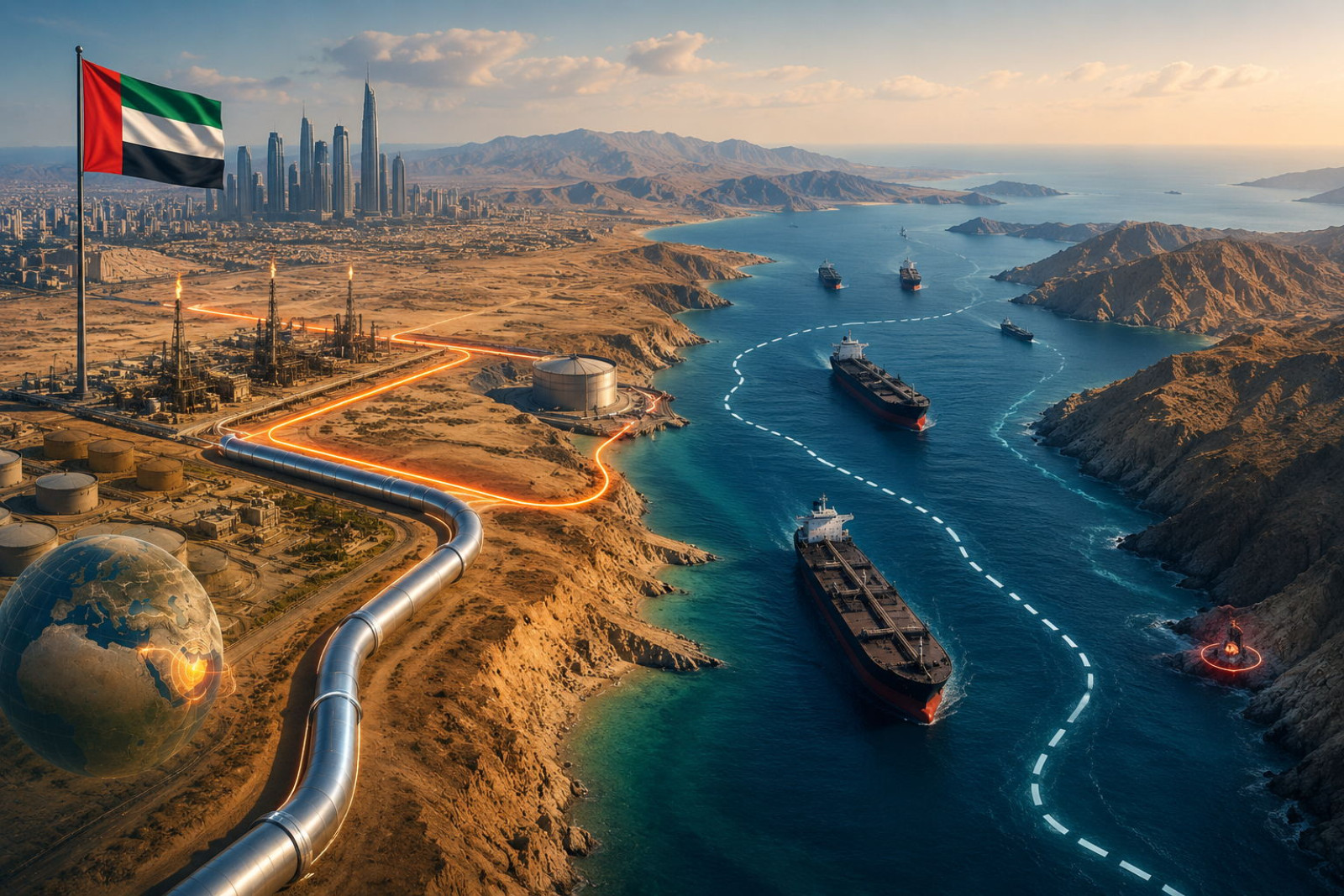
This narrow corridor between Iran and Oman has served as the main export route for Gulf producers. According to U.S. Energy Information Administration data, roughly one-fifth of global petroleum consumption depends on shipments moving through the strait.
| Year | Oil Flow (mb/d) |
| 2020 | 19.1 |
| 2021 | 19.4 |
| 2022 | 21.4 |
| 2023 | 21.4 |
| 2024 | 20.3 |
| 1Q25 | 20.1 |
Whenever tensions rise in the region, attention immediately turns to Hormuz because there are few alternative routes capable of handling comparable volumes.
A Different Approach to the Same Risk
Most oil-producing countries in the Gulf manage geopolitical risk through diplomacy, security agreements, or emergency stockpiles. The UAE has spent the past decade investing in physical infrastructure instead.
The goal is straightforward: move a larger share of exports directly to the Indian Ocean without passing through the Strait of Hormuz. That strategy began years ago with the Habshan–Fujairah pipeline, which can transport up to 1.8 million barrels per day across the country to the Gulf of Oman.
At Fujairah, ADNOC also operates storage facilities capable of holding approximately 42 million barrels of crude. Together, those assets created an alternative export corridor long before recent regional tensions put the system under pressure.

When the Route Was Put to the Test
Recent disruptions in regional shipping offered a practical demonstration of how the network performs under stress.
According to the IEA, UAE crude exports increased by approximately 260,000 barrels per day in May, reaching 3.1 million barrels per day despite concerns surrounding shipping in the Gulf. Part of that increase was supported by the Fujairah corridor and existing storage infrastructure.
Rather than relying entirely on traffic through Hormuz, exporters were able to continue moving volumes through routes that had already been established years earlier. The episode highlighted a growing distinction between the UAE and many of its regional peers.
Production Capacity Has Been Expanding in Parallel
Export infrastructure is only one side of the story. Over the same period, the UAE has steadily increased production capacity.
Crude capacity rose from 3.1 million barrels per day in 2016 to nearly 4.4 million barrels per day in 2026.
Adding roughly 1.1 million barrels per day of condensates and natural gas liquids brings total technical hydrocarbon capacity above 5 million barrels per day.
| Year | Capacity (mb/d) |
| 2016 | 3.1 |
| 2026 | 4.4 |
| 2027 Target | 5.2 |
The IEA expects total output to reach approximately 5.2 million barrels per day in 2027. Meanwhile, ADNOC plans to invest $55 billion between 2026 and 2028 and roughly $150 billion through 2030.
Fujairah Is Becoming More Than a Backup Route
The next phase focuses on increasing the amount of crude that can reach Fujairah. ADNOC is accelerating construction of a new west-east pipeline that would further expand export capacity outside the Strait of Hormuz. The project is reported to be around 50% complete and scheduled to begin operations in 2027. Once operational, the network could allow a significantly larger share of UAE production to reach international markets without entering the Gulf's most heavily monitored waterway.
This would make Fujairah not simply an alternative route, but one of the country's primary export gateways.
Why Geography Is Becoming a Competitive Advantage
Most major Gulf exporters continue to depend heavily on Hormuz. Saudi Arabia, Iraq, Kuwait, Qatar and Iran all ship substantial volumes through the strait. The UAE remains exposed as well, but the share of exports that can be redirected through alternative routes is steadily increasing. That flexibility matters because infrastructure tends to outlast political cycles, military tensions and market fluctuations. Pipelines, storage terminals and export hubs can influence trade flows for decades.
A Shift That Extends Beyond the UAE
The immediate objective is clear: reduce dependence on a strategic chokepoint. The longer-term effect may be broader. For decades, oil markets have treated the Strait of Hormuz as an unavoidable part of global energy logistics. The UAE is effectively testing a different model - one in which a major Gulf producer can continue expanding output while gradually reducing its reliance on the region's most sensitive shipping route.
Whether other producers pursue similar strategies remains to be seen. What is already visible, however, is a gradual redrawing of the map that connects Gulf oil fields to global consumers.
 Artem Voloskovets