Artem Voloskovets

The bank now expects S&P 500 earnings per share (EPS) to reach $358 in 2026, up from its previous forecast of $342, while its 2027 estimate rises to $420 from $390. The revision follows an earnings season in which corporate America has delivered one of its strongest performances in years.
Earnings Surprises Are No Longer Limited to Mega-Caps
The headline number is difficult to ignore: 87% of S&P 500 companies have beaten Wall Street earnings estimates, well above the long-term average of roughly 75%.
| Metric | Current Reading |
| Companies beating EPS estimates | 87% |
| Expected Q2 earnings growth | 33% YoY |
| Deutsche Bank 2026 EPS forecast | $358 (vs. $342 previously) |
| Deutsche Bank 2027 EPS forecast | $420 (vs. $390 previously) |
Bar chart comparing the historical average (~75%) with Q2 2026 (87%).
Unlike previous quarters, earnings growth is no longer concentrated in a handful of AI leaders. Deutsche Bank notes that stronger results are appearing across a much wider range of industries, suggesting that profit growth is becoming more resilient and less dependent on the performance of Big Tech.
Revenue Growth Is Translating Into Higher Profitability
The current earnings cycle is being driven by two forces at the same time: healthy sales growth and unusually strong profitability.
Companies have largely preserved the efficiency gains achieved over the past two years through automation, disciplined cost control and productivity improvements, allowing operating margins to remain close to record highs even as revenues continue to expand.
- Sales are accelerating across more industries.
- Operating margins remain near historical peaks.
- Higher productivity is supporting earnings despite elevated financing costs.
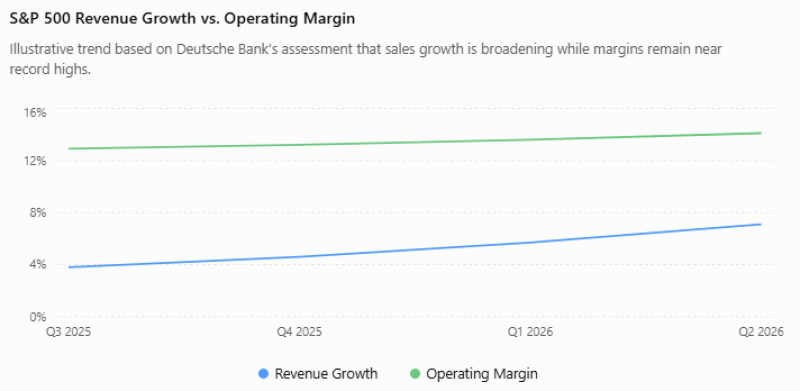
Dual-axis chart showing revenue growth alongside operating margins over recent quarters.
The combination of expanding revenue and stable margins explains why second-quarter earnings are projected to increase 33% year over year, far exceeding expectations at the beginning of the reporting season.
Forecast Revisions Are Moving Higher Instead of Lower
Analysts typically reduce earnings forecasts as reporting season progresses. This quarter, estimates have moved in the opposite direction.
Deutsche Bank's revisions illustrate the scale of the change:
| Year | Previous Forecast | New Forecast |
| 2026 | $342 | $358 |
| 2027 | $390 | $420 |
The upgrades imply that analysts underestimated both revenue growth and corporate profitability. If additional companies continue to report above expectations, consensus forecasts across Wall Street could move higher in the coming months.
Higher Earnings Make Valuations Easier to Defend
The S&P 500 continues to trade at elevated valuation multiples, but stronger earnings improve that equation.
A higher earnings base lowers the market's forward price-to-earnings ratio without requiring stock prices to decline. In other words, companies can justify current valuations through profit growth rather than multiple expansion.
That dynamic is becoming increasingly important as investors balance strong corporate fundamentals against persistent risks, including elevated interest rates, government borrowing, and geopolitical uncertainty.
The second-quarter reporting season suggests that earnings, not valuation expansion, are once again becoming the primary engine of equity returns. If profit growth continues to broaden beyond the technology sector, the market will have a stronger fundamental foundation than it did during the first stages of the AI-driven rally.
 Artem Voloskovets