Marina Lubimova

Every Minute Matters
Every minute, the global economy consumes roughly 45 tonnes of copper. During the time it takes to read this article, enough copper will be used to manufacture dozens of electric vehicles, expand power grids on multiple continents, build thousands of electric motors, and wire new data centers that will train the next generation of artificial intelligence.
Almost nobody notices.
Copper rarely dominates newspaper headlines. Politicians rarely campaign on copper policy. Consumers never check copper prices before buying a new phone or turning on the lights.
Yet remove copper from the modern economy, and almost everything stops. Power grids cannot transmit electricity efficiently. Electric vehicles lose the metal that carries power between batteries and motors. Wind turbines become far less productive.
Factories slow.
Semiconductor plants struggle. Data centers consume enormous amounts of electricity but have no practical way to distribute it internally. Copper was treated as an ordinary industrial commodity — important, certainly, but interchangeable with iron ore, aluminum or steel. That assumption is beginning to break down.
Around the world, governments are redesigning industrial strategies around "critical minerals." Mining companies are investing tens of billions of dollars in projects that may not produce their first tonne of copper until the late 2030s. Manufacturers are signing long-term supply agreements years before new mines even exist. Analysts who once focused on oil increasingly describe copper as the commodity most likely to determine whether the global energy transition stays on schedule.
The reason is surprisingly simple. The world is entering an era in which almost everything runs on electricity. Electricity, in turn, runs on copper.
One Mine, One Country, One Warning
In late 2023, thousands of protesters filled the streets of Panama. Their target was not a government ministry or a financial institution. It was one of the world's newest and largest copper mines. After weeks of demonstrations, Panama's Supreme Court ruled that the contract governing Cobre Panamá was unconstitutional. Operations stopped.
The closure immediately removed roughly 1% of global copper production from the market. One mine. One political decision. One percentage point of global supply.
For most commodities, losing one percent of production would barely register outside specialist circles. For copper, it became a reminder of how little spare capacity exists in a market that is expected to grow dramatically over the next two decades.
The incident also exposed something investors had largely overlooked. Copper is no longer just a mining business. It has become a question of industrial policy, energy security and geopolitical resilience.
Five Facts That Explain Copper Better Than Any Definition
1. Copper has powered civilization for more than 10,000 years.
Long before silicon chips or lithium-ion batteries, copper helped humanity build tools, irrigation systems and the bronze weapons that transformed early civilizations.
2. The world's appetite for copper is accelerating.
Global demand is expected to rise from around 28 million tonnes today to roughly 42 million tonnes by 2040, driven largely by electrification, urbanization and digital infrastructure.
3. New supply cannot appear quickly.
Developing a large copper mine commonly takes 15 to 20 years, from exploration and permitting to construction and commercial production.
4. China consumes more refined copper than the rest of the world's largest economies combined.
Its manufacturing sector, construction industry and renewable-energy investments have made it the center of global copper demand.
5. There is still no perfect substitute.
Aluminum can replace copper in some applications, but it conducts electricity less efficiently, occupies more space and often requires different engineering solutions. In many high-performance electrical systems, copper remains the preferred material because physics, not economics, sets the limits.
The Invisible Metal
Oil announces its presence. Drivers watch fuel prices every week. Gold is displayed in jewelry stores and central-bank vaults. Lithium has become synonymous with electric vehicles. Copper enjoys none of that visibility. It disappears inside walls.
- Inside motors.
- Inside transformers.
- Inside charging stations.
- Inside wind turbines.
- Inside factories.
- Inside server racks.
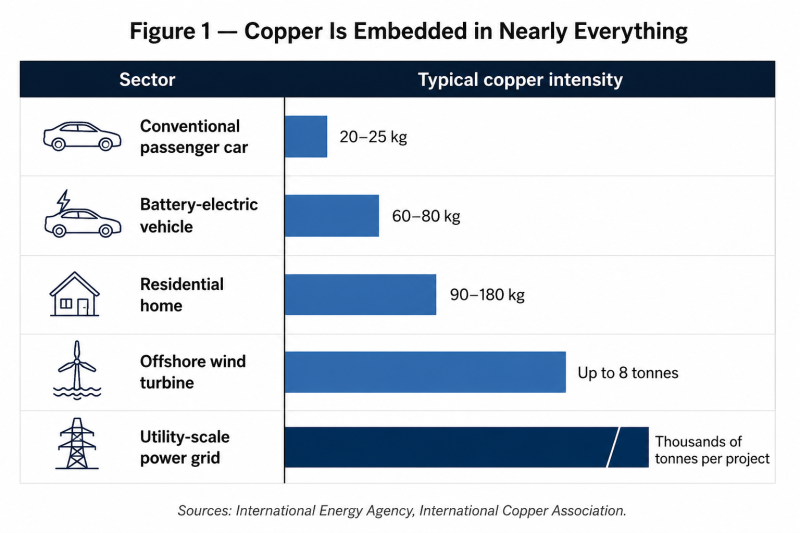
Its success is its invisibility. A modern apartment may contain well over 100 kilograms of copper hidden behind plaster, beneath floors and inside appliances. A battery-electric vehicle typically contains three to four times more copper than a conventional gasoline-powered car. Offshore wind turbines require several tonnes, while modern power grids consume thousands of tonnes for transmission lines, substations and transformers. Consumers rarely think about these numbers because copper is not the product they buy. It is the material that allows every other product to work.
The Metal Behind Every Megatrend
Most technological revolutions reduce demand for older materials. The digital economy reduced paper consumption. Streaming services reduced demand for DVDs. Cloud computing reduced the need for physical servers inside office buildings. Electrification is different.
Nearly every major technological trend of the twenty-first century requires more copper than the system it replaces. An electric vehicle needs significantly more copper than a gasoline-powered vehicle.
Renewable energy requires far more transmission infrastructure than traditional fossil-fuel generation because electricity must travel longer distances from wind farms and solar parks to population centers.
Artificial intelligence depends on massive data centers, whose expansion requires not only advanced chips but also transformers, switchgear, cooling systems and high-capacity electrical networks.
Even if the world stopped talking about climate change tomorrow, electricity demand would continue to grow because digitalization, automation and AI all consume enormous amounts of power.
Copper sits beneath every one of those trends. That is why executives increasingly describe it not as another industrial commodity but as strategic infrastructure in metallic form.
Copper is the metal of electrification. — Fatih Birol, Executive Director, International Energy Agency
The quote has become something of a shorthand within the mining industry, but it captures a broader economic reality. For more than a century, economic growth was closely tied to access to cheap oil. The next phase of industrial development may instead depend on access to reliable electricity. And reliable electricity depends, to a remarkable extent, on copper.
The Next Question Isn't Whether the World Needs More Copper
It clearly does. The harder question is whether the mining industry can produce enough of it. That challenge is far more complicated than opening another mine. New discoveries are becoming rarer. Ore grades have been declining for decades. Permitting has become longer and more politically contentious.
Water shortages threaten operations in major producing regions such as Chile. Communities increasingly demand higher environmental standards and greater economic benefits before supporting new projects.
All of these pressures are arriving at exactly the moment when demand is accelerating. Analysts at S&P Global estimate that, without substantial new investment, the world could face a copper supply gap approaching 10 million tonnes per year by 2040 — a shortfall large enough to affect industrial growth and the pace of electrification.
Copper quietly enabled every technological revolution. Now it risks becoming the bottleneck that determines how quickly the next one can happen.
The Age of Electricity
In 1859, the world's most valuable energy resource was coal. A century later, it was oil. Today, the global economy is entering a third era — one in which electricity, rather than any single fuel, becomes the foundation of industrial growth. This shift is often described as the energy transition.
In reality, it is something much larger. It is an infrastructure transition.
For more than a hundred years, economies were designed around fuels that could be extracted, transported and burned wherever energy was needed. Oil powered cars directly. Natural gas heated buildings. Coal generated electricity close to industrial centers.
Electricity changes that equation. It is not a fuel. It is a system. Every electron must be generated, transmitted, transformed and delivered through physical infrastructure before it can power a factory, charge a vehicle or train an artificial intelligence model. That infrastructure has one indispensable ingredient. Copper.
Electricity Is Becoming the World's Largest Growth Industry
Global electricity consumption has always expanded alongside economic development, but the relationship is changing. Rising electricity demand mainly reflected population growth, urbanization and industrialization. Today, an entirely new group of consumers is reshaping the market.
Electric vehicles. Artificial intelligence. Hyperscale data centers. Heat pumps. Battery storage. Green hydrogen. Advanced manufacturing. These industries have one thing in common: they replace fossil fuels with electricity rather than simply consuming more energy.
The International Energy Agency expects global electricity demand to continue growing rapidly through the coming decades, with digital infrastructure and electrification becoming two of the most powerful drivers.
This is more than an environmental story. It is an economic one. Electricity is increasingly becoming the platform upon which modern industries are built.
The New Industrial Equation
Every previous industrial revolution created demand for a dominant resource. Steam engines required coal. Automobiles required oil. Computers required silicon.
The emerging industrial economy requires three things simultaneously:
- abundant electricity,
- reliable power grids,
- conductive materials capable of moving enormous amounts of electricity with minimal losses.
Only one of those three is often overlooked. The conductor. Without it, generation becomes irrelevant. A solar farm that cannot deliver electricity to cities creates little economic value. A data center connected to an unstable grid cannot reliably train AI models. An electric vehicle is only useful if electricity can reach millions of charging stations. Electricity has to move. Copper makes that movement possible.
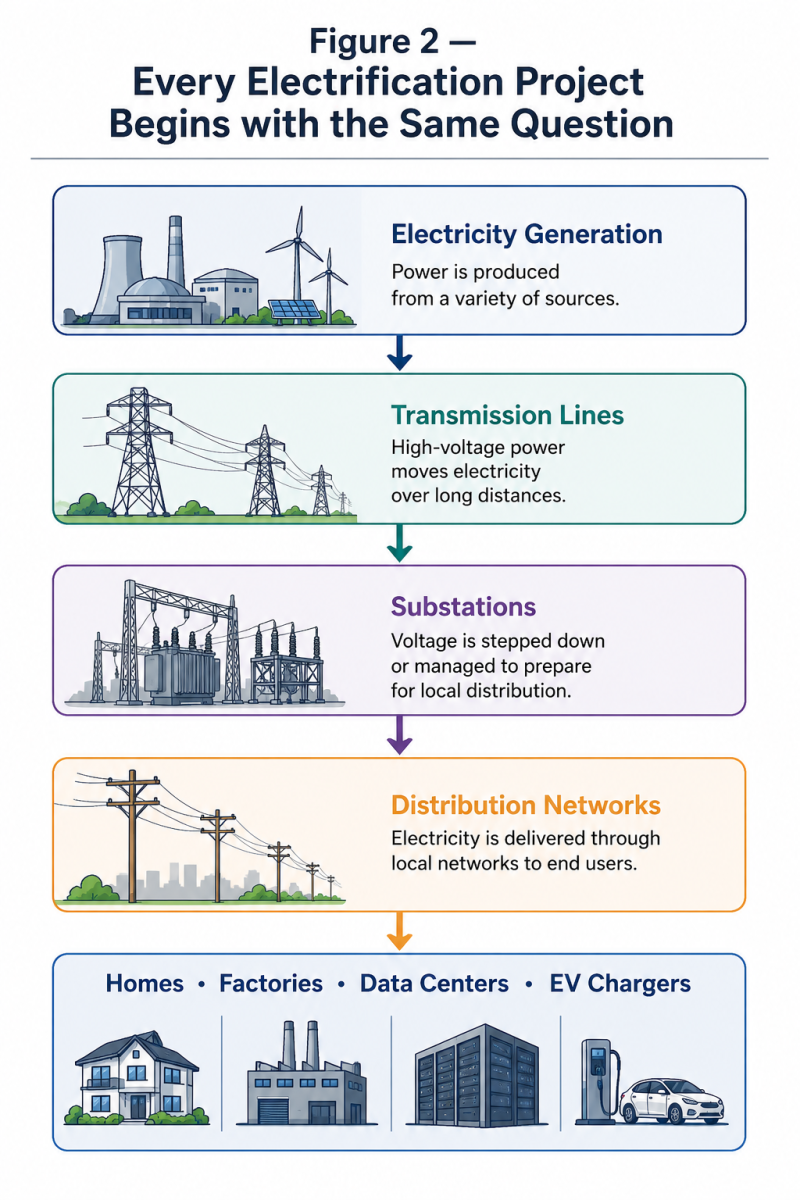
Every stage of this chain depends heavily on copper.
The AI Boom Has an Unexpected Physical Constraint
Artificial intelligence is usually discussed in terms of algorithms, chips and software. Investors debate which model is more capable. Governments compete to develop sovereign AI. Technology companies race to build increasingly powerful data centers.
Yet beneath every breakthrough lies a far less glamorous challenge. Power. A modern hyperscale data center consumes extraordinary amounts of electricity. Some of the newest AI campuses under development are expected to require as much power as a medium-sized city.
Meeting that demand is not simply a question of generating more electricity. Utilities must upgrade transmission lines. Engineers must install larger transformers. Contractors must build new substations. Every server rack requires electrical distribution. Every cooling system requires motors and wiring. Every backup generator connects through copper-intensive switchgear. The digital economy may appear weightless. Its infrastructure is anything but.
The Physical Side of Artificial Intelligence
Behind every AI model stands an enormous industrial ecosystem.
- Copper wiring
- High-voltage transformers
- Electric motors
- Cooling systems
- Power distribution equipment
- Grid infrastructure
The future of AI depends not only on better software but also on stronger electrical networks.
Why Electric Vehicles Changed Everything
Copper demand closely followed construction and manufacturing. Electric vehicles changed the equation. A conventional internal combustion vehicle contains relatively modest amounts of copper, mostly in wiring harnesses, electronics and small electric motors. Battery-electric vehicles require substantially more.
Additional copper appears in:
- traction motors,
- battery packs,
- inverters,
- charging systems,
- high-voltage cables,
- onboard electronics.
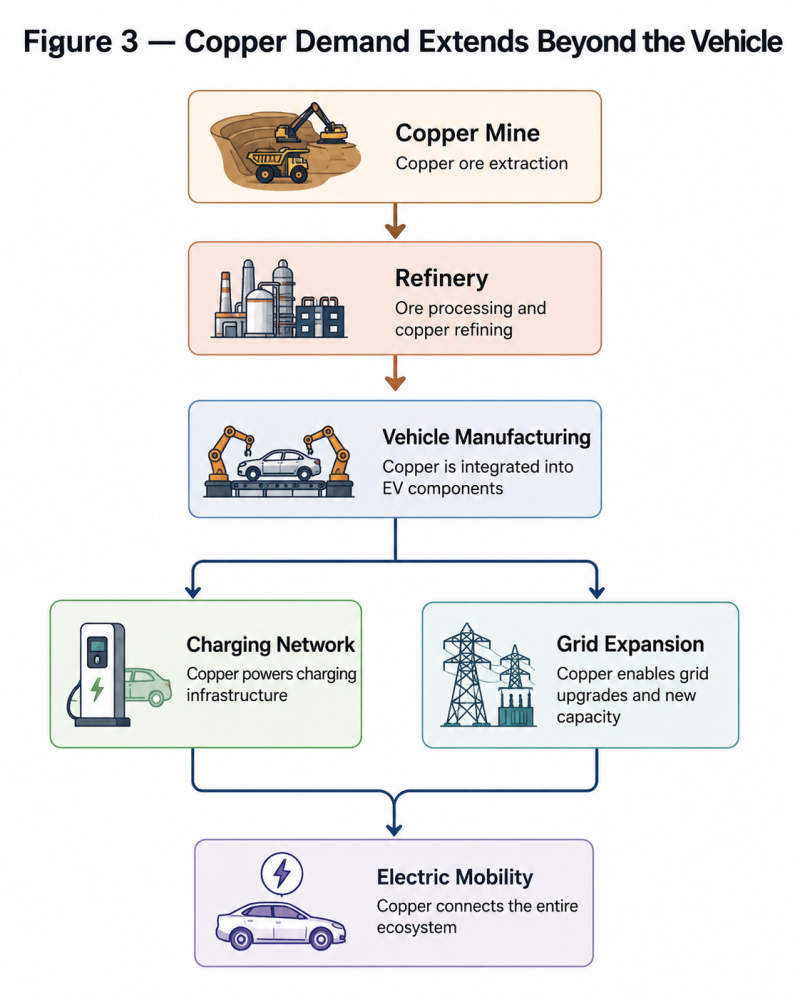
Charging infrastructure multiplies demand further. Fast-charging stations require transformers, underground cables, switchgear and distribution equipment before a single vehicle can recharge. The vehicle is only one part of the system. The grid behind it is often even more copper-intensive.
Renewable Energy Requires More Infrastructure Than Fossil Fuels
A gas-fired power plant can often be built close to the cities it serves. Wind and solar resources rarely enjoy that luxury. The strongest winds are frequently hundreds of kilometers offshore or across remote plains. Large solar projects are commonly located in deserts. Electricity must travel from where nature provides energy to where people consume it.
That means transmission lines. Substations. Transformers. Distribution upgrades. Every kilometer adds more copper. Electrification is therefore not simply about replacing one power plant with another. It requires rebuilding large sections of the electrical system itself.
The International Energy Agency estimates that achieving long-term energy and climate objectives will require unprecedented investment in electricity networks alongside new generating capacity.
The Grid Is Becoming the New Oil Pipeline
During the twentieth century, countries measured energy security through oil pipelines, refineries and fuel reserves. Today, governments increasingly evaluate resilience through electricity networks.
Can the grid support millions of electric vehicles?
Can it accommodate new semiconductor factories?
Can it connect offshore wind farms?
Can it power AI infrastructure without causing shortages elsewhere?
These questions have moved from engineering departments into cabinet meetings.
Across North America, Europe and Asia, utilities are planning network upgrades measured not in millions but in hundreds of billions of dollars over coming decades. The limiting factor is no longer just capital.
It is materials. Transformers require copper. Switchgear requires copper. Transmission cables require copper. Distribution systems require copper. The expansion of electricity networks has become inseparable from the availability of the metal itself.
The energy transition is not just about generating clean electricity. It is about building the infrastructure that allows electricity to flow.
While executives phrase this differently across industries, the underlying message is remarkably consistent: generation alone is not enough. The network matters just as much.
The Economy Is Becoming More Electric And More Material Intensive
Economists assumed that advanced economies would gradually consume fewer raw materials as they shifted toward services and software.
That prediction proved only partly correct. The products people increasingly depend on — cloud computing, electric mobility, robotics, artificial intelligence and renewable energy — may appear digital, but they require vast quantities of physical infrastructure. In many ways, the modern economy is becoming simultaneously more digital and more material-intensive.
That paradox is one of the defining economic stories of the twenty-first century. Every new layer of digital capability rests on another layer of electrical infrastructure. And every new layer of electrical infrastructure increases demand for copper.
Transition
If demand were the only challenge, higher prices would eventually encourage new production. Commodity markets have solved that problem many times before. Copper is different. Finding new deposits is becoming harder. Building new mines is taking longer.
Producing each tonne requires moving more rock than ever before. The question is no longer whether the world needs more copper. The question is whether the mining industry can deliver it quickly enough.
The Supply Problem Money Alone Cannot Solve
For most commodities, rising prices solve shortages. Higher prices encourage investment. Investment creates new supply. Markets rebalance. Copper is beginning to break that pattern.
Mining companies are willing to spend billions of dollars. Governments increasingly recognize copper as a strategic resource. Investors understand that long-term demand is likely to remain strong. Yet new production is arriving far more slowly than demand. The obstacle is no longer capital.
A Copper Mine Is Not a Factory
If demand for smartphones doubles, manufacturers can build another assembly line. If demand for electric vehicles doubles, automakers can expand production plants. Mining does not work that way. Copper deposits cannot be manufactured. They must first be discovered.
Only after all of that can production begin. By the time the first truck leaves a newly built mine, the executives who approved the original investment may already have retired.
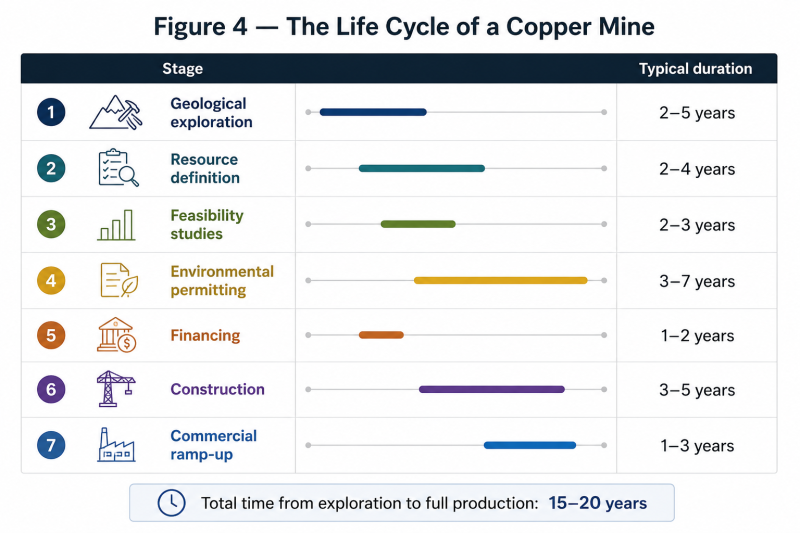
Developing a major copper project now typically requires 15 to 20 years, and some projects take even longer depending on environmental reviews, legal challenges and infrastructure requirements.
For industries accustomed to software development cycles measured in months, this timescale feels almost unimaginable. For mining, it has become normal.
The Easy Copper Has Already Been Found
The first generation of giant copper mines shared one important characteristic. They were obvious. Rich ore bodies often reached close to the surface. Prospectors could identify mineralization with relatively simple geological methods. Some deposits contained several percent copper, making extraction comparatively straightforward.
Those days are largely over. Modern exploration increasingly searches deeper underground, in more remote regions and beneath layers of rock that conceal mineral deposits from the surface.
Even when discoveries are made, they are often less concentrated than the mines that built the industry. This decline in ore quality is one of the least discussed challenges facing the global economy. It is also one of the most important.
Every Tonne Requires More Rock
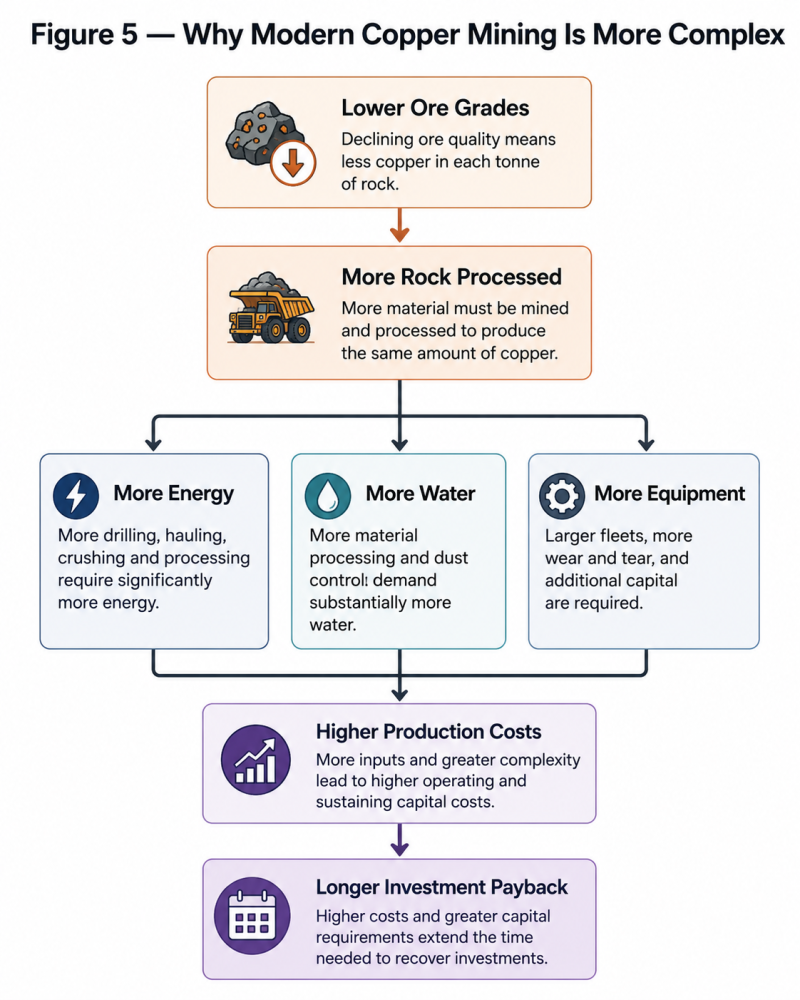
Imagine two mines. The first processes ore containing 2% copper. The second processes ore containing 0.5% copper. Both ultimately produce one tonne of refined metal. The second mine must move, crush, grind and process roughly four times as much rock to produce the same amount of copper.
That difference affects almost everything. Mining companies have become remarkably efficient over the past several decades, but declining ore grades have steadily offset many of those gains. The industry is working harder simply to stand still.
Copper Grades Matter More Than Most Investors Realize
Ore grade is one of the strongest indicators of a mine's long-term economics.
Lower grades generally mean:
- higher energy consumption;
- greater water requirements;
- more material handling;
- larger processing facilities;
- higher operating costs;
- increased environmental footprint.
In other words, declining grades affect profitability and sustainability at the same time.
Chile's Success Has Become Its Challenge
No country illustrates the copper paradox better than Chile. Stretching along the Pacific coast of South America, the country has spent decades building the world's most sophisticated copper industry. Today, it remains the largest producer of mined copper.
Its giant deposits, including Escondida, Chuquicamata and Collahuasi, have helped supply the industrial expansion of the modern world.
Yet even Chile is confronting new limits. Many of its oldest mines are becoming deeper. Ore grades have declined. Operations require more energy than before. Most importantly, they require more water. The richest copper region on Earth lies within one of the driest deserts on the planet.
Mining companies have responded by investing billions of dollars in desalination plants and pipelines stretching from the Pacific Ocean to high-altitude operations in the Atacama Desert.
Water has become almost as strategic as copper itself. It is an extraordinary image of the modern mining industry. Before companies can extract copper from the mountains, they must first transport seawater across one of the world's harshest landscapes.
Mining Is Becoming a Social Project
For much of the twentieth century, developing a mine was largely an engineering challenge. Today, it is also a political and social one. Communities expect greater environmental protection. Indigenous groups demand meaningful consultation.
Governments seek larger economic benefits. Environmental organizations closely monitor biodiversity, emissions and water use. Investors increasingly evaluate mining companies through environmental, social and governance metrics alongside financial performance.
None of these developments are inherently obstacles. Many represent legitimate improvements in how large industrial projects are managed. But they also make permitting more complex, more expensive and more time-consuming. A modern copper mine is no longer approved simply because the geology is attractive. It must also earn a social license to operate. That license cannot be purchased. It must be built over years of engagement.
Capital Is No Longer the Scarce Resource
The mining industry is not short of money. Major producers, including BHP, Rio Tinto, Freeport-McMoRan and Codelco, are collectively investing tens of billions of dollars in expanding existing operations and developing new projects. Private capital remains interested.
Governments increasingly support critical mineral development. Strategic investors are entering the sector. The bottleneck lies elsewhere. Finding quality deposits. Securing permits. Building infrastructure. Recruiting skilled workers. Managing environmental risks.
These constraints cannot be solved simply by increasing budgets. They are structural.
The best time to discover a world-class copper deposit was thirty years ago. The second-best time is today.
The phrase has become common among mining executives because it captures a difficult reality: the industry is investing for demand that has not yet fully arrived, while knowing that many projects will not begin producing until well into the next decade.
The Clock Is Already Running
Commodity markets often react only when shortages become visible. Copper does not offer that luxury. If a supply gap emerges in 2038, the mines needed to prevent it must begin development today. Waiting until prices spike will be too late. This is why analysts increasingly focus less on current inventories and more on the project pipeline.
According to S&P Global, global copper demand could increase by roughly 50% by 2040, while supply growth risks falling well short without sustained investment in new mines and processing capacity.
The challenge facing the industry is therefore unlike a typical commodity cycle. It is not merely about producing more copper. It is about deciding, years in advance, how much copper the future economy will need. And that decision is becoming increasingly geopolitical. Because once copper leaves the mine, another question emerges.
Who controls the refining, processing and manufacturing that transform raw ore into the metal powering the world's economy?
That question leads directly to the next chapter.
Why the Market Keeps Underestimating Copper
Commodity markets have a simple reputation. When prices rise, producers invest. When new supply arrives, prices fall. The cycle repeats. Copper largely followed that pattern. But the market now faces a challenge that looks increasingly unfamiliar. Demand is becoming structural. Supply remains cyclical. The mismatch between the two is beginning to reshape one of the world's oldest commodity markets.
Copper Has Always Been Cyclical
Copper demand reflected the broader economy. When construction accelerated, copper prices climbed. When recessions arrived, prices weakened. China's industrial boom during the 2000s created one of the strongest commodity supercycles in modern history. Then came the global financial crisis, followed by years of slower growth and cautious investment.
Mining executives learned an expensive lesson. Never build capacity assuming today's high prices will last forever. Investors learned the same lesson. Mining shares became synonymous with volatility. That memory still influences decisions today. It also explains why the industry has been reluctant to approve enough large-scale projects to meet demand expected in the 2030s.
The Future Is Driving Today's Investment Decisions
The copper market is unusual because today's investment decisions are based on tomorrow's economy. A mine approved in 2026 may not begin commercial production until the early or mid-2040s. Its economics depend less on current prices than on what the world will look like twenty years from now.
Will electric vehicles dominate global transportation?
How quickly will artificial intelligence increase electricity consumption?
Will governments continue investing in grid modernization?
How much renewable energy will actually be built?
These are not geological questions. They are forecasts about the future of civilization. Mining companies are effectively making trillion-dollar assumptions about how the global economy will evolve.
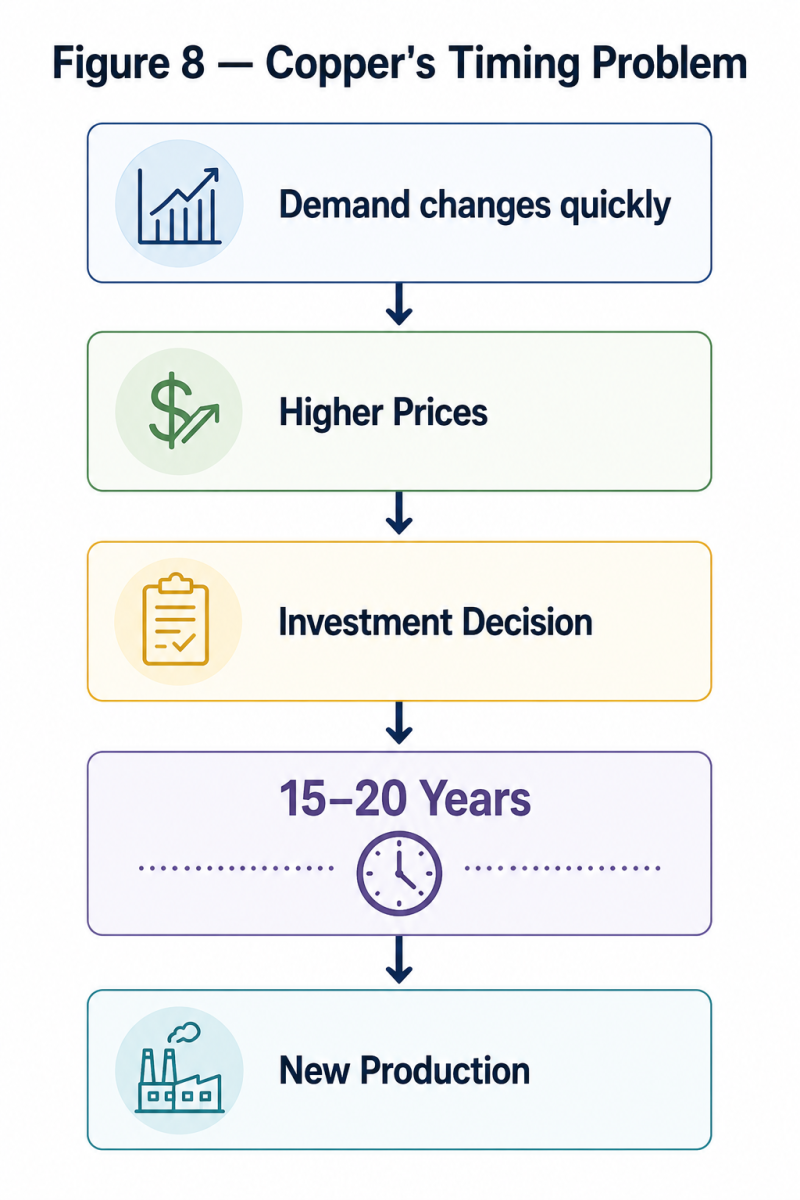
The market reacts immediately. Supply reacts a generation later.
Investors Prefer Short-Term Certainty
Financial markets reward quarterly results. Mining rewards patience. This creates an uncomfortable tension.
Building a new copper mine often requires:
- billions of dollars in capital;
- years of environmental studies;
- uncertain permitting outcomes;
- volatile commodity prices;
- political risk;
- no meaningful revenue for more than a decade.
From the perspective of many investors, there are easier ways to generate returns. A software company can double revenue without moving a single tonne of rock. A semiconductor company can build a new fabrication plant in a fraction of the time required to develop a major mine.
Mining competes for capital against industries that promise faster growth and quicker payback. That competition has become one of the industry's greatest disadvantages.
Copper Is Expensive Before It Produces Anything
Imagine building a factory. Construction begins. Within a few years, products start leaving the assembly line. Cash flow follows. Now imagine building a copper mine. The first years generate almost no revenue.
Instead, they generate expenses. Exploration teams. Geologists. Environmental consultants. Engineers. Roads. Power infrastructure. Water pipelines. Processing plants.
Only after billions of dollars have already been committed does the project begin producing saleable metal. Mining companies spend enormous amounts of capital before earning their first dollar. That reality makes executives naturally cautious.
One mistake can affect an entire decade of financial performance.
Capital Intensity by Industry
| Industry | Typical time to revenue |
| Software | Months |
| Manufacturing | 2–5 years |
| Semiconductor fabrication | 4–7 years |
| Copper mining | 15–20 years |
The comparison helps explain why mining often struggles to attract the same enthusiasm as technology sectors, despite its strategic importance.
The Price Signal Often Arrives Too Late
Commodity markets assume higher prices will encourage more production. Copper complicates that assumption. Imagine demand suddenly increases by 15%. Prices surge.
Investors become optimistic.
Mining companies approve new projects. The market celebrates. Yet no additional copper reaches manufacturers for another decade or more. During that period, shortages can persist. Prices remain elevated. Manufacturers delay investments. Governments intervene. The market eventually balances, but only after years of adjustment. Copper therefore behaves differently from commodities where production can respond relatively quickly. Its delays amplify every cycle.
CEOs Are Talking Less About Prices and More About Pipelines
Listen to earnings calls from the world's largest mining companies and a pattern quickly emerges. Executives spend surprisingly little time predicting next year's copper price.
Instead, they discuss:
- future project pipelines;
- permitting timelines;
- ore grades;
- processing capacity;
- labor availability;
- water infrastructure;
- geopolitical stability.
In other words, they focus on the industry's ability to deliver supply — not the market's ability to discover a price. That shift reflects a broader change. Copper is gradually moving from a cyclical commodity story to a structural investment story.
The biggest risk isn't running out of copper tomorrow. It's failing to build enough capacity before demand arrives.
That sentiment now appears repeatedly across industry conferences, investor presentations and long-term outlooks. The debate has shifted from whether demand will grow to whether the industry can prepare in time.
Markets Are Beginning to Price Time
Historically, copper was valued by tonnes. Increasingly, it is also being valued by years. A project capable of producing 500,000 tonnes annually sounds impressive. A project capable of producing 500,000 tonnes annually within five years is strategically transformative.
Time has become a scarce resource. Governments understand this. Manufacturers understand this. Utilities understand this. Financial markets are only beginning to catch up.
The New Economics of Copper
The industry is entering an unusual phase. Demand growth is becoming more predictable because electrification is driven by long-term investment cycles. Supply growth remains uncertain because mining projects are exposed to geology, politics, permitting and environmental constraints.
This combination creates something investors rarely encounter:
high confidence in demand alongside low confidence in supply.
That imbalance explains why many analysts now view copper less as a traditional commodity and more as a strategic industrial asset. Estimates from S&P Global suggest that, without accelerated investment, the market could face a significant supply deficit by 2040, even under conservative demand assumptions.
The Next Phase Is Bigger Than Mining
If the twentieth century taught countries to secure access to oil, the twenty-first is teaching them something different. Control over strategic materials is no longer enough. The real challenge is ensuring that the entire industrial ecosystem, from mines and refineries to power grids and advanced manufacturing, can expand together.
Copper sits at the center of that system. But it is also revealing a broader truth. The clean-energy transition is not limited by ideas. It is limited by execution.
And execution depends on physical materials. That realization takes us to the final chapter. Because copper is ultimately not just a story about mining. It is a story about how civilizations grow — and what happens when the materials beneath them become the limiting factor.
 Marina Lubimova