Marina Lubimova

That interpretation focuses on inputs rather than outcomes.
Infrastructure alone does not create competitive advantage. Microsoft's advantage comes from converting computing capacity into higher productivity inside software that enterprises already use every day. GPUs, networking equipment and hyperscale data centers remain invisible to customers. What users experience instead is faster coding, shorter meetings, quicker access to information and less time spent on repetitive administrative work.
For companies developing their own AI strategy, this distinction is far more valuable than Microsoft's infrastructure budget. Few organizations can replicate Microsoft's capital spending. Many can replicate the principles behind its deployment model.
The Productivity Constraint Behind Microsoft's AI Strategy
Generative AI solved an economic problem before it solved a technological one. Over the past decade, enterprise employees have accumulated an expanding layer of digital work. Meetings generate chats, chats generate emails, emails generate documents, and every application produces another stream of notifications. As collaboration tools multiplied, uninterrupted working time became increasingly scarce.
Microsoft's internal workplace research illustrates how rapidly this pressure has intensified:
- employees experience 275 interruptions during an average workday;
- messages received immediately before and after meetings have increased by 122% compared with several years ago;
- 60% of meetings are now scheduled on short notice;
- after-hours chat activity has risen by 15% year over year.
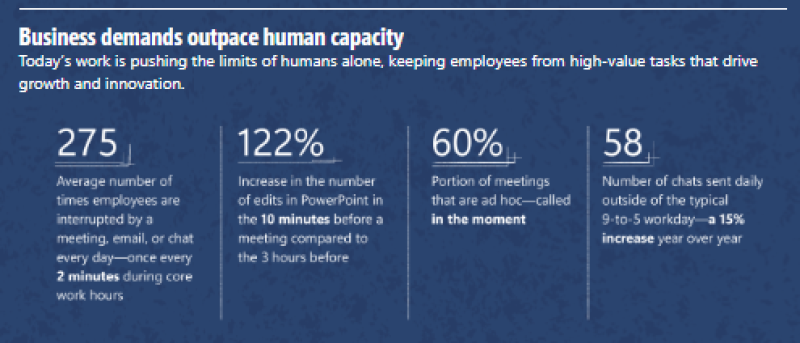
Viewed together, these statistics explain why Microsoft's AI strategy focused on workflow rather than technology. The objective was not to produce better text or images. It was to reduce the amount of time knowledge workers spend switching between fragmented tasks.
This also explains why Copilot was integrated directly into Microsoft 365 instead of launching as a standalone application. Employees were not asked to adopt another platform. AI was inserted into software they already opened every morning.
That decision lowered one of the biggest barriers to enterprise AI adoption: changing user behavior.
Infrastructure Became Microsoft's Largest Competitive Investment
Embedding AI into everyday software requires computing capacity on a scale few companies can finance.
Microsoft's recent financial statements show how quickly that investment has accelerated. Quarterly additions to property and equipment increased from $16.7 billion in the March 2025 quarter to $30.9 billion one year later, representing an increase of approximately 84%.
Unlike traditional software investment, these expenditures are directed toward physical assets:
- GPU clusters;
- servers and networking hardware;
- hyperscale data centers;
- cooling systems;
- electrical infrastructure;
- long-term cloud capacity.
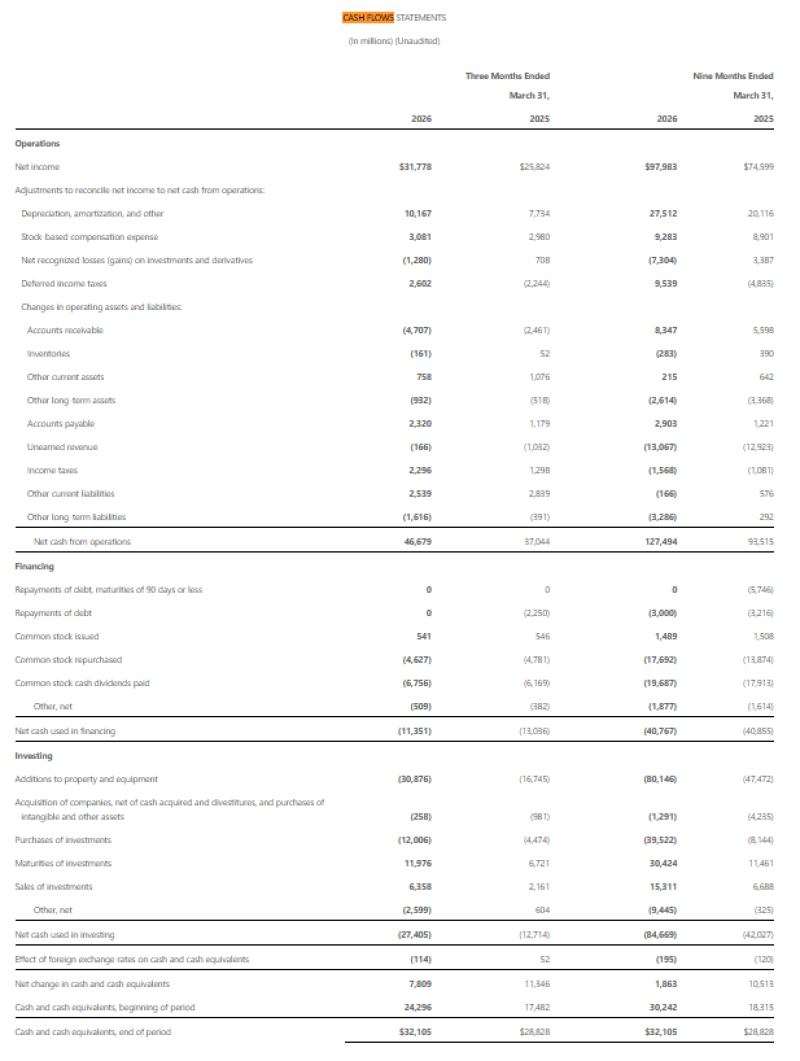
The composition of those investments is equally important. Microsoft has indicated that roughly half of recent capital expenditure has been allocated to shorter-lived assets such as GPUs and CPUs, while the remainder supports long-lived infrastructure including buildings and data-center facilities.
This distinction matters because the company's AI expansion is no longer limited by software development. It increasingly depends on how quickly physical infrastructure can be deployed.
The result is a business model that resembles a utility as much as a software company. Microsoft continues to generate high-margin recurring revenue, but doing so now requires sustained investment in assets that consume electricity, occupy real estate and depreciate over time.
Following Microsoft's AI Capital Through the Supply Chain
Public discussion often reduces Microsoft's AI investment to its partnership with OpenAI. The financial reality is considerably broader. Every dollar allocated to AI infrastructure passes through a long industrial chain before reaching an end user.
The sequence typically looks like this:
Capital investment → Semiconductor designers → Chip manufacturers → Networking suppliers → Data-center construction → Power and cooling infrastructure → Azure AI platform → Microsoft Copilot → Enterprise workflows
By the time an employee asks Copilot to summarize a meeting or retrieve information from SharePoint, multiple industries have already contributed to delivering that response. Semiconductor companies manufacture processors, construction firms expand data-center capacity, utilities provide electricity, networking vendors connect thousands of GPUs, and Azure abstracts the entire stack into a cloud service.
Microsoft's role is to integrate these layers into products that enterprises already depend on. This is why measuring Microsoft's AI strategy solely by infrastructure spending misses the broader economic picture. Capital expenditure is not the product being sold. It is the mechanism that allows AI capabilities to be delivered as another feature inside familiar business software.
Distribution Matters More Than Models
The market often attributes Microsoft's AI leadership to its partnership with OpenAI. While access to frontier models accelerated the company's position, it does not explain why Microsoft has been able to commercialize AI faster than most competitors.
Microsoft already owns one of the largest business software ecosystems in the world. Microsoft 365, Outlook, Teams, Excel, Word, Dynamics, GitHub and Azure are deeply embedded in daily operations across millions of organizations. AI did not need to attract users to a new platform — it arrived inside workflows employees were already using.
This significantly reduced one of the largest costs associated with enterprise software adoption: changing user behavior.
Rather than convincing organizations to replace existing tools, Microsoft increased the value of tools they had already standardized on. A sales representative drafts proposals in Outlook, a developer receives code suggestions inside Visual Studio, a financial analyst summarizes spreadsheets in Excel, and a project manager reviews meeting notes in Teams. AI appears within the workflow instead of competing with it.
That integration creates a structural advantage that is difficult to replicate. Competitors can develop comparable models, but matching Microsoft's distribution network requires years of enterprise relationships, software integration and customer trust.
The broader lesson is that successful AI deployment depends less on model quality than on workflow integration. Employees rarely change established habits because a model is marginally better. They adopt technology when it removes friction from work they already perform.
How Microsoft Rolls Out AI Inside the Enterprise
Technology is only one component of Microsoft's AI strategy. The company's deployment process is equally important.
Instead of pursuing organization-wide rollouts, Microsoft follows a staged implementation framework that prioritizes measurable operational improvements. Each phase builds on evidence gathered during the previous one, limiting unnecessary investment while increasing adoption rates.
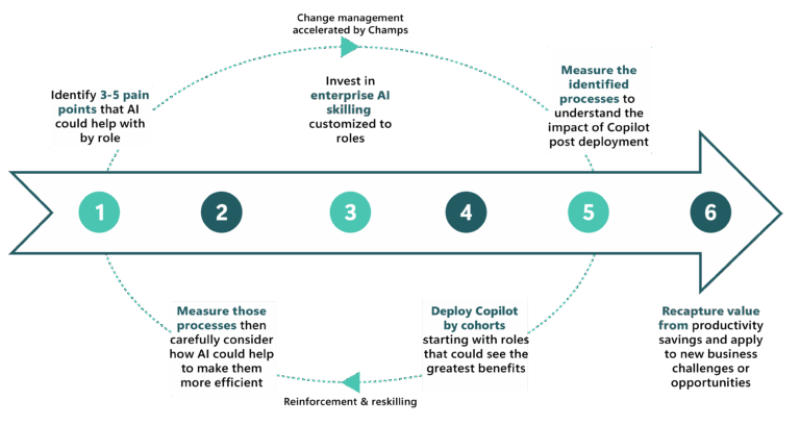
The framework can be summarized in six steps.
Step 1 — Identify Repetitive Work
Every implementation begins by identifying routine activities that consume time without creating significant value.
Rather than searching for impressive AI demonstrations, Microsoft focuses on repetitive administrative work: summarizing meetings, searching internal documents, drafting routine emails, preparing reports or retrieving information scattered across multiple systems.
This approach changes the starting point of an AI project. The objective is not to introduce artificial intelligence into the business. The objective is to remove friction from an existing process.
Step 2 — Establish a Baseline
Before deploying Copilot, Microsoft measures how the existing process performs.
Typical metrics include:
- time required to complete a task;
- number of manual steps;
- employee satisfaction;
- response times;
- error frequency.
Without a baseline, productivity improvements cannot be verified. Many organizations skip this stage and evaluate AI using subjective impressions. Microsoft's framework treats AI implementation as an operational investment that must produce measurable returns.
Step 3 — Prepare Employees
Technology adoption depends as much on user behavior as software capability. Microsoft therefore introduces training before expecting productivity gains. Employees learn where AI provides reliable assistance, where human review remains necessary and how prompts should be adapted for specific business functions.
This stage also identifies unrealistic expectations. AI is presented as an assistant that accelerates routine work rather than an autonomous replacement for professional judgment. The distinction reduces resistance while encouraging practical experimentation.
Step 4 — Deploy Through Small Pilots
Instead of rolling out Copilot across an entire organization, Microsoft begins with carefully selected teams where repetitive work is common and outcomes are easy to measure. Departments such as customer support, software development, finance or sales often provide the clearest early opportunities. Limiting the scope serves two purposes. First, it minimizes operational risk. Second, it produces measurable evidence that can support broader deployment decisions.
Organizations frequently fail because they attempt enterprise-wide implementation before understanding where AI creates the greatest value.
Step 5 — Measure the Results
After deployment, Microsoft compares new performance against the original baseline. The objective is not to measure AI usage. It is to measure business outcomes.
Questions include:
- Has task completion become faster?
- Has response quality improved?
- Have manual workloads declined?
- Are employees spending more time on higher-value work?
Projects that fail to demonstrate measurable improvement are revised before additional investment is approved.
This disciplined evaluation process prevents AI initiatives from becoming technology experiments without commercial value.
Step 6 — Scale Proven Workflows
Only after productivity gains have been verified does Microsoft expand deployment across additional teams. Successful workflows become organizational standards. Unsuccessful pilots remain limited in scope or are discontinued altogether.
The sequence may appear conservative, but it explains why Microsoft's AI initiatives continue expanding while many enterprise AI projects stall after initial enthusiasm.
- The most striking aspect of this framework is what it excludes.
- There is no requirement to train a proprietary foundation model
- No recommendation to build private GPU clusters
- No expectation that every department adopt AI simultaneously
The emphasis remains on measurable operational improvements rather than technological ambition.
Three Practices Worth Adopting
Microsoft's implementation strategy contains several principles that are transferable to organizations with far smaller budgets. The value lies not in Microsoft's infrastructure but in the decisions made after the infrastructure is available.
1. Build Internal Knowledge Before Customer-Facing AI
Many organizations begin AI projects by deploying chatbots for customers. Microsoft prioritized employees instead. Copilot was first integrated into Outlook, Teams, SharePoint and Microsoft 365 because these applications contain the information employees search for every day.
Reducing internal search time improves productivity across the organization, regardless of industry.
For smaller businesses, this often means connecting AI to documentation, operating procedures, contracts, technical manuals or internal knowledge bases before investing in external customer experiences. The return is usually easier to measure because employees interact with these resources continuously.
2. Remove Communication Overhead
Knowledge work increasingly consists of processing communication rather than producing it. Meetings generate follow-up tasks. Emails require summaries. Chat conversations produce decisions that later need documentation.
Microsoft addressed these repetitive activities before attempting more complex automation. Meeting summaries, email drafting, action-item extraction and document synthesis require relatively little customization while affecting nearly every employee.
Automating communication does not eliminate work. It reduces the administrative effort surrounding work.
3. Expand One Business Function at a Time
Microsoft's customer examples consistently follow the same pattern: one department, one workflow and one measurable objective. Access Holdings reduced software development work that previously required approximately two hours to around eight minutes using Microsoft 365 Copilot.
Allpay reported a 25% improvement in developer productivity after adopting GitHub Copilot. AXA implemented Azure Secure GPT to support employees while maintaining internal security requirements.
Despite operating in different industries, these organizations followed a similar strategy. Each deployment addressed a clearly defined operational problem before expanding into additional business functions.
That incremental approach contrasts sharply with organizations attempting to build enterprise-wide AI platforms before demonstrating value in a single department. The practical implication is straightforward. The first successful AI project should solve one measurable business problem exceptionally well. Expansion can wait until the economics have been proven.
Evidence Beyond Microsoft's Own Workforce
One of the easiest mistakes when evaluating Microsoft's AI strategy is assuming that its results are unique to a company with nearly a quarter of a million employees and one of the world's largest technology budgets.
The available evidence suggests otherwise. Many of Microsoft's customer deployments involve organizations that differ significantly in size, industry and technical maturity. While the individual results should be viewed as customer-reported outcomes rather than independent academic studies, they reveal a consistent pattern: productivity gains tend to emerge first in routine knowledge work rather than highly specialized tasks.
The Royal College of Surgeons of England offers a useful example. After deploying Microsoft 365 Copilot, 71% of employees reported higher productivity, with the largest improvements occurring in administrative work such as preparing documents, managing email and locating information. Time previously spent on routine office tasks shifted toward activities that required professional expertise.
The result illustrates an important principle. The value of AI rarely comes from replacing skilled employees. It comes from reducing the amount of low-value work surrounding their expertise. The same pattern appears across Microsoft's commercial customer base. Access Holdings shortened software development tasks that previously required approximately two hours to around eight minutes.
Allpay reported a 25% improvement in developer productivity after introducing GitHub Copilot. AXA deployed Azure Secure GPT to help employees access information securely without exposing sensitive corporate data to public AI services.
Although these organizations operate in different sectors, they followed remarkably similar implementation strategies. Each project addressed a narrowly defined business process, measured the outcome and expanded only after demonstrating operational value.
That consistency matters more than the individual performance numbers. It suggests that Microsoft's deployment framework is transferable because it emphasizes process design rather than technology itself. The same conclusion appears in Microsoft's latest research on small and medium-sized businesses.
According to the company's survey:
- 81% of SMB leaders believe the current business environment requires organizations to rethink how work is performed.
- 45% identify workforce capacity as a greater constraint than hiring.
- 79% expect AI agents to become part of daily operations within the next 12 to 18 months.
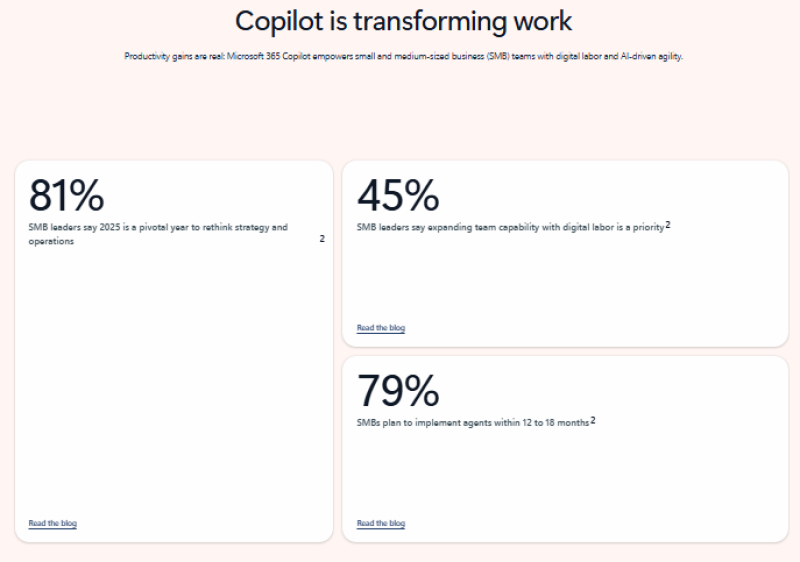
These findings indicate that AI adoption is moving beyond experimentation. The conversation is gradually shifting from whether organizations should use AI to where AI delivers measurable economic value first.
The Wrong Lessons From Microsoft's AI Strategy
Microsoft's infrastructure investments dominate headlines, but they are also the least transferable part of the company's strategy. Many organizations mistakenly assume they need to imitate Microsoft's scale before they can benefit from AI. That assumption often leads to expensive projects with uncertain returns.
Several common mistakes appear repeatedly. The first is treating AI as an infrastructure problem. Most businesses do not need dedicated GPU clusters, proprietary models or private data centers. Existing foundation models are already capable of solving a large share of everyday business tasks.
The second mistake is pursuing organization-wide deployment before identifying a successful use case. Large-scale implementation increases cost and complexity while making it more difficult to understand which workflows actually improved.
Microsoft follows the opposite sequence. Small pilots precede broad deployment. The third mistake is measuring activity instead of outcomes. Many organizations evaluate AI projects using metrics such as prompt volume, user adoption or chatbot interactions.
Microsoft's framework focuses on operational indicators instead:
- time saved;
- cost reduction;
- faster delivery;
- higher employee productivity;
- improved service quality.
Finally, many companies attempt to automate unstable processes. If a workflow is inconsistent before AI is introduced, automation usually accelerates existing inefficiencies rather than eliminating them. Microsoft's implementation model begins by simplifying work before applying AI to it. Technology amplifies process quality. It rarely compensates for poor process design.
Applying the Framework on a Smaller Budget
The practical value of Microsoft's strategy lies in its sequencing rather than its scale. A smaller organization can reproduce most of the decision-making process without reproducing Microsoft's capital expenditure. A realistic implementation plan might look like this.
Week 1 — Choose One Workflow
Select a repetitive activity that consumes measurable time.
Typical examples include:
- preparing meeting summaries;
- responding to routine customer inquiries;
- drafting proposals;
- searching internal documentation;
- generating standard reports.
The narrower the workflow, the easier it becomes to measure improvement.
Week 2 — Establish a Baseline and Launch a Pilot
Measure the existing process before introducing AI.
- How long does the task take?
- How many manual steps are involved?
- How often does rework occur?
Then deploy an existing AI assistant to a small group of users rather than the entire organization. The objective is not broad adoption. It is reliable evidence.
Week 3 — Measure Operational Impact
Evaluate the pilot using business metrics instead of AI usage statistics.
Questions worth asking include:
- Has completion time declined?
- Has response quality improved?
- Are employees spending less time on repetitive work?
- Has customer response time improved?
- Has manual effort decreased?
Collect qualitative feedback alongside quantitative measurements. Unexpected workflow improvements often emerge during this stage.
Week 4 — Expand Only What Works
If measurable improvements appear, extend the deployment to additional teams performing similar work. If results remain inconclusive, refine the workflow before expanding further. This incremental approach may appear slower than organization-wide implementation, but it substantially reduces both financial risk and organizational resistance. It is also remarkably close to the deployment process Microsoft has adopted internally.
Conclusion
Microsoft's AI strategy is frequently described as a story of extraordinary capital investment. That perspective captures the scale of the company's infrastructure but overlooks the source of its competitive advantage. Data centers, GPUs and cloud capacity are enabling assets.
The strategy begins much later — inside the workflow. Microsoft identified a growing productivity constraint, embedded AI into software employees already used, measured operational outcomes and expanded only after demonstrating measurable value. Infrastructure made that strategy possible, but disciplined execution made it commercially successful.
This distinction is particularly relevant for smaller organizations. Few businesses can replicate Microsoft's investment profile. Most can replicate its implementation model. The practical lesson is not to spend more on AI.
It is to identify where routine work slows the business, introduce AI into that specific process, measure the result and expand only when the economics justify it.
The companies most likely to benefit from AI over the coming decade will not necessarily be those with the largest computing budgets. They will be those that integrate AI into everyday operations with the same discipline that Microsoft applied to its own transformation.
 Marina Lubimova