Marina Lubimova

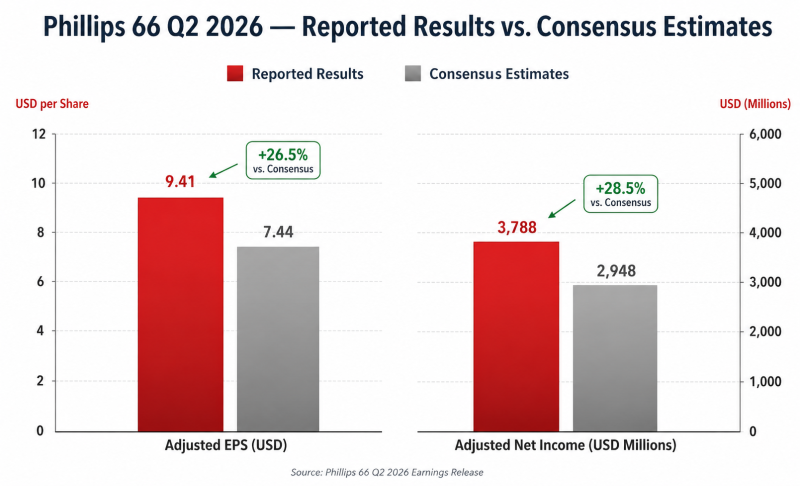
The company reported adjusted net income of $3.79 billion, well above the $2.95 billion analysts had expected. Adjusted earnings reached $9.41 per share, beating the consensus estimate of $7.44, while reported EPS came in at $9.55.
The results show that refining fundamentals remained considerably stronger than the market had anticipated.
Margin Expansion Drove the Quarter
The biggest contributor to the earnings surprise was Phillips 66's realized refining margin of $24.08 per barrel.
For refiners, profitability is determined less by crude oil prices than by the spread between feedstock costs and the value of refined products such as gasoline, diesel and jet fuel. Wider spreads allow refiners to generate substantially more profit from every barrel processed.
Phillips 66 benefited from those conditions while keeping its refining system operating at exceptionally high efficiency.
Q2 2026 Performance Snapshot
| Metric | Q2 2026 | Consensus | Why It Matters |
| Adjusted Net Income | $3.79B | $2.95B | Profit materially exceeded market expectations |
| Adjusted EPS | $9.41 | $7.44 | Nearly 27% earnings beat |
| Reported EPS | $9.55 | — | Reflects exceptionally profitable operations |
| Refinery Utilization | 96% | — | Assets operated close to maximum capacity |
| Clean Product Yield | 86% | — | Greater share of higher-value transportation fuels |
| Realized Refining Margin | $24.08/bbl | — | Core driver of refining profitability |
The numbers point to more than favorable market conditions. Phillips 66 combined high throughput with an attractive product mix and wide refining spreads, allowing the company to convert strong industry fundamentals directly into earnings.
High Utilization Maximized Strong Market Conditions
Phillips 66 operated its refineries at 96% utilization, leaving very little idle capacity during the quarter.
Maintaining utilization at that level is operationally challenging because refineries require continuous maintenance while operators must manage equipment reliability, feedstock availability and unplanned outages.
Running nearly every available processing unit during a period of elevated refining margins significantly increased the company's earnings potential.
Product Mix Added Another Layer of Profitability
The company also reported an 86% clean product yield, meaning the overwhelming majority of production consisted of higher-value fuels including gasoline, diesel and jet fuel rather than lower-value residual products.
The metric illustrates one of the industry's most important competitive differences. Two refiners may process similar volumes of crude oil, yet generate very different financial results depending on how efficiently they convert that crude into premium transportation fuels.
How Operations Translate Into Earnings
| Operational Metric | Financial Impact |
| 96% refinery utilization | More barrels processed during a period of favorable economics |
| 86% clean product yield | Larger output of premium fuels with stronger pricing |
| $24.08/bbl refining margin | Higher profit generated from every barrel processed |
| Combined effect | Strong earnings beat and significantly higher cash generation |
The combination of high utilization, premium product output and strong refining margins created a powerful operating leverage effect, allowing profitability to increase much faster than production volumes alone.
What Matters Going Forward
The durability of refining margins will determine whether Phillips 66 can maintain earnings at similar levels over the coming quarters.
Global refinery capacity has expanded only gradually while fuel demand has remained more resilient than many analysts expected. As long as crack spreads remain healthy, efficient refiners are likely to continue generating strong cash flows even without a major increase in crude oil prices.
Operational execution therefore becomes increasingly important. Companies able to keep utilization high while maximizing premium fuel production capture a disproportionate share of industry profits.
The Bottom Line
Phillips 66's second-quarter results highlight how operational performance can amplify favorable market conditions.
Wide refining margins provided the opportunity, but near-full refinery utilization and a high-value product mix allowed the company to convert those margins into profits that comfortably exceeded Wall Street forecasts.
 Marina Lubimova