Marina Lubimova

Demographic change is usually discussed in terms of birth rates, aging populations, or migration. Yet one of the most important demographic transitions happens much earlier. It begins around the age of twenty.
During the following five years, millions of young adults make a series of decisions that shape not only their own lives but also the trajectory of the broader economy. They leave their parents' home, enter the labour market, form independent households, establish long-term relationships and, eventually, begin families.
Germany's latest demographic data offers a remarkably clear picture of this transition. Rather than occurring gradually across adulthood, these milestones are concentrated within a surprisingly narrow window. That five-year period has become Germany's demographic clock.
The Five Years That Change Everything
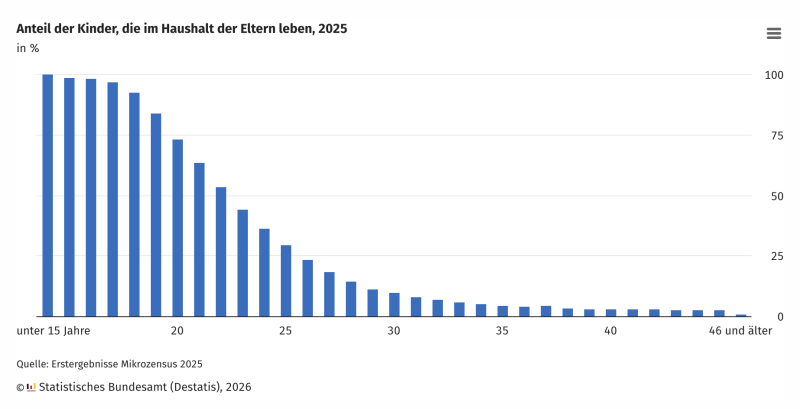
The first chart illustrates one of the sharpest demographic transitions visible in Germany today. Living with parents remains almost universal throughout childhood and the late teenage years. At age 20, approximately 74% of young adults still live in their parents' household.
Then the pattern changes rapidly. By age 23, the figure falls to roughly 45%. By 25, only about 30% remain. At 30, the proportion is already close to 10%. Beyond the age of forty, only a very small minority continues to live with parents. The curve does not simply describe residential choices. It captures the moment when one generation begins creating entirely new households. Every percentage point represents thousands of people becoming independent consumers.
One Decision Creates Multiple Economic Events
Leaving home is often treated as a personal milestone. Economically, it is something much larger. One move generates demand across multiple sectors simultaneously.
A newly independent household typically requires:
- rental housing;
- furniture;
- household appliances;
- internet services;
- utilities;
- insurance;
- transportation;
- financial products.
Household formation therefore acts as one of the economy's most important multiplier events. The first chart is effectively a timeline showing when this demand enters the market.
Housing Determines the Speed of the Clock
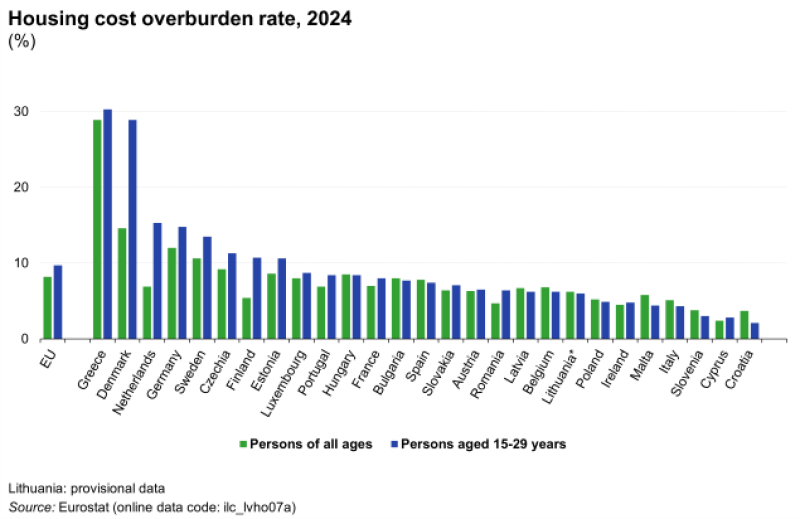
If the first chart explains when Germany's demographic clock starts ticking, the second helps explain what controls its speed. Eurostat data shows that approximately 15% of Germans aged 15–29 spend more than 40% of their disposable income on housing.
Among the overall population, the figure is closer to 12%. Germany sits well below countries such as Greece, where the youth housing-cost overburden rate reaches roughly 30%, but above several Central and Eastern European countries where housing consumes a smaller share of young people's income.
This positioning matters. Germany is neither experiencing an extreme housing crisis nor enjoying exceptionally affordable housing. Instead, affordability acts as a subtle brake on independence. The largest financial hurdle appears precisely when young adults are expected to establish their first independent household.
Why Age Twenty Has Become a National Turning Point
Historically, adulthood was associated with reaching a certain birthday. Today, adulthood increasingly depends on achieving financial stability. The sequence has changed. Education now lasts longer. Careers often begin later. Housing has become more expensive. Financial security takes more time to build. As a result, demographic milestones that once occurred independently have become tightly linked.
Leaving home often determines when people:
- form partnerships;
- marry;
- have children;
- purchase property;
- accumulate wealth.
One delayed step pushes the entire timeline forward.
Germany's Demographic Clock Extends Beyond Demographics
The implications stretch well beyond population statistics.
A slower transition into independent living influences:
- housing demand;
- consumer spending;
- urban development;
- labour mobility;
- fertility;
- long-term economic growth.
Viewed this way, the first chart is not simply about where young adults live. It maps the speed at which Germany generates new households and, by extension, new economic activity.
 Marina Lubimova