Marina Lubimova

The estimate contrasts with comments from Glencore CEO Gary Nagle, who said the company had taken a provision related to Radiant World but described the exposure as not material.
Glencore can afford a substantial loss. It generated $10.1 billion of adjusted EBITDA in the first half of 2026, while its marketing division produced $3.3 billion of adjusted EBIT, up 142% from a year earlier. The more consequential issue is what the Radiant World case says about counterparty risk inside commodity trading, where billions of dollars of physical cargoes depend on continuously available short-term credit.
The $500 Million Line
Glencore has not disclosed the size of its Radiant World provision. Reuters reported exposure above $500 million, with one estimate reaching $800 million. The company declined to comment on those figures.
The lower end of that range is notable because Glencore’s auditor uses roughly $500 million as its materiality threshold, according to Reuters. Exposure is not the same as loss. Commodity transactions can be backed by cargoes, receivables, collateral, insurance and other claims. The amount ultimately written off could therefore be substantially smaller.
What remains unclear is how much of Glencore’s position can be recovered.
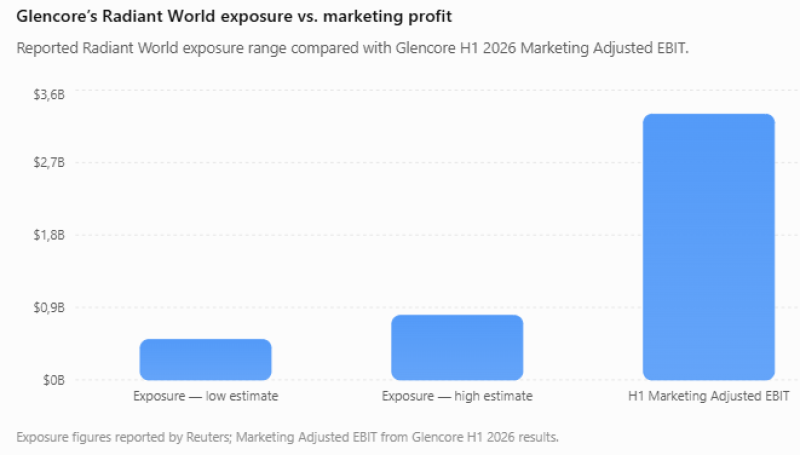
At $800 million, the reported exposure would equal about 24% of the adjusted EBIT generated by Glencore’s marketing division during the first six months of 2026.
That is not an estimate of the potential earnings hit. It puts the size of the position against the business where Glencore assumes much of its trading and counterparty risk.
Radiant World’s Network
Radiant World trades as much as 75 million tonnes of iron ore annually, representing cargoes worth more than $7 billion, according to Reuters.
Concerns surrounding the company emerged after questions were raised about whether some documents and invoices provided to banks were valid. Radiant World has rejected allegations against it as inaccurate and unsubstantiated.
Counterparties have already responded. Vitol and Cargill stopped trading with Radiant World, while Glencore stopped entering into new business with the company. Deutsche Bank and KBC were reported to have frozen some Radiant World accounts in Singapore, while other lenders suspended credit lines. Rio Tinto and Vale were also reported to have removed the trader from approved-customer lists.
For a physical commodity trader, losing access to credit can be more damaging than losing an individual trading relationship.
Iron ore cargoes can be worth tens or hundreds of millions of dollars and remain in transit for weeks. Traders typically finance purchases before receiving payment from the eventual buyer. That makes bank funding part of the operating cycle rather than an optional source of leverage.
At Least Three Large Creditors
Glencore is only one institution with substantial exposure to Radiant World. Intesa Sanpaolo disclosed €200 million of exposure and said provisions largely covered the position. The Italian bank said the issue would not affect its 2026 net-profit guidance.
Jefferies’ Point Bonita trade-finance fund has approximately $300 million of exposure, according to a person familiar with the matter cited by Reuters. Jefferies was investigating the position and expected repayment, with no provision taken at the time of the report.
Together with Glencore, the publicly identified positions already approach or exceed $1 billion, depending on the final size of Glencore’s exposure.
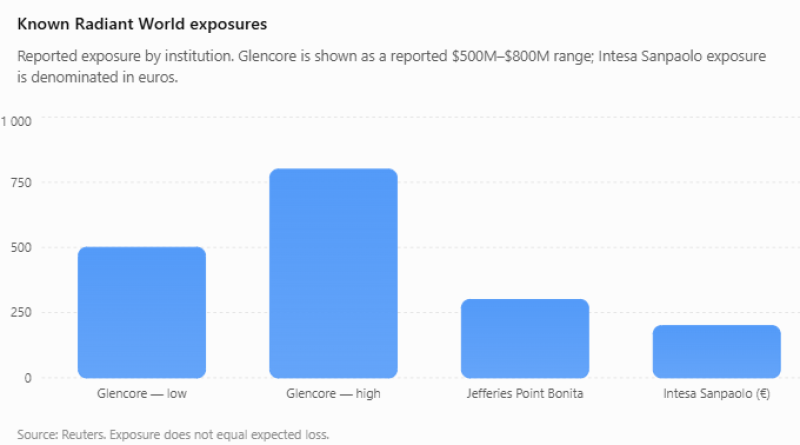
Those figures are exposures, not expected losses. But their size shows how much credit can accumulate around a single independent commodity trader.
A typical transaction can involve a miner selling iron ore to a trader, a bank financing the purchase, the trader reselling the cargo and the final buyer providing the cash used to repay the financing.
Documents linking those stages — invoices, bills of lading, warehouse records and other trade paperwork — help determine whether banks are willing to release funds. Once lenders question that documentation, credit can disappear before an actual default occurs.
When Credit Stops
Physical commodity trading requires large amounts of working capital because payment and delivery rarely happen simultaneously.
A trader purchasing a $100 million cargo may have to fund it weeks before receiving cash from the buyer. Running dozens of such transactions at the same time can create billions of dollars of financing requirements despite relatively thin margins on individual trades.
Banks fill that gap with revolving credit and trade-finance facilities. If lenders reduce those facilities, the trader must replace the financing, use its own cash, sell positions or cut trading volumes. If several banks withdraw simultaneously, the pressure compounds.
Commodity trade-finance cycle — Bank financing → Trader buys cargo → Commodity shipment → Buyer payment → Loan repayment → Credit recycled
This is also where Glencore differs sharply from a smaller independent merchant.
Glencore reported $14 billion of available committed liquidity at the end of the first half. Its net debt-to-adjusted EBITDA ratio stood at 0.56 times, while funds from operations reached $8.1 billion.
That balance-sheet capacity allows Glencore to absorb counterparty failures that could create immediate liquidity problems for smaller traders.
A Manageable Exposure for Glencore
Glencore entered the Radiant World episode after a strong six months. Marketing adjusted EBIT reached $3.3 billion, up 142%, while industrial adjusted EBITDA rose 72% to $6.5 billion.
The company also announced about $1.5 billion of additional shareholder distributions with its half-year results: roughly $1 billion through a special cash distribution and $500 million through a share buyback. Total shareholder returns announced for 2026 are expected to reach approximately $3.5 billion.
Even the upper $800 million estimate for Radiant World therefore looks manageable at group level, particularly because exposure does not translate directly into a write-off. The more relevant consequence may come from how Glencore, banks and competing commodity houses adjust their counterparty policies.
Smaller merchants could face lower credit limits, higher collateral requirements or more extensive verification of trade documents. Banks may also become less willing to finance transactions where several intermediaries separate the original producer from the final buyer.
That would raise the cost of capital precisely where commodity traders rely most heavily on short-term funding.
The Cost of a More Cautious Market
Glencore’s trading operation benefits from scale, liquidity and access to thousands of counterparties. Those advantages helped its marketing division more than double adjusted EBIT during a volatile first half.
The same network creates exposures that are difficult to see from consolidated financial statements.
Commodity traders finance inventories, extend credit, manage receivables and move cargoes between producers and buyers across multiple jurisdictions. Counterparty exposure can build quickly even when each transaction appears routine in isolation.
Radiant World puts a number on that risk. For Glencore, it is currently somewhere above $500 million and potentially as high as $800 million.
The eventual write-off could be much smaller. But if banks respond by tightening financing across independent commodity traders, the effects will extend beyond one balance sheet.
The lasting cost of Radiant World may be measured less by Glencore’s provision than by the amount of credit the commodity trading industry becomes unwilling to extend.
 Marina Lubimova