Artem Voloskovets
- Cheap Labor Was Only Phase One
- The Biggest Industrial Machine Ever Built
- China Didn't Build Factories. It Built Ecosystems
- Infrastructure Is China's Hidden Superpower
- China Educated an Army of Engineers
- From Copying Products to Inventing Them
- Scale Is an Economic Weapon
- China Is Replacing Workers With Robots
- The Strategy Nobody Talks About
- Can Anyone Repeat China's Success?
- The Next Battle: AI + Manufacturing
- Conclusion
Ask why China became an economic superpower and the most common answer is 'cheap labor.' That explanation is increasingly outdated. China today accounts for roughly one-third of global manufacturing output while wages in many industrial regions have risen far above those of Vietnam, Bangladesh, or India. If labor costs were the decisive factor, production would have shifted away on a much larger scale.
The more convincing explanation is that China built an industrial ecosystem rather than merely factories. Infrastructure, engineering talent, supplier density, long-term planning, and the world's largest domestic manufacturing network reinforce one another, creating advantages that are difficult to replicate.
Cheap Labor Was Only Phase One
The turning point came in 1978, when Deng Xiaoping initiated economic reforms. Special Economic Zones such as Shenzhen attracted foreign investment and integrated China into global supply chains. Multinational corporations transferred production, but they also transferred knowledge: quality control, logistics, manufacturing processes, supplier management, and engineering practices.
Cheap labor reduced costs, yet it was not sufficient to explain sustained growth. As wages rose, China continued to attract investment because manufacturers had already become embedded in a dense industrial ecosystem.
The Biggest Industrial Machine Ever Built
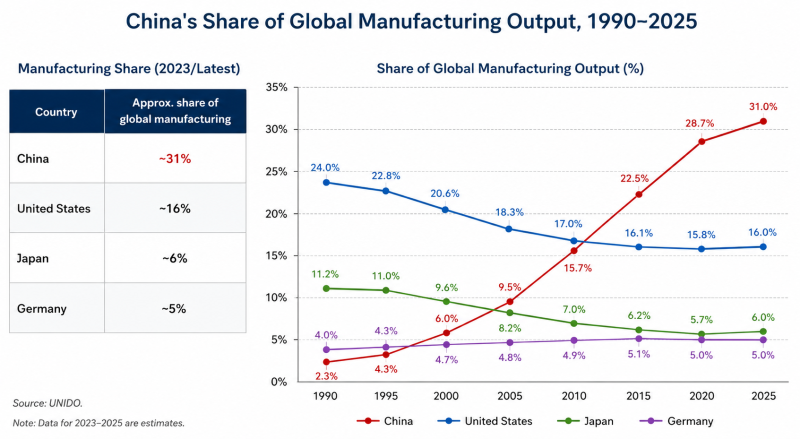
China's greatest achievement is not that it became the world's largest exporter. It is that it built the largest integrated manufacturing system in modern history. According to UNIDO, China accounts for roughly 31% of global manufacturing value added — more than the United States, Japan, and Germany combined. Manufacturing is not concentrated in a handful of flagship companies but spread across thousands of industrial clusters.
| Metric | China |
| Share of global manufacturing output | ~31% |
| Share of global industrial robot installations (annual) | ~54% |
| High-speed rail network | 48,000+ km |
| Top-10 global container ports | 7 |
Key Drivers:
- Industrial clusters reduce production time.
- Dense supplier networks shorten product-development cycles.
- Large domestic demand accelerates commercialization.
- Infrastructure lowers logistics costs.
- Engineering talent sustains continuous innovation.
The scale of China’s manufacturing ecosystem is unmatched and difficult to replicate quickly. McKinsey Global Institute
China Didn't Build Factories. It Built Ecosystems
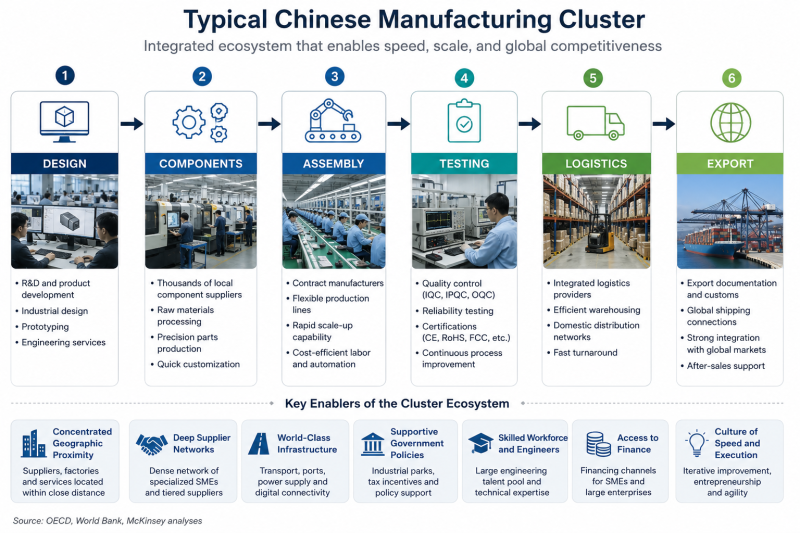
The true competitive advantage of Chinese manufacturing is not a single factory but the density of interconnected suppliers. In regions such as the Pearl River Delta and Yangtze River Delta, component makers, tooling companies, logistics providers, industrial designers, testing labs, universities and exporters operate within a few hours of one another. This concentration reduces transaction costs and dramatically shortens product-development cycles.
Case Study: Shenzhen
Shenzhen evolved from a Special Economic Zone into one of the world's most sophisticated electronics clusters. A hardware startup can source printed circuit boards, sensors, displays, batteries, molds, packaging and certification services locally, allowing prototypes to move from design to production in days rather than months.
Manufacturing Ecosystem vs. Standalone Factory
| Capability | Industrial Ecosystem | Standalone Factory |
| Supplier access | Thousands nearby | Often imported |
| Prototype speed | Days | Weeks or months |
| Engineering support | High | Limited |
| Logistics | Integrated | Fragmented |
| Innovation | Continuous | Incremental |
Key Takeaways:
- Supplier density creates speed rather than simply lowering costs.
- Industrial clusters improve resilience through multiple sourcing options.
- Knowledge spreads quickly when engineers, suppliers and manufacturers work side by side.
- This ecosystem is one of the hardest competitive advantages to replicate.
Infrastructure Is China's Hidden Superpower
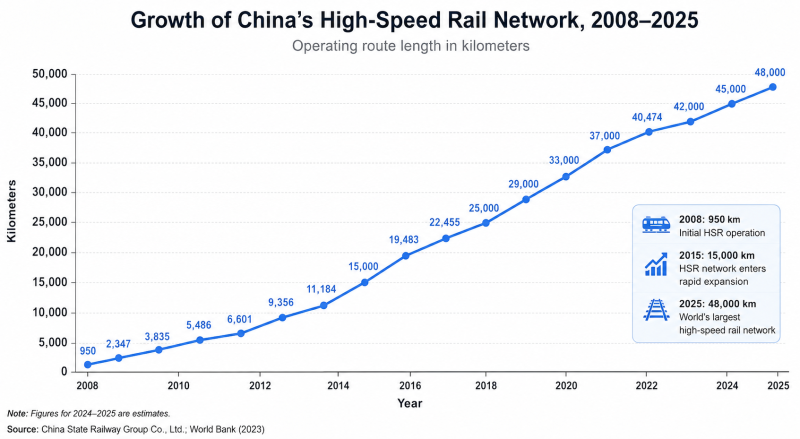
Factories create products, but infrastructure determines how efficiently those products move. Over four decades China treated transport, ports, power generation and digital networks as productive assets rather than supporting services. This reduced logistics costs, shortened delivery times and made industrial clusters more competitive.
Infrastructure by the Numbers
| Indicator | China | Why it matters |
| High-speed rail | 48,000+ km | Fast movement of people and expertise |
| Top 10 container ports | 7 located in China | Lower export costs |
| Expressway network | 180,000+ km | Efficient domestic logistics |
| Electricity generation | World's largest | Supports heavy industry |
Why Infrastructure Matters:
- Lower transportation costs improve export competitiveness.
- Reliable electricity reduces production interruptions.
- Modern ports increase inventory turnover and shorten delivery times.
- Digital infrastructure enables smart manufacturing and industrial automation.
Infrastructure is not simply a cost; it is a foundation for long-term productivity growth. World Bank analyses on infrastructure and development.
China Educated an Army of Engineers
As labor costs increased, China shifted its competitive advantage toward human capital. The country expanded universities, engineering schools and research institutes while increasing investment in science and technology. The result was one of the world's largest pools of engineers, researchers and industrial specialists.
| Capability | Impact on industry |
| Large STEM graduate pipeline | Supports advanced manufacturing |
| Growing R&D expenditure | Accelerates innovation |
| University–industry collaboration | Speeds commercialization |
| Engineering workforce | Improves productivity and automation |
Rather than relying solely on low-cost assembly, Chinese firms increasingly design products, develop proprietary technologies and automate production. This transition underpins the rise of companies such as Huawei, BYD, CATL and DJI.
From Copying Products to Inventing Them
China's industrial evolution did not stop at contract manufacturing. During the 1990s and early 2000s, many factories assembled products designed elsewhere. Over time, however, companies invested heavily in research, design, software, semiconductors, batteries, telecommunications and advanced manufacturing. The shift was supported by rising R&D spending, a larger engineering workforce and government programs aimed at moving industry up the value chain.
Today companies such as Huawei, BYD, CATL, DJI and Xiaomi compete through technology as much as price. China also leads global production of batteries, solar panels and electric vehicles, while becoming one of the world's largest sources of patent applications.
| Company | Industry | Strategic significance |
| Huawei | Telecommunications | 5G, networking, enterprise technology |
| BYD | Electric vehicles | Vertical integration |
| CATL | Batteries | Global battery supplier |
| DJI | Drones | Commercial drone leadership |
| Xiaomi | Consumer electronics | Integrated hardware ecosystem |
Scale Is an Economic Weapon
China's domestic market provides manufacturers with an advantage that is difficult to duplicate. Large production runs reduce unit costs, while hundreds of millions of consumers generate rapid feedback. Products can be refined, tested and commercialized at a speed unavailable in smaller economies.
- Large domestic demand supports economies of scale.
- Digital platforms accelerate product feedback.
- Extensive supplier networks shorten redesign cycles.
- Competition forces continuous improvement.
China Is Replacing Workers With Robots
Rising wages have pushed Chinese manufacturers toward automation rather than relocation. According to the International Federation of Robotics, China has become the world's largest installer of industrial robots, accounting for more than half of annual global installations in recent years. Automation improves quality, consistency and productivity while reducing dependence on labor-intensive production.
| Automation trend | Industrial impact |
| Industrial robots | Higher productivity |
| AI quality inspection | Lower defect rates |
| Automated warehouses | Faster logistics |
| Predictive maintenance | Less downtime |
The Strategy Nobody Talks About
Many analyses focus on wages or exports. A less visible advantage is China's willingness to plan industrial development over decades rather than quarters. Successive Five-Year Plans, the expansion of transport infrastructure, the Made in China 2025 initiative, and continued investment in strategic technologies all reflect a long-term approach to industrial upgrading.
This does not guarantee success, but it gives companies clearer signals about priority sectors such as semiconductors, robotics, advanced materials, renewable energy, biotechnology and AI.
| Period | Priority | Economic objective |
| 1978–1990s | Export manufacturing | Industrialization |
| 2001–2015 | Global integration | Move up value chain |
| 2015–2025 | Advanced manufacturing | Technology leadership |
| 2025+ | AI, robotics, chips | Productivity growth |
Can Anyone Repeat China's Success?
Countries including India, Vietnam, Indonesia and Mexico have attracted manufacturing investment, often with lower labor costs than China. However, reproducing China's ecosystem requires more than competitive wages. It requires supplier density, engineering talent, logistics, capital markets, stable energy supplies and decades of coordinated investment.
| Factor | China | India | Vietnam | Mexico |
| Industrial clusters | High | Medium | Medium | Medium |
| Infrastructure | High | Medium | Medium | High |
| Engineering scale | High | Medium | Low | Medium |
| Domestic market | Very High | High | Low | Medium |
The Next Battle: AI + Manufacturing
The next phase of competition will be determined less by labor costs than by productivity. Artificial intelligence is being integrated into factories through predictive maintenance, computer vision, digital twins, autonomous logistics and industrial robotics. Companies that combine AI with advanced manufacturing are likely to capture a growing share of global value creation.
Conclusion
Cheap labor opened the first door to China's rise, but it did not explain what followed. Industrial ecosystems, infrastructure, engineering education, manufacturing scale, automation and long-term investment transformed China from a low-cost production base into one of the world's most sophisticated industrial economies. Countries hoping to replicate that success must build systems rather than isolated factories.
 Artem Voloskovets