Artem Voloskovets

Wednesday's close at 49,918.78 places the index roughly 1,740 points below that peak and back under 50,000 — a level that many traders had already started treating as the market's new baseline.
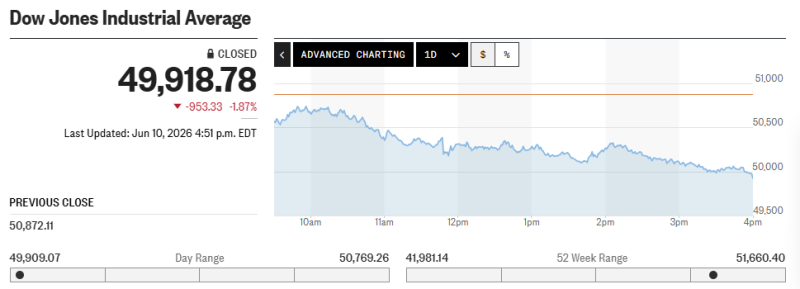
The session itself was unusually one-sided. The Dow opened around 50,800 and spent most of the day moving lower. A brief recovery attempt during the afternoon failed to change the trend. By the closing bell, the index was sitting only a few points above the day's low of 49,909.
That detail matters. Markets often stage late-session rebounds when buyers view a decline as an opportunity. Wednesday produced the opposite pattern: sellers remained active until the end of trading.
When a Breakout Stops Looking Like a Breakout
Crossing a round number does not change earnings, interest rates or economic growth. What it changes is positioning. The move above 50,000 encouraged investors to assume that recent gains would continue. Capital followed momentum. Risk exposure increased. Expectations adjusted higher.
The decline back below that level challenges those assumptions. Not because 50,000 has intrinsic value, but because the market failed to build support above it. A breakout that cannot hold eventually starts looking less like a breakout and more like exhaustion.
The Real Move Started at 51,660
The one-day decline attracted attention because it was large. The pullback from the high is more revealing. From roughly 51,660 to 49,918, the Dow has surrendered around 3.4%. That is not a crisis. It is, however, the first meaningful interruption to a rally that had become increasingly comfortable.
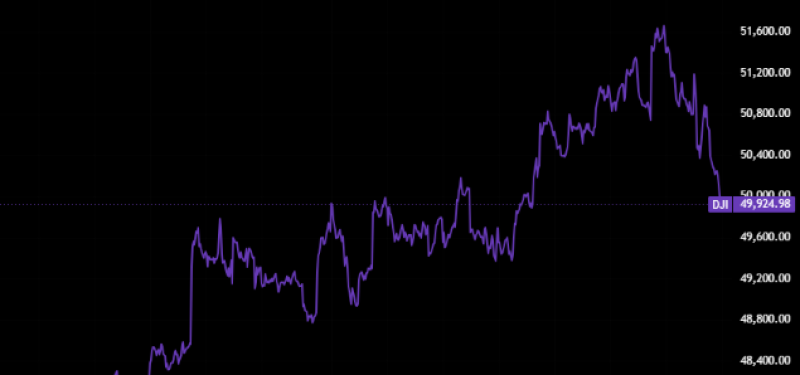
Bull markets rarely end because of a single bad session. They usually weaken in stages. New highs attract fewer buyers. Positive news generates smaller reactions. Momentum slows. Then price begins doing the work that headlines cannot explain. The current chart is starting to resemble that sequence.
The Question Is No Longer How High the Dow Can Go
For most of the spring, the dominant discussion centered on upside targets. That conversation has changed. The focus now shifts to whether demand exists below the market. The first test sits around Wednesday's low near 49,900. A successful defense would suggest the recent decline is simply a pause after a strong advance. Failure to stabilize there would imply that investors are reassessing valuations after the rapid run toward record highs.
Why This Pullback Matters
The significance of Wednesday's decline is not the 953-point headline. Large point moves have become common as index levels have risen. The more meaningful development is that the market is no longer behaving the way it did during the advance to 51,660. For months, weakness attracted buyers almost immediately. This week, weakness attracted more selling.
That shift does not confirm a larger correction. But it does suggest that momentum, which carried the Dow to record territory, is no longer doing the heavy lifting. The market has entered a phase where price must prove the rally still has support beneath it. That is a far more important story than a single day's point loss.
 Artem Voloskovets