Marina Lubimova
The AI trade that dominated markets over the past two years is starting to look different. Investors are still rewarding companies exposed to artificial intelligence, but the latest list of S&P 500 stocks reaching all-time highs suggests attention is spreading beyond the names that defined the first stage of the boom.
On May 29, twenty S&P 500 companies closed at record highs. Thirteen of them were classified as AI-related businesses.
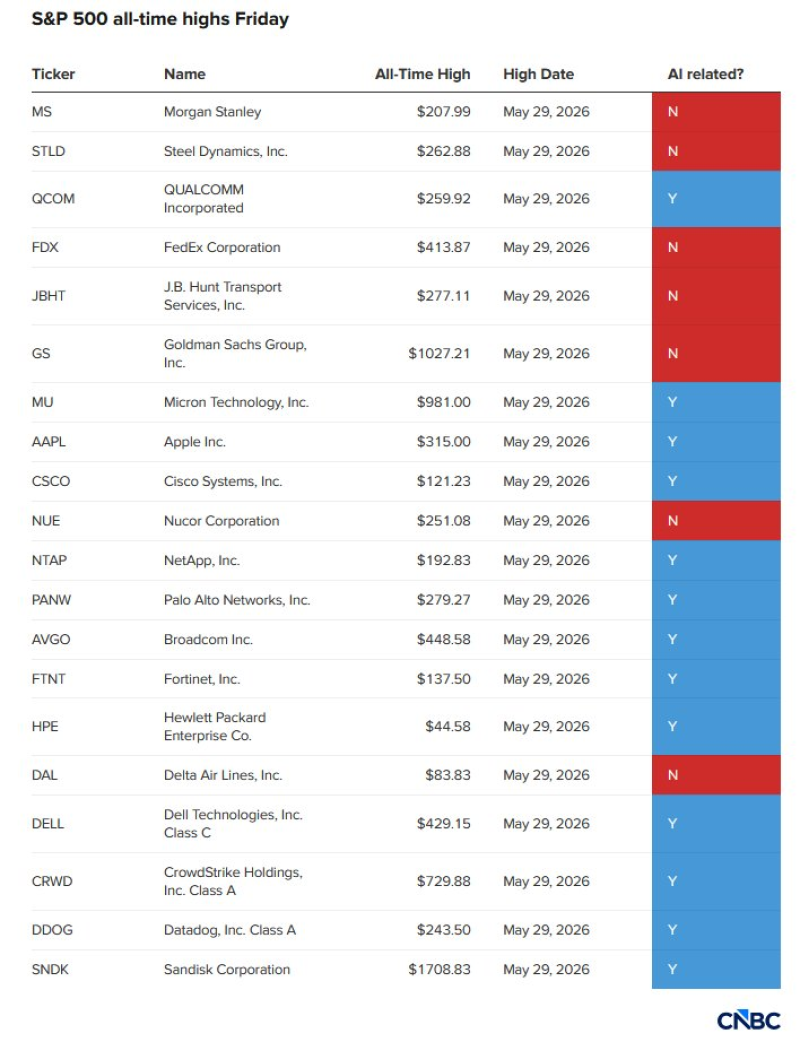
The list includes familiar technology names such as Broadcom, Micron, Qualcomm, Cisco Systems, Dell Technologies, NetApp, CrowdStrike, Palo Alto Networks, Fortinet, Datadog, Hewlett Packard Enterprise, and Sandisk. The significance is not that these companies reached records. It is where they sit in the AI economy.
The First Wave Created the Hype
The first phase of the AI boom was easy to identify. Capital poured into Nvidia as demand for AI accelerators exploded. Microsoft, Amazon, Alphabet, and Meta followed as investors focused on data-center expansion, cloud infrastructure, and AI model development.
That trade remains intact, but the latest all-time highs suggest Wall Street is beginning to look further down the supply chain. Rather than focusing exclusively on the companies building AI models, investors are increasingly backing the businesses that help organizations deploy, manage, secure, and scale AI systems.
The Second Wave Is Infrastructure
The composition of the list reveals where money is moving next. Cisco sells networking equipment needed to handle rising AI-related data traffic. Dell, Hewlett Packard Enterprise, and NetApp provide servers, storage systems, and enterprise infrastructure. CrowdStrike, Palo Alto Networks, and Fortinet secure increasingly complex digital environments. Datadog helps enterprises monitor and manage large-scale workloads.
These businesses rarely dominate AI headlines. Yet they sit at critical points of the AI deployment cycle.
Every new AI application generates additional demand for computing infrastructure, networking capacity, data storage, observability tools, and cybersecurity protection. As companies move from experimentation to implementation, spending naturally expands beyond chips and cloud providers.
That shift is becoming visible in stock prices. Nearly two-thirds of the companies reaching fresh highs on May 29 were tied to AI infrastructure, despite representing only a fraction of the overall S&P 500.
The Rally Is Broader Than Many Assume
The chart also challenges the idea that the market is being carried solely by technology stocks. Morgan Stanley, Goldman Sachs, Steel Dynamics, Nucor, FedEx, J.B. Hunt Transport Services, and Delta Air Lines all joined the list of companies setting new records.
Those names belong to entirely different parts of the economy. Financial firms benefit from healthy capital markets and corporate activity. Industrial and materials companies often reflect investment spending trends. Transportation stocks can provide insight into economic demand and business activity.
Their presence alongside AI infrastructure companies suggests investors are finding opportunities across multiple sectors rather than concentrating capital in a narrow group of mega-cap technology stocks. Market leadership is expanding, not contracting.
What Wall Street May Be Pricing In
Investors already know who won the first phase of the AI boom. The question now is who benefits as AI adoption spreads across the economy. The latest record highs point toward a growing group of infrastructure providers that supply the networks, storage systems, cybersecurity tools, and enterprise platforms needed to support that expansion.
The market is no longer focused exclusively on creating AI. It is increasingly focused on operating AI at scale. That is why companies as different as Broadcom, Cisco, NetApp, Dell, CrowdStrike, and Palo Alto Networks are appearing on the same list of record-setting stocks.
Wall Street is still betting on AI. The difference is that the bet is becoming much broader than it was a year ago.
 Marina Lubimova