Artem Voloskovets

- The AI Value Capture Pyramid
- Infrastructure Is Winning the First Round
- Microsoft Shows How Infrastructure Becomes a Product
- ServiceNow: AI Attached to a Workflow
- JPMorgan: Proprietary Data and Internal Distribution
- Siemens: AI Producing Physical Results
- Duolingo: AI Expanding Product Output
- The Evidence So Far
- The TradeOpus AI Value Matrix
- What Investors Should Measure
- The Next Phase of the AI Trade
That imbalance defines the current AI market. Infrastructure companies are collecting the first wave of spending. The next question is whether they will retain the largest share of the profits — or whether value will move upward toward software, proprietary workflows and industry-specific applications.
The AI Value Capture Pyramid separates the businesses enabling AI from those turning it into recurring revenue and measurable operating results.
The AI Value Capture Pyramid
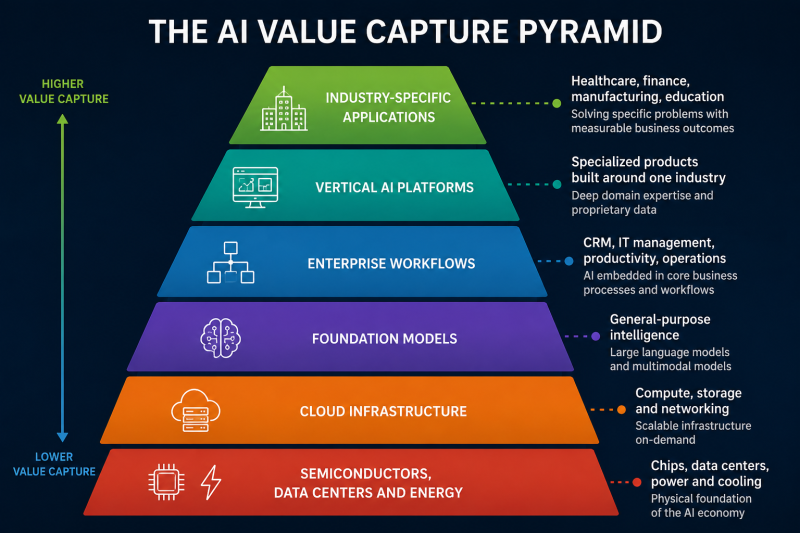
The lower layers require the most capital. The upper layers can develop stronger customer relationships, higher switching costs and more differentiated products.
This does not mean chipmakers or cloud providers will stop growing. It means that infrastructure spending and long-term value capture are not necessarily the same thing.
Infrastructure Is Winning the First Round
Gartner expects worldwide AI spending to rise from roughly $1.76 trillion in 2025 to $2.59 trillion in 2026. Infrastructure remains the largest component because technology companies are building the capacity required to train models and run AI services at scale.
Big Tech’s capital budgets show the scale of the buildout. Microsoft spent $41 billion on capital expenditures in its April–June 2026 quarter. Meta raised its expected 2026 capital spending to $130–145 billion.
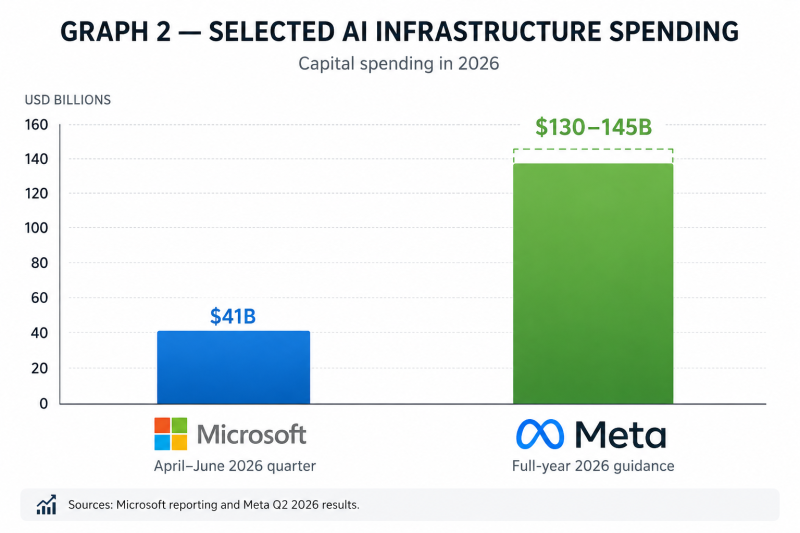
The figures are not directly comparable because one covers a quarter and the other a full year. Together, however, they show how much capital is being committed before the industry has fully established where sustainable AI margins will settle.
Meta’s second-quarter results demonstrate the pressure created by this investment cycle. Revenue increased 28% year over year to $60.8 billion, but free cash flow fell from $8.55 billion to $784 million as infrastructure investment and other expenses rose.
Infrastructure is essential. It is also expensive, continuously depreciating and dependent on sustained demand.
Microsoft Shows How Infrastructure Becomes a Product
Microsoft provides the clearest example of a company operating across several levels of the pyramid.
Its Azure cloud business supplies the infrastructure. Its partnership ecosystem provides access to models. Microsoft 365 Copilot converts those capabilities into a product attached to software already used by businesses.
In Microsoft’s fiscal fourth quarter of 2026:
- Azure revenue grew 43%.
- Microsoft Cloud revenue reached $59.3 billion, up 27%.
- Microsoft 365 Copilot passed 30 million paid seats.
- Annual Azure revenue exceeded $100 billion for the first time.
Microsoft CEO Satya Nadella described the company’s objective as helping customers “turn tokens into business results.”
That phrase captures the central distinction in the AI economy. Tokens are a technical input. Customers pay for completed work, lower costs, faster decisions and higher revenue.
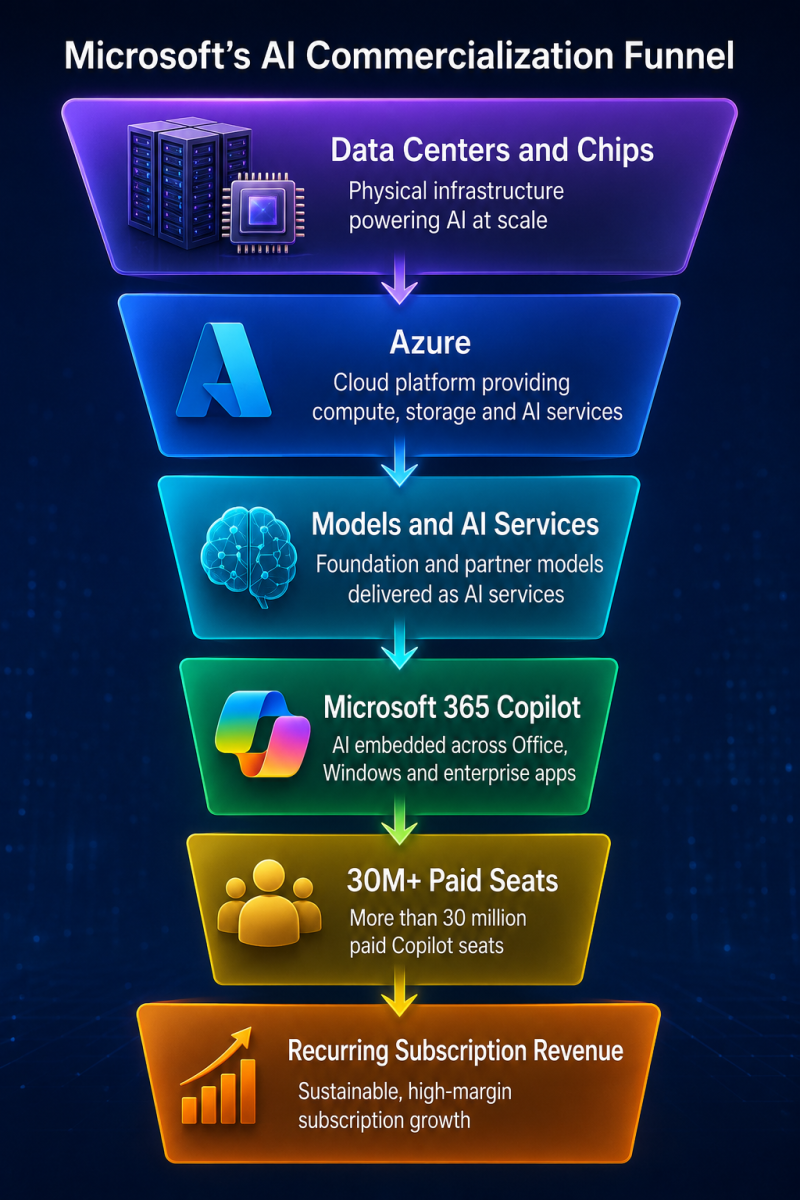
Microsoft is not only selling access to AI. It is distributing AI through software, identity systems, documents, email, meetings and corporate data that customers already use. That position is more defensible than selling undifferentiated compute alone.
ServiceNow: AI Attached to a Workflow
ServiceNow represents a more focused model of AI value capture. The company does not compete primarily by building chips or frontier models. It owns enterprise workflows in IT, customer service, human resources and operations. AI is sold inside those workflows.
In the second quarter of 2026:
- Subscription revenue reached $3.88 billion, up 24.5%.
- Remaining performance obligations reached $29 billion, up 21%.
- ServiceNow’s AI products crossed $1 billion in annual contract value.
This is one of the clearest signs that companies will pay for AI when it is connected to a defined business process. The customer is not buying a general-purpose chatbot. It is buying faster ticket resolution, automated service requests, incident management and workflow execution.
JPMorgan: Proprietary Data and Internal Distribution
JPMorgan demonstrates another path: using AI internally across a large organization with proprietary data and tightly controlled workflows.
The bank introduced its LLM Suite in 2024 and onboarded 200,000 employees within eight months. Employees use the secure platform for research, drafting, idea generation and other knowledge-work tasks.
JPMorgan later reported that:
- More than 90% of its engineers used AI coding assistants.
- More than 65,000 employees in its Corporate and Investment Bank actively used LLM Suite.
- Certain groups of users reported saving several hours per week.
JPMorgan does not need to sell a foundation model to capture value. It can generate a return through lower internal costs, faster product development, better risk analysis and increased employee capacity.
Its advantage comes from combining AI with financial data, compliance systems, institutional knowledge and employee distribution.
Siemens: AI Producing Physical Results
Industrial AI provides some of the strongest examples of measurable value because the output can be connected to equipment uptime, energy consumption and production speed.
Siemens has reported customer outcomes including:
- Up to 67% fewer equipment breakdowns from AI-driven predictive maintenance at Tata Steel Netherlands.
- Up to 55% energy savings from AI-powered data-center cooling at Bank of Montreal.
- Up to 40% faster production ramp-up using digital twins at DMG Mori.
- Up to 20% shorter product time-to-market at Siemens’ digital-native factory in Jiangsu.
These are not improvements in chatbot engagement or model benchmark scores. They are operational metrics with direct financial consequences.
Avoiding a production stoppage can be worth more than reducing the cost of the AI model used to predict it.
Duolingo: AI Expanding Product Output
Duolingo shows how AI can increase the volume of a company’s core product.
The company published:
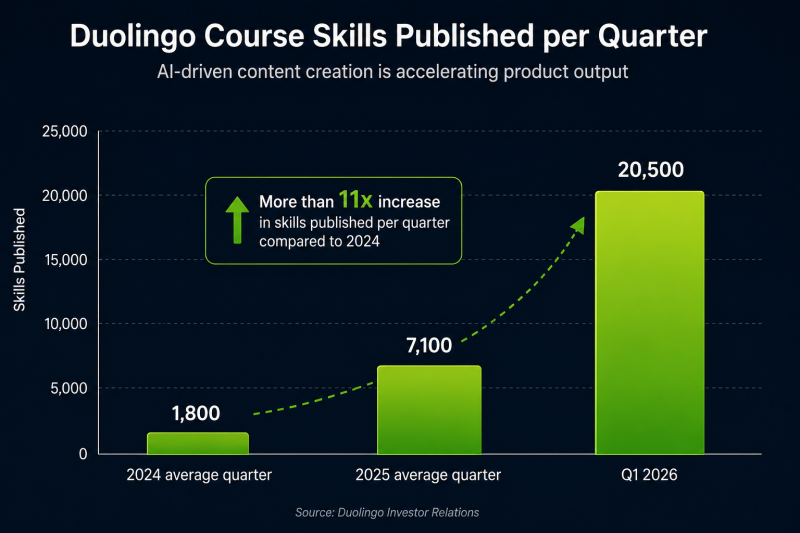
- Approximately 1,800 course skills per quarter in 2024.
- Approximately 7,100 per quarter in 2025.
- 20,500 in the first quarter of 2026.
That is more than an elevenfold increase compared with the 2024 quarterly rate.
Duolingo has also used AI to create features such as roleplay and simulated video conversations. At the same time, the company expects greater AI usage to put pressure on gross margin, which it projected would decline toward approximately 69% by the fourth quarter of 2026.
The case illustrates both sides of AI economics: AI can dramatically increase product output, but inference is not free. A successful application must create enough engagement, subscription revenue or operational efficiency to cover the additional cost.
The Evidence So Far
| Company | AI advantage | Measured result |
| Microsoft | Existing enterprise distribution | 30M+ paid Copilot seats |
| Service | Now | Ownership of enterprise workflows |
| $1B AI annual contract value | JPMorgan | Proprietary data and internal scale |
| 200,000 LLM Suite users | Siemens | Industrial data and operational systems |
| Up to 67% fewer breakdowns | DuolingoAI-assisted content production | 20,500 skills published in Q1 |
The strongest cases share four characteristics:
- Existing distribution. The company already has access to customers or employees.
- Proprietary context. AI operates on company-specific data, systems or expertise.
- Workflow ownership. The product is connected to a task customers already need to complete.
- Measurable output. The benefit appears in revenue, productivity, uptime, cost or speed.
A company does not create a durable AI advantage merely by connecting its product to the same model available to competitors.
The TradeOpus AI Value Matrix
| Layer | Capital intensity | Differentiation | Switching costs | Margin potential | Value-capture outlook |
| Semiconductors | Very high | High | Medium | High | Strong but cyclical |
| Cloud infrastructure | Very high | Medium | High | Medium | Strong at scale |
| Foundation models | Very high | Declining | Low–medium | Uncertain | Competitive |
| Enterprise workflows | Medium | High | High | High | Attractive |
| Vertical AI | Low–medium | Potentially high | High | High | Highest upside, highest execution risk |
| AI-enabled incumbents | Varies | High with proprietary data | High | High | Underappreciated |
This is a qualitative framework, not a recommendation to buy or sell any security.
The most attractive layer is not automatically the one with the fastest revenue growth. Investors must also consider valuation, competition, reinvestment requirements and whether reported AI revenue is incremental or simply replacing existing products.
What Investors Should Measure
The useful question is no longer whether a company “uses AI.” Nearly every large company can make that claim.
The relevant questions are:
- Is AI producing paid revenue or only user activity?
- Does the company control the customer workflow?
- Does it possess data competitors cannot easily reproduce?
- Are productivity gains visible in margins, output or headcount efficiency?
- How much continuing infrastructure investment is required?
- Can customers switch to another model without switching the application?
Microsoft’s paid Copilot seats and ServiceNow’s AI contract value provide evidence of monetization. Siemens provides operational results. Duolingo demonstrates output growth but also exposes the cost of greater inference usage. JPMorgan shows the value of deploying AI inside a proprietary organization without selling it as a standalone product.
Together, these examples suggest that AI value is beginning to move upward through the pyramid.
The Next Phase of the AI Trade
The first phase rewarded scarcity: advanced chips, data-center capacity and access to frontier models. The next phase will reward conversion. The winning companies will convert compute into a product, a product into a workflow and a workflow into recurring cash flow or measurable cost savings.
Infrastructure providers will remain indispensable, but their customers are becoming more important. As models improve and access broadens, competitive advantage is likely to depend increasingly on distribution, proprietary data, workflow integration and execution.
The largest AI businesses may therefore not look like AI laboratories.
They may look like software platforms, banks, manufacturers, healthcare providers or education companies that use AI to produce better economic results than their competitors.
 Artem Voloskovets