Marina Lubimova
- Big Tech’s infrastructure budget
- An AI model sits on top of an industrial system
- Electricity is setting the pace
- Data centers are moving into gigawatt territory
- A GPU cannot operate alone
- Alphabet nearly doubled its spending plan
- Meta is converting advertising cash into compute
- Microsoft’s physical investment is accelerating
- AI weakens the old software margin model
- Infrastructure is becoming a second moat
- The money spreads far beyond AI applications
- The spending carries industrial-scale risks
- Metrics that now matter
- Software now requires an industrial foundation
Software became one of the world’s most profitable businesses because it required relatively few physical assets. A product could be developed once, distributed globally and sold to millions of customers at a low marginal cost.
Generative AI changes that equation. Every chatbot response, generated image and coding suggestion requires servers, accelerators, networking equipment, electricity and cooling. Serving another customer is no longer nearly free: each interaction consumes computing capacity.
The result is visible in Big Tech’s investment budgets. Microsoft added $64.6 billion of property and equipment in fiscal 2025, up from $44.5 billion the previous year. In the first nine months of fiscal 2026, additions had already reached $80.1 billion, compared with $47.5 billion during the same period a year earlier.
Alphabet expects capital expenditure of $175 billion to $185 billion in 2026, almost twice its latest 2025 estimate of $91 billion to $93 billion. Most of that money will fund servers, chips, data centers and networking infrastructure.
Meta spent $72.2 billion on capital expenditure in 2025. Its 2026 forecast is $115 billion to $135 billion, driven primarily by AI compute, data centers and infrastructure for Meta Superintelligence Labs.
These are not software-development budgets. They represent one of the largest physical construction programs in corporate history.
Big Tech’s infrastructure budget
| Company | Latest annual investment | 2026 outlook | Main uses |
| Microsoft | $64.6B in FY2025 | No full-year guidance; $80.1B spent in the first nine months | Data centers, servers, cloud and AI capacity |
| Alphabet | $91B–$93B expected in 2025 | $175B–$185B | Servers, custom chips, buildings and networking |
| Meta | $72.2B in 2025 | $115B–$135B | AI clusters, data centers and superintelligence infrastructure |
| Alphabet and Meta combined | — | $290B–$320B | Mostly physical AI infrastructure |
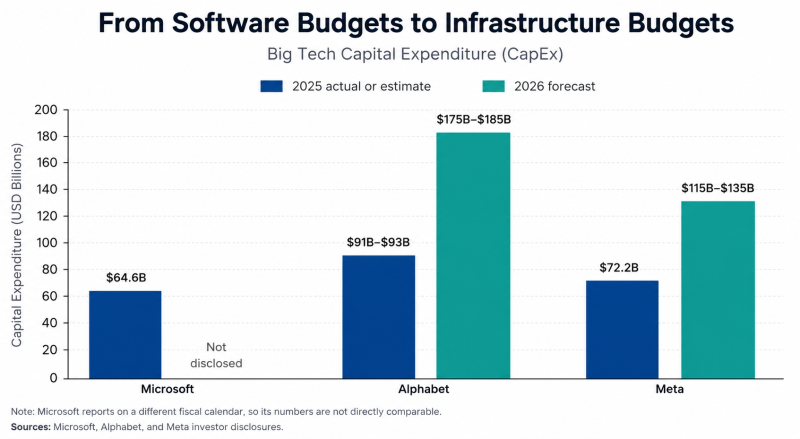
Use the midpoint of each forecast range for the bars and show the full range in the labels. Microsoft reports on a different fiscal calendar, so its number should not be presented as directly comparable without a note.
An AI model sits on top of an industrial system
A modern AI data center is closer to a factory than to a conventional office building. It receives electricity and data, processes them through thousands of accelerators and produces training runs, model responses and cloud services. Microsoft CEO Satya Nadella has described this network as a “planet-scale cloud and AI factory.”
The term is accurate. An AI product depends on a chain of physical assets:
Power generation → transmission lines → substations → transformers → data centers → cooling → servers → accelerators → fiber networks → AI models → applications
Code occupies the top of the stack. Most of the capital is spent underneath it. Alphabet has said that roughly 60% of its technical-infrastructure investment goes toward servers and chips, while approximately 40% funds data centers and networking equipment.
Even before accounting for the manufacturing plants that produce processors and electrical components, a substantial share of AI spending is tied to land, buildings, power systems and communications hardware.
Electricity is setting the pace
Global data centers consumed about 415 terawatt-hours of electricity in 2024, according to the International Energy Agency. That was approximately 1.5% of global electricity consumption.
The IEA expects demand to reach about 945 TWh by 2030 — more than double the 2024 level and slightly above Japan’s current annual electricity use.
That implies average annual growth of roughly 15%, more than four times the expected rate for the rest of the global economy.
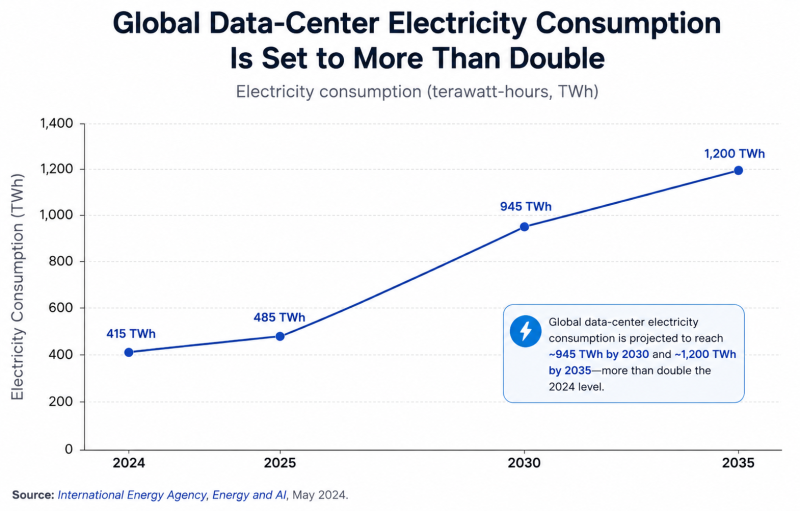
The global share understates the local pressure. Data centers are concentrated around a limited number of power networks, so their effect on individual regions can be much larger. US data-center electricity use is projected to increase by roughly 240 TWh between 2024 and 2030, a rise of about 130%. The sector could account for nearly half of US electricity-demand growth during that period.
By 2030, US data centers may consume more electricity than the country uses to manufacture aluminium, steel, cement, chemicals and other energy-intensive goods combined.
Grid capacity is therefore becoming a practical limit on AI deployment. A company may have land, financing and access to chips but still wait years for a transmission connection or substation upgrade.
This is why Microsoft, Google and Meta are signing long-term power contracts, supporting nuclear projects and placing new campuses in regions where large blocks of electricity remain available.
Data centers are moving into gigawatt territory
Microsoft’s Fairwater AI campus in Wisconsin is designed to reach two gigawatts of capacity. The company also expects its AI capacity to increase by more than 80% within a year and its total data-center footprint to roughly double over two years.
One gigawatt of continuous demand equals 8.76 TWh per year. At full utilization, a two-gigawatt complex would use approximately 17.5 TWh annually. That comparison does not mean the campus will always operate at maximum load, but it shows the scale involved. A single AI complex can require an electricity supply comparable to that of a small country.
The building itself may no longer be the slowest part of the project. Connecting it to the grid can require new substations, high-voltage lines, transformers and generation capacity. The critical construction schedule is increasingly the grid schedule.
A GPU cannot operate alone
Accelerators receive most of the attention because they perform the calculations. Their supporting systems determine whether those calculations can happen at all.
| Infrastructure layer | Function |
| Transformers and substations | Convert and distribute electricity at the required voltage |
| Switchgear | Protect and control electrical systems |
| Cooling equipment | Removes heat generated by dense accelerator clusters |
| Backup generation and storage | Keeps facilities operating during grid disturbances |
| Fiber-optic networks | Connect servers and move data between locations |
| Land and water | Support large campuses and some cooling designs |
| Construction and engineering | Deliver complex facilities on compressed timelines |
These components were once treated as background infrastructure. Their availability now determines when expensive chips can begin producing revenue.
Microsoft reported that it reduced the time required to move equipment from the delivery dock into live operation by 20% during fiscal 2026.
That is not a software metric. It is a factory-deployment metric. Purchasing accelerators is only the first step. Competitive advantage also comes from installing, connecting and operating them faster than rivals.
Alphabet nearly doubled its spending plan
Alphabet began 2025 expecting capital expenditure of approximately $75 billion. It raised the forecast to $85 billion in July as server purchases increased and data-center construction accelerated. By October, the range had risen again to $91 billion to $93 billion.
Its 2026 forecast then jumped to $175 billion to $185 billion. At the midpoint, Alphabet would invest about $180 billion in one year — nearly twice the latest 2025 estimate. The money will support Gemini, Google Cloud, AI-powered Search and other products. It will also expand Alphabet’s custom-chip capacity, including its Tensor Processing Units.
Alphabet’s disclosures define technical infrastructure as servers, networking equipment, land, buildings and data-center construction. Its AI investment is therefore not an abstract research budget. It is a program for expanding physical computing supply.
The company that built its business around a search algorithm is now competing through chips, power contracts and industrial-scale construction.
Meta is converting advertising cash into compute
Meta earns most of its revenue from advertising displayed across Facebook, Instagram and its other platforms. Its spending pattern is becoming much more capital-intensive. Capital expenditure reached $72.2 billion in 2025, including finance-lease payments. Meta expects to spend between $115 billion and $135 billion in 2026.
That would be an annual increase of approximately 59% to 87%. At the midpoint of the range, Meta would invest around $125 billion — more than its total operating costs and expenses of $117.7 billion in 2025.
The comparison is not exact because capital expenditure is recorded over the useful life of an asset rather than immediately as an expense. It nevertheless shows the scale of the program.
Meta is using advertising profits to finance:
- larger recommendation systems;
- generative-AI products;
- Llama model development;
- training infrastructure;
- Meta Superintelligence Labs;
- a private network of data centers and computing clusters.
Its products remain digital. The system supporting them increasingly resembles an industrial base.
Microsoft’s physical investment is accelerating
Microsoft has operated data centers for years, but AI is pushing its capital requirements to a different level. Additions to property and equipment increased from $44.5 billion in fiscal 2024 to $64.6 billion in fiscal 2025, a rise of about 45%.
The expansion accelerated again in fiscal 2026.
| Period | Additions to property and equipment |
| FY2024 | $44.5B |
| FY2025 | $64.6B |
| First nine months of FY2025 | $47.5B |
| First nine months of FY2026 | $80.1B |
The year-over-year increase for the first nine months of fiscal 2026 was approximately 69%.
Microsoft also reported that its AI business had exceeded an annual revenue run rate of $37 billion, with growth of 123% year over year. That suggests the infrastructure is generating commercial activity, although it does not yet prove that the full investment program will earn an adequate return.
Nadella summarized the shift directly:
We’re investing more in CapEx than ever before.
Microsoft plans to rebuild each layer of its technology stack around AI, beginning with infrastructure and extending through models, applications and agents.
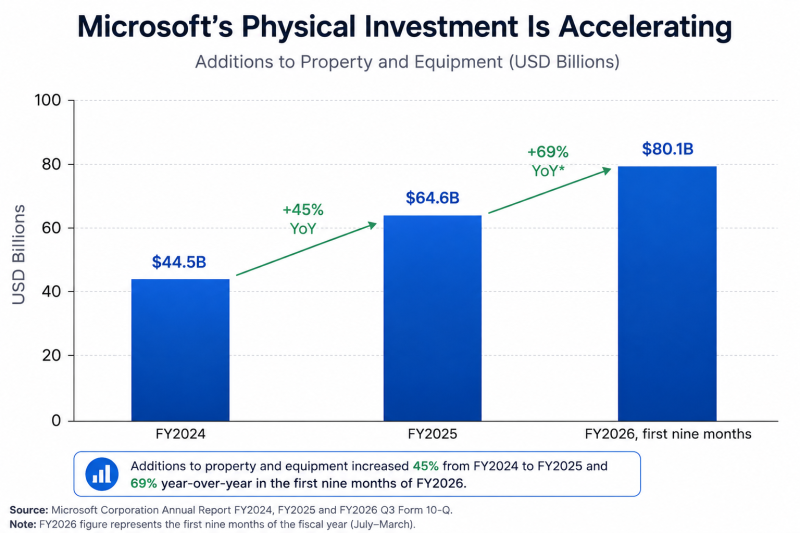
The final bar must be marked as a nine-month figure rather than a full fiscal year.
AI weakens the old software margin model
Traditional software produces high margins because one product can be copied and distributed at little additional cost. AI inference requires new computation for every task.
Another user, a longer answer, a high-resolution image or a more complex reasoning process consumes additional accelerator time, electricity and cooling. Efficiency gains can lower those costs, but they do not eliminate them.
The economics depend on:
- revenue generated per unit of compute;
- accelerator utilization;
- electricity and cooling costs;
- the useful life of processors;
- the pace of model-efficiency improvements;
- the price customers will pay for AI services.
Microsoft has already reported pressure on corporate gross margin from AI-infrastructure investment and higher usage of AI products.
For software companies, product-market fit is no longer enough. They must also manage power prices, construction schedules, hardware depreciation and asset utilization.
Infrastructure is becoming a second moat
Microsoft, Alphabet and Meta have not replaced software development with construction. They continue to spend heavily on engineers, models, data and security. The change is that software alone is no longer sufficient.
A competitor may copy an AI feature or reproduce an interface. Replicating the underlying infrastructure is much harder:
- a global data-center network;
- access to hundreds of thousands of accelerators;
- long-term electricity contracts;
- custom processors;
- high-capacity fiber connections;
- specialized cooling systems;
- experience building across several jurisdictions.
The largest technology companies are creating a physical barrier beneath their software advantage.
Capital spending does more than increase capacity. It raises the cost of entering the market and makes smaller AI companies more dependent on infrastructure owned by the same firms they compete with.
The money spreads far beyond AI applications
Big Tech’s capital spending creates revenue across a long industrial chain. A dollar allocated to AI infrastructure can reach:
- semiconductor designers;
- chip foundries;
- server manufacturers;
- networking suppliers;
- cooling companies;
- electrical-equipment producers;
- utilities;
- construction and engineering firms;
- optical-component manufacturers;
- landowners and data-center operators.
These suppliers do not need to predict whether Copilot, Gemini, Meta AI or another model will dominate the consumer market. They benefit when total computing capacity expands.
The closest historical comparison is not an application launch. It is the sale of machinery during an industrial buildout.
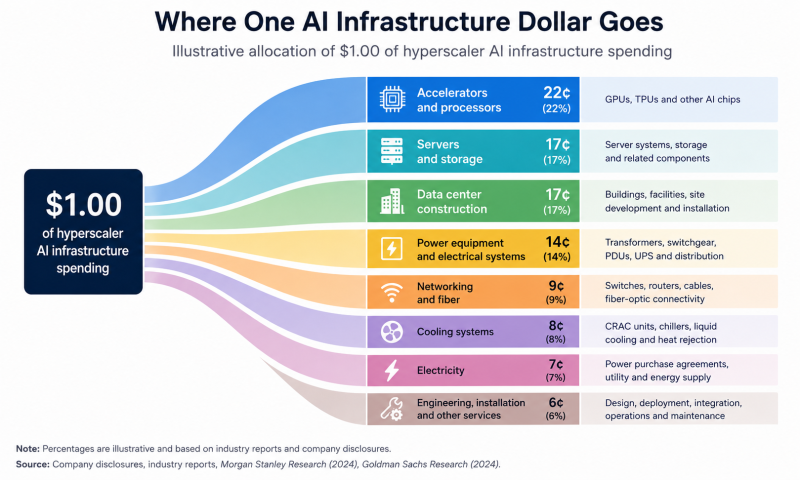
Exact industry-wide percentages should not be shown without a reliable source. Alphabet’s disclosed split of approximately 60% for chips and servers and 40% for data centers and networking can be presented separately as an Alphabet-specific example.
The spending carries industrial-scale risks
The size of these projects creates risks that software companies historically faced only in limited form.
Excess capacity
Big Tech could build more infrastructure than customers are willing to pay for. Faster models and more efficient chips could also reduce the computing needed for some tasks.
Short hardware cycles
Data-center buildings may operate for decades, but accelerators can lose economic relevance within a few years. Companies must recover their investment before the hardware becomes uncompetitive.
Grid delays
A completed facility cannot operate without power. Transmission connections, substations, transformers and permits can delay projects even when construction is finished.
Lower margins
AI revenue can rise while profitability weakens if inference remains expensive or competition drives prices down.
Greater concentration
Only a small number of companies can internally fund annual infrastructure budgets exceeding $100 billion. Smaller developers may have to rent computing capacity from their largest competitors.
AI may broaden the software market while concentrating the infrastructure underneath it.
Metrics that now matter
Model benchmarks show technical performance but reveal little about the economics of running AI at scale.
Investors should also monitor:
| Metric | What it reveals |
| Capital-expenditure growth | The pace of capacity expansion |
| Property and equipment additions | The scale of physical infrastructure being created |
| Secured power capacity | How much compute can be connected and operated |
| Construction pipeline | Future data-center availability |
| Accelerator utilization | Whether expensive hardware is generating revenue |
| Depreciation growth | The cost of the expanding asset base |
| Cloud backlog | Whether customer commitments support the investment |
| AI revenue and gross margin | Whether new capacity is producing acceptable returns |
Spending the most does not guarantee leadership. The relevant question is which company can turn infrastructure into revenue, cash flow and a lasting cost advantage before its equipment becomes obsolete.
Software now requires an industrial foundation
The first generation of software companies created value by separating digital products from physical production. AI reconnects the two.
Models consist of code and mathematics, but operating them at scale requires concrete, copper, steel, land, electricity, water and industrial equipment. That is why Microsoft describes data centers as AI factories. It is why Alphabet may spend $185 billion in one year. It is why Meta is prepared to invest as much as $135 billion in infrastructure supporting products that appear entirely digital.
Microsoft, Google and Meta remain software companies. But their ability to compete increasingly depends on assets traditionally associated with utilities, manufacturers and property developers.
The decisive AI advantage may not be the company with the best model. It may be the company that can power, cool and deploy the most compute at the lowest cost.
 Marina Lubimova