Marina Lubimova
Meta changed that conversation. While the company's projected $130–145 billion in capital expenditure for 2026 attracted most headlines, another figure hidden in its regulatory filing reveals a much bigger story. Meta disclosed approximately $696 billion in future contractual commitments and lease obligations tied largely to AI infrastructure.
Unlike annual CapEx guidance, these aren't management ambitions. They're legal commitments. Contracts have been negotiated, leases have been signed, and infrastructure has already been reserved.
That distinction matters because it changes how investors should think about the AI race. The biggest technology companies are no longer making short-term investment decisions. They're building infrastructure that may not reach full utilization for years.
Annual CapEx Tells Only Half the Story
Annual capital expenditure measures how much a company expects to invest during a given year. Future commitments measure something different: how much infrastructure has already been secured regardless of when cash ultimately leaves the balance sheet.
Meta's disclosure combines several categories of long-term obligations.
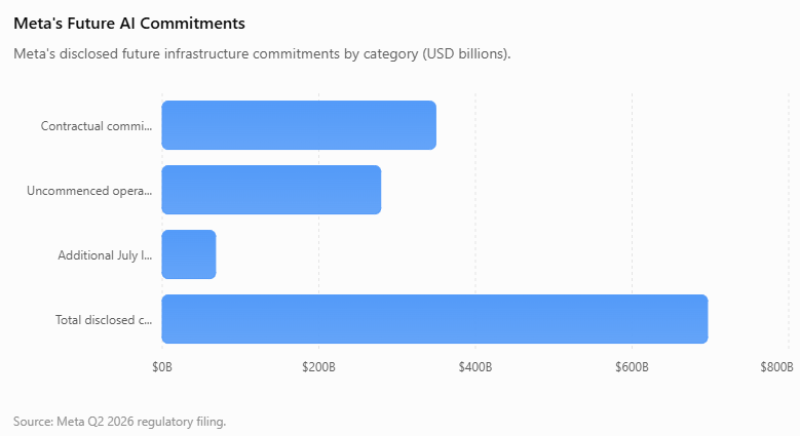
A stacked bar comparing lease obligations, contractual commitments and additional July agreements.
These categories follow different accounting rules, and they should not be interpreted as one giant capital expenditure budget. But together they describe something much more valuable than next year's spending forecast: infrastructure capacity that Meta has already locked in.
Many of these agreements stretch well into the next decade. Some leases extend as long as thirty years. That tells investors something annual CapEx never can. Meta isn't reacting to demand anymore. It's committing to supply years before demand fully exists.
Buying Compute Before Customers Need It
Technology companies traditionally expanded infrastructure only after demand became visible. Cloud providers added servers as customers consumed more computing power. Streaming companies built data centers as traffic increased. Retailers expanded logistics networks as online orders grew.
AI has reversed that sequence. Today, infrastructure comes first. Revenue is expected to catch up later.
Meta is reserving data-center capacity, networking equipment, cloud infrastructure, power and cooling systems long before anyone knows exactly how large the commercial AI market will become.
That changes the nature of investment risk. If AI adoption accelerates, companies with available compute gain an enormous competitive advantage. If demand disappoints, those same companies are left carrying billions of dollars of underutilized infrastructure. Either outcome is possible. Meta has already chosen which scenario it believes is more likely.
Facebook Is Financing an AI Utility
One detail often disappears behind discussions about AI. Meta still earns almost all of its money from advertising. Facebook, Instagram, WhatsApp and Threads continue to generate extraordinary cash flows. Those businesses, not AI subscriptions, are paying for today's infrastructure build-out.
This creates an unusual transition. For twenty years Meta was an asset-light software company. Today it is becoming one of the world's largest private investors in physical infrastructure.
| Then | Now |
| Digital products | Power-intensive infrastructure |
| Advertising platform | AI infrastructure platform |
| Software assets | Physical assets |
| Algorithms | Data centers |
| User growth | Compute growth |
The transformation is larger than adding more GPUs. Building frontier AI requires land, electricity, cooling systems, fiber connections, substations, networking equipment and thousands of specialized servers. These projects take years to complete and often require commitments long before construction even begins.
Software scales almost instantly. Infrastructure doesn't. That difference increasingly defines the economics of artificial intelligence.
AI Is Already Reshaping Meta's Cash Flow
Income statements still paint the picture of an exceptionally profitable company. Cash flow tells a different story.
Meta generated nearly $31.9 billion in operating cash flow during the latest quarter. Almost the entire amount was absorbed by capital expenditure and finance lease payments, leaving free cash flow at less than $1 billion.
A year earlier, free cash flow exceeded $8.5 billion. The advertising business isn't weakening. Infrastructure spending is simply growing much faster.
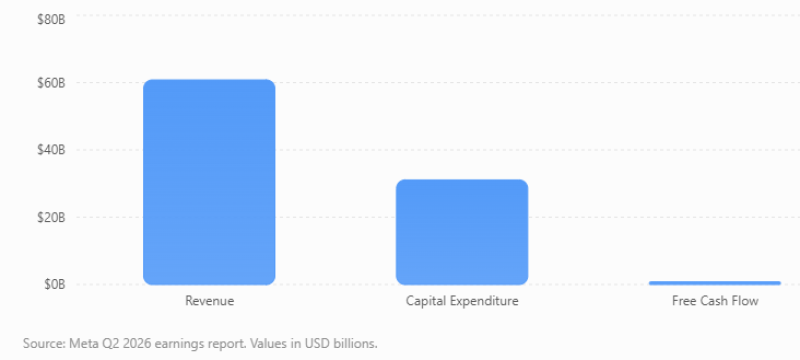
Suggested chart showing revenue growth alongside rising CapEx and collapsing free cash flow. This may become the defining financial pattern of the AI era. Technology companies are no longer converting higher revenue into higher free cash flow. They're converting higher revenue into larger infrastructure programs. For years investors rewarded software companies because they generated exceptional returns with relatively little physical investment.
AI changes that equation. The industry's biggest winners increasingly resemble utilities, telecommunications operators or industrial manufacturers — businesses that require enormous upfront investment before producing long-term returns.
For Meta, the question is no longer whether it can afford the spending. The company clearly can. The question is whether the infrastructure being built today will generate returns large enough to justify commitments already locked in years before the AI economy fully matures.
Suppliers Get Paid First
Meta's future returns remain uncertain. Its suppliers face much less uncertainty. Every new AI cluster translates into orders for semiconductor manufacturers, networking vendors, power-equipment companies, cooling specialists, construction firms and utilities. Meta assumes the commercial risk. Much of the supply chain gets paid long before that risk is resolved.
This is one of the defining characteristics of the current AI investment cycle. Software companies are financing an industrial expansion that reaches far beyond Silicon Valley.
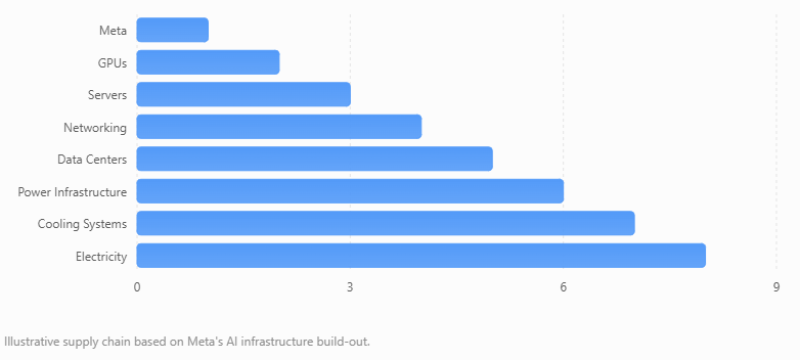
Each layer creates revenue for a different group of companies. NVIDIA sells accelerators. TSMC manufactures advanced chips. Broadcom supplies networking silicon. Arista Networks builds high-speed switching equipment. Vertiv and Schneider Electric provide cooling and power infrastructure. Utilities expand electrical capacity.
Construction firms build campuses that increasingly resemble power stations more than office parks. That means Meta's commitments are also a roadmap for where AI spending will flow over the next several years. The AI race isn't creating one winner. It's creating an entire industrial ecosystem.
AI Is Becoming an Infrastructure Business
Software companies competed by writing better code. Today they compete by securing scarce physical resources. The new bottlenecks are no longer software engineers or cloud instances available on demand. They are land with access to high-voltage transmission lines.
Electricity that can support gigawatt-scale campuses. Advanced semiconductor packaging. Optical networking. Cooling systems. Construction capacity. These are constraints more commonly associated with energy projects than internet companies.
That shift explains why Meta is willing to sign agreements measured in hundreds of billions of dollars. Waiting until demand becomes obvious may mean discovering that the necessary infrastructure has already been reserved by someone else.
The AI leaders of the next decade may not simply be those with the best models. They may be the companies that secured enough compute before everyone else realized it would become scarce.
Could Meta Eventually Sell Compute?
Meta has hinted that not all of the infrastructure it is building will be used internally. As capacity expands, the company could offer computing resources or AI services to external customers, creating an additional revenue stream beyond advertising.
The idea is strategically attractive. If Meta builds more compute than its own applications immediately require, selling excess capacity could improve utilization while spreading fixed costs across a broader customer base.
But becoming an infrastructure provider is very different from becoming an infrastructure owner.
Running a cloud platform requires enterprise sales teams, developer tools, service-level agreements, customer support and global operations. Those capabilities have taken Amazon Web Services, Microsoft Azure and Google Cloud more than a decade to develop.
Owning data centers is only the first step. Turning them into a profitable infrastructure business is a much harder challenge.
Four Numbers That Matter
Quarterly earnings will continue to focus on revenue, earnings per share and capital expenditure. Those metrics remain important, but they no longer tell the whole story. The next phase of Meta's AI strategy will be defined by four questions.
1. Does AI continue to improve advertising economics?
Meta's core business must keep generating enough incremental profit to finance one of the largest infrastructure programs ever undertaken by a technology company.
2. Do new AI products generate meaningful revenue?
Personal AI assistants, business agents, messaging tools and enterprise services need to become material businesses rather than promising experiments.
3. Is infrastructure being fully utilized?
Signing long-term leases is one thing.
Keeping those facilities busy for decades is another.
Low utilization would quickly turn today's strategic advantage into tomorrow's financial burden.
4. Does free cash flow recover?
Investors will eventually expect infrastructure spending to produce operating leverage rather than consume nearly all available cash.
Until that happens, every new commitment raises the threshold AI must clear to justify the investment.
A Different Kind of Technology Company
Meta's nearly $700 billion in disclosed commitments should not be viewed as a prediction of future spending. They are evidence that the company has already made a strategic decision. The AI race is no longer being fought only in research labs.
It is being fought through power contracts, construction schedules, semiconductor supply, network capacity and long-term leases. The technology industry was built on the idea that software scaled without heavy physical investment. Artificial intelligence is rewriting that assumption.
The companies shaping the next decade are pouring capital into assets that look less like traditional technology investments and more like national infrastructure projects. Meta has become one of the clearest examples of that shift.
Its advertising platforms still generate the cash. Its balance sheet is increasingly financing concrete, steel, fiber, electricity and silicon. Whether that strategy delivers exceptional shareholder returns remains an open question.
What already seems clear is something larger. The next generation of technology leaders may not be determined solely by who builds the smartest model.
They may be determined by who secured the land, power, chips and data centers before everyone else realized those resources would become the world's most valuable competitive advantage.
 Marina Lubimova