Marina Lubimova
- Commercial Revenue Is Carrying More of the Valuation
- Scarcity Explains the Premium Better Than Earnings
- One Transaction Could Lift Prices Across the League
- The Return Profile Is Difficult at $6 Billion
- AI Can Lower the Cost of Global Fan Monetization
- The Platform Comparison Has Limits
- The Deal Depends on Revenue That Does Not Yet Exist
At that price, the buyer would not be purchasing a conventional football business. The valuation assumes that Liverpool can extract more revenue from its global audience through sponsorships, licensing, digital products and personalized content — without losing the sporting success that supports the brand. The financial case rests on a clear shift in Liverpool’s revenue mix.
Commercial Revenue Is Carrying More of the Valuation
Liverpool’s total revenue increased from £417 million in 2018 to £620 million in 2025, a rise of almost 49%. Commercial income grew from £168 million to £265 million, an increase of roughly 58%. Broadcast revenue rose more slowly, from £177 million to £235 million, while matchday revenue advanced from £72 million to £120 million.
The pandemic distorted the middle of the period. Matchday income nearly disappeared in 2021, while broadcast revenue reached £227 million as delayed fixtures and media payments shifted between reporting periods. By 2025, however, all three divisions were above their pre-pandemic levels.
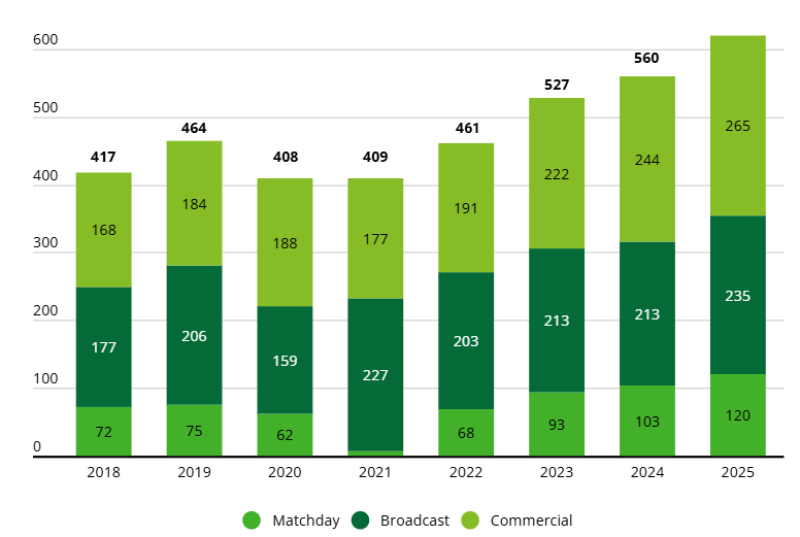
Commercial revenue accounted for about 43% of the 2025 total, compared with 38% from broadcasting and 19% from matchday operations. It was the club’s largest revenue source.
That mix is central to the $6 billion case. Broadcast distributions are large but constrained by league-level agreements and sporting results. Commercial income offers more room for club-specific growth through sponsorship contracts, retail, licensing and international partnerships.
Liverpool is therefore becoming less dependent on television rights, but it is not yet a high-margin platform business. Revenue growth still requires spending on players, wages, facilities and global operations.
Scarcity Explains the Premium Better Than Earnings
Current revenue alone does not support a $6 billion price without a substantial premium. Liverpool is one of a limited number of clubs combining Premier League access, a global fan base, historic success and regular participation in European competition. Investors cannot reproduce that combination by launching a new team or acquiring a smaller club and increasing its marketing budget.
The scarcity premium is real, but it also complicates valuation. Buyers are not comparing Liverpool only with other football clubs. They are comparing it with NFL, NBA and other major sports franchises whose values have increased despite modest cash yields.
That encourages buyers to accept low near-term returns in exchange for long-term asset appreciation.
One Transaction Could Lift Prices Across the League
A completed deal would create a reference point for other Premier League owners. Clubs with comparable international reach could use the Liverpool valuation in minority-stake sales, refinancing negotiations and future takeover discussions. Even teams with weaker commercial profiles may benefit because the transaction would raise the implied value of Premier League membership itself.
This does not mean every club suddenly becomes more profitable. It means sellers gain a stronger benchmark.
The effect could be especially pronounced for minority investments, where buyers often pay for access to an asset without receiving full operating control.
The Return Profile Is Difficult at $6 Billion
A financial investor entering at this valuation has limited room for conventional operational improvement.
Cutting player spending may improve short-term cash flow but weaken results, Champions League qualification and sponsorship value. Cost reduction can therefore damage the revenue base it is intended to protect.
The alternative is continued top-line expansion:
- larger sponsorship contracts;
- premium hospitality;
- international retail and licensing;
- direct-to-consumer subscriptions;
- more efficient monetization of supporter data;
- digital products built around matches and players.
Those opportunities exist, but much of their expected value is already embedded in the purchase price. The investor must generate growth fast enough to justify the premium or rely on a future buyer accepting an even higher valuation.
AI Can Lower the Cost of Global Fan Monetization
Liverpool produces far more content than it can distribute manually. Each match generates highlights, interviews, statistics, tactical analysis and player-specific material. Generative AI can convert that content into multiple languages, formats and audience segments at a lower cost.
A single match package can be adapted by geography, platform, player preference or sponsor. AI can also support ticket pricing, merchandise recommendations, sponsorship measurement and customer segmentation. The opportunity is not to create more football. It is to produce more commercial inventory from the same event.
This could make Liverpool’s international audience more valuable, particularly in markets where local-language production was previously too expensive. However, AI-driven content growth will matter only if it produces measurable gains in subscriptions, sponsorship pricing or merchandise sales.
The Platform Comparison Has Limits
Liverpool has several characteristics associated with consumer platforms: a large user base, high engagement, strong identity and recurring content. It does not have platform-level control over its economics.
The Premier League sells media rights collectively. UEFA revenue depends on qualification and performance. Financial regulations constrain spending, while football authorities can alter competition formats and ownership rules.
The club also depends on expensive human talent. Unlike software, football content cannot scale without maintaining a competitive squad. Investors are therefore paying a platform-like valuation for an asset operating inside a regulated league structure.
The Deal Depends on Revenue That Does Not Yet Exist
Liverpool’s revenue growth supports a higher valuation than several years ago. The strongest evidence is the expansion of commercial income, which reached £265 million in 2025 and became the club’s largest segment. It does not remove the valuation risk.
A price above $6 billion assumes that commercial revenue will continue growing faster than broadcasting, that digital tools will improve monetization and that sporting performance will remain strong enough to protect the brand.
The buyer would be paying for Liverpool’s current audience and for the future products that can be sold to it. That makes the proposed deal less a judgment on today’s football economics than a wager on how efficiently one of the sport’s largest global audiences can be monetized.
 Marina Lubimova