Marina Lubimova

At first glance, this looks like another generic drug launch. In reality, it marks the beginning of a rapid transfer of one of the hospital sector's most valuable anesthetic products from a single branded supplier to multiple generic manufacturers.
More importantly, it highlights where competition in the generic pharmaceutical industry is moving: away from commodity tablets and toward technically demanding sterile injectables.
A $1.6 Billion Market Opens Overnight
According to Glenmark, citing IQVIA data, the U.S. market for Bridion and its therapeutically equivalent products generated approximately $1.6 billion in sales during the 12 months ending May 2026.
Unlike many generic launches that enter mature, low-growth markets, Glenmark is targeting a product category that remained commercially significant until the final day of patent protection.
Merck's own results illustrate why.
| Year | Worldwide Bridion Sales |
| 2023 | $1.842 billion |
| 2024 | $1.764 billion |
| 2025 | $1.841 billion |
After a decline in 2024 driven by international generic competition, Bridion returned to growth in 2025 as U.S. demand and favorable pricing offset pressure in overseas markets.
That resilience explains why generic manufacturers were prepared to enter the market as soon as exclusivity expired.
Five Years of Preparation for a One-Day Launch
Glenmark's commercial launch was anything but sudden. The FDA granted tentative approval for the company's abbreviated new drug application in May 2021, confirming that its product was therapeutically equivalent to Bridion. Commercialization, however, remained blocked by Merck's patent protection.
The delay lasted more than five years. Merck successfully defended its patent term extension in federal court and later secured an additional six months of pediatric exclusivity, keeping generic competitors out of the U.S. market until July 27, 2026.
Only after those protections expired could companies such as Glenmark begin commercial sales.
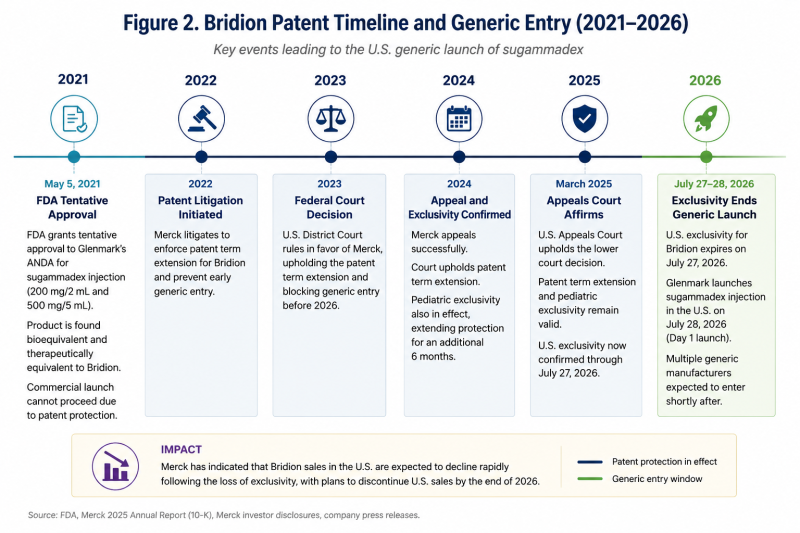
This timeline reflects a broader trend in pharmaceuticals: by the time a generic product reaches the market, years of regulatory work, manufacturing validation and legal disputes have already taken place behind the scenes.
Merck Expected This Shift
The arrival of generic sugammadex was not an unexpected disruption. Merck warned investors that Bridion would face rapid generic competition once exclusivity ended and indicated that U.S. sales could decline sharply. The company also disclosed plans to discontinue Bridion sales in the United States by the end of 2026.
That changes the competitive landscape. Instead of trying to capture incremental market share from an entrenched brand, generic manufacturers are competing to replace the branded product altogether.
For Glenmark, the opportunity is not limited to offering a lower-priced alternative. It is participating in the restructuring of an entire hospital drug category.
Sterile Injectables Follow Different Economics
Most generic medicines compete in crowded markets where manufacturing is relatively straightforward and price erosion begins quickly. Sterile injectables operate under different conditions.
Production requires:
- aseptic manufacturing facilities;
- validated sterilization processes;
- specialized packaging;
- continuous regulatory oversight;
- rigorous quality control.
These requirements reduce the number of qualified manufacturers and increase the cost of maintaining production capacity.
| Conventional Generic Tablets | Sterile Injectable Generics |
| Simple manufacturing | Complex aseptic production |
| Large number of competitors | Limited number of suppliers |
| Rapid price erosion | More gradual pricing pressure |
| Retail pharmacy distribution | Hospital procurement |
| Easier production expansion | High capital requirements |
As a result, competitive advantage depends on more than price. Manufacturing consistency, regulatory compliance and supply reliability often become equally important.
Reliability Can Matter More Than Price
Hospital buyers want competitive pricing, but uninterrupted supply is often the deciding factor.
FDA analyses show that manufacturing and quality issues remain among the leading causes of drug shortages, particularly for sterile injectable medicines. Production delays, component shortages and quality failures can remove critical products from the market for extended periods.
That makes supply resilience a commercial advantage rather than simply an operational requirement. For Glenmark, launching both the 200 mg and 500 mg presentations immediately provides hospitals with a product range matching the original Bridion portfolio.
Whether that translates into market share will depend less on launch timing than on the company's ability to maintain uninterrupted production.
Competition Will Expand Quickly
Glenmark is unlikely to remain the only supplier for long. Merck disclosed settlement agreements with multiple generic manufacturers, while B. Braun has already announced commercialization of its own FDA-approved generic sugammadex.
The result will not be a winner-takes-all market.
Instead, hospitals will have multiple suppliers offering therapeutically equivalent products, forcing manufacturers to compete through pricing, contracting, inventory management and manufacturing performance.
The competitive advantage will gradually shift from regulatory approval to operational execution.
What the Launch Says About Glenmark
Sugammadex alone will not redefine Glenmark's business. Its strategic importance lies elsewhere.
The launch demonstrates that the company is expanding into higher-value hospital medicines where technical complexity limits competition and where manufacturing capabilities can become a long-term competitive asset.
That approach also reduces exposure to heavily commoditized oral generics, where margins have been compressed for years. For companies capable of operating complex sterile manufacturing facilities, injectable generics offer one of the few segments where scale, quality and regulatory expertise can still create durable advantages.
The Bigger Story
Glenmark's launch is not simply another generic approval reaching pharmacy shelves. It marks the opening of a $1.6 billion U.S. market that had been protected by patents until the end of July 2026.
The companies entering that market are competing for far more than short-term pricing opportunities. They are positioning themselves in one of the pharmaceutical industry's most technically demanding and strategically valuable segments.
As generic competition intensifies, success will depend less on who enters first and more on who can manufacture consistently, secure hospital contracts and keep products available when operating rooms need them most.
 Marina Lubimova