Marina Lubimova
- At a Glance
- Imagine Buying a Smartphone That Already Comes With Digital Dollars
- The Biggest Advantage Isn't Blockchain—It's Distribution
- Why Haven't Stablecoins Become Mainstream Yet?
- What Could Using Stablecoins Actually Look Like?
- Samsung Isn't Starting From Scratch
- Why USDC Makes Sense
- Stablecoins Are Becoming Part of the Payment Industry
- Samsung vs. the Competition
- What Samsung Still Hasn't Told Us
At a Glance
| Company | Samsung |
| Product | Samsung Wallet |
| Digital asset demonstrated | USDC |
| Functions shown | Send • Receive • Top Up |
| Potential ecosystem | More than 1 billion active Samsung devices |
| Issuer partner | Not yet announced |
| Launch timeline | Not disclosed |
Imagine Buying a Smartphone That Already Comes With Digital Dollars
For most people, using stablecoins still means opening a cryptocurrency exchange, creating a wallet, learning about blockchain networks and worrying about recovery phrases.
Samsung's vision is different.
Instead of asking consumers to enter the crypto world, the company wants crypto to appear inside a product they already use every day.
Samsung recently revealed plans to bring native stablecoin support to Samsung Wallet, demonstrating a USDC interface with Send, Receive, and Top Up functions. Although no issuer partner or launch date has been announced, the message is clear: Samsung believes stablecoins belong inside the smartphone — not hidden behind specialist financial apps.
If successful, that could expose blockchain-based money to one of the largest consumer ecosystems in the world.
The Biggest Advantage Isn't Blockchain—It's Distribution
Technology rarely wins because it's technically superior. It wins because it reaches people. Samsung already has that advantage. According to Counterpoint Research, Samsung controls roughly 19% of the world's active smartphone installed base, second only to Apple at approximately 24%. Xiaomi follows with around 12%, while Oppo and Vivo each account for less than 10%.
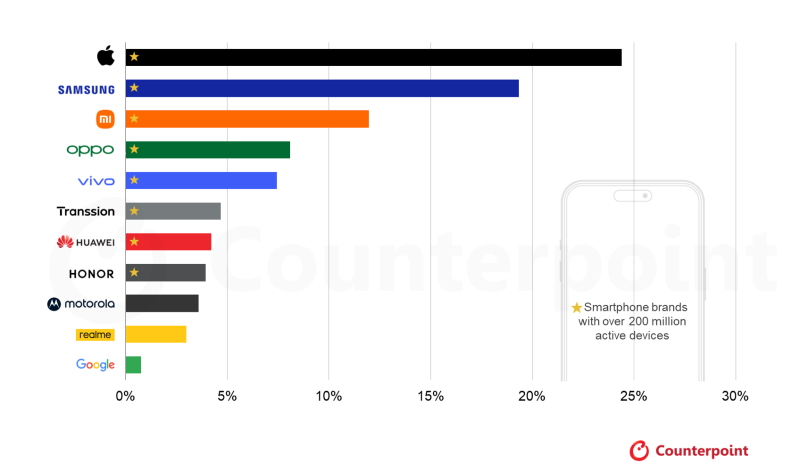
More importantly, Samsung belongs to an exclusive group of smartphone brands with more than 200 million active devices, while estimates place its broader ecosystem at well over one billion active devices worldwide.
That scale changes the conversation. Circle can build USDC. Visa can build settlement infrastructure. Coinbase can provide trading. But Samsung owns something none of them possess — a direct relationship with hundreds of millions of consumers who already trust its software.
Key Insight
- Stablecoins don't have a technology problem anymore.
- They have a distribution problem.
- Samsung may be one of the first companies capable of solving it.
Why Haven't Stablecoins Become Mainstream Yet?
The answer has little to do with technology. Stablecoins already settle billions of dollars every month. Transfers can be completed within minutes, transaction costs are often lower than traditional international payments, and the infrastructure has matured significantly.
The problem is everything users must do before sending their first dollar.
Today, a newcomer typically needs to:
- download a crypto wallet;
- understand blockchain networks;
- save a recovery phrase;
- purchase tokens through an exchange;
- learn how wallet addresses work.
For the average smartphone owner, that's simply too much friction. Samsung could remove almost all of it. Instead of introducing blockchain first, users would simply open Samsung Wallet — the same application they already use for payment cards, boarding passes, loyalty cards and digital IDs. Blockchain would quietly operate behind the interface.
What Could Using Stablecoins Actually Look Like?
Imagine two freelance designers working for the same American client.
Designer A
Receives an international bank transfer. Waits three business days. Pays banking fees. Loses money converting currencies.
Designer B
Receives USDC directly into Samsung Wallet. The payment arrives within minutes. The balance remains in digital dollars until conversion is needed. No separate crypto application. No exchange login. Samsung isn't promising this exact experience today.
But this is precisely the kind of payment flow native stablecoins are designed to support.
Samsung Isn't Starting From Scratch
The company has already been expanding its crypto ecosystem. Samsung recently deepened its partnership with Coinbase, allowing Galaxy users in the United States to purchase cryptocurrencies directly through the Coinbase app using Samsung Pay.
Samsung described the partnership as giving users more options for "managing their investments and accessing money on Samsung's easy to use and secure platform." The collaboration goes further than payments.
Samsung Wallet users also receive:
- three months of Coinbase One;
- zero trading fees on selected assets;
- enhanced staking rewards;
- exclusive partner offers;
- a $25 Coinbase credit after completing their first trade.
This isn't native stablecoin support yet. But it demonstrates that Samsung has already begun connecting its mobile ecosystem with regulated cryptocurrency services.
Why USDC Makes Sense
Samsung demonstrated USDC, not a speculative cryptocurrency. That choice is significant. Unlike Bitcoin or Ethereum, USDC is designed to maintain a value close to one U.S. dollar. For consumers, this removes one of crypto's biggest barriers — price volatility. If integrated properly, users wouldn't need to understand blockchain addresses or token standards. They would simply see a dollar balance inside Samsung Wallet. That's a dramatically different user experience from today's crypto wallets.
Stablecoins Are Becoming Part of the Payment Industry
Samsung's announcement also fits a broader trend. Payment companies are already preparing for stablecoin settlement. Visa recently reported that its stablecoin settlement pilot has expanded to nine blockchain networks, while reaching an annualized settlement run rate of approximately $7 billion — a 50% increase quarter over quarter.
But that's not the important number. The important number is the growth rate. Major payment companies no longer treat stablecoins as experimental technology. They're beginning to integrate them into existing financial infrastructure. Samsung could become the consumer-facing layer of that ecosystem.
Samsung vs. the Competition
| Company | Stablecoin strategy |
| Samsung | Native Wallet integration (planned) |
| PayPal | PYUSD stablecoin |
| Visa | Stablecoin settlement infrastructure |
| Coinbase | Trading, custody and wallet services |
| Apple | No announced native stablecoin support |
Samsung isn't trying to compete with Coinbase. Nor is it trying to become another Visa. Instead, it occupies a different position. It controls the device people use every day.
What Samsung Still Hasn't Told Us
The demonstration answered one question — Samsung is serious about stablecoins. It left several others unanswered.
Among them:
- Which company will issue the supported stablecoin?
- Will users control their own private keys?
- Will Samsung Wallet be custodial or self-custodial?
- Which countries will receive the feature first?
- Will only USDC be supported?
- How will users convert between bank accounts and digital dollars?
- Will merchants be able to accept stablecoin payments directly?
These details will ultimately determine whether Samsung Wallet becomes a true digital-dollar platform or simply another interface connected to third-party providers.
The Real Product Isn't USDC
Samsung isn't trying to sell cryptocurrency. It's trying to make digital money disappear into the operating system. The less consumers think about blockchain, the more successful the strategy becomes.
 Marina Lubimova