Artem Voloskovets

Unlike many momentum-driven rallies that fade within hours, Meta attracted buyers throughout the morning. The stock advanced from roughly $631 at the open to an intraday peak near $675, before stabilizing around $668.68, up 5.89% at 10:56 a.m. EDT. The steady trajectory indicates persistent demand rather than a brief reaction to headlines.
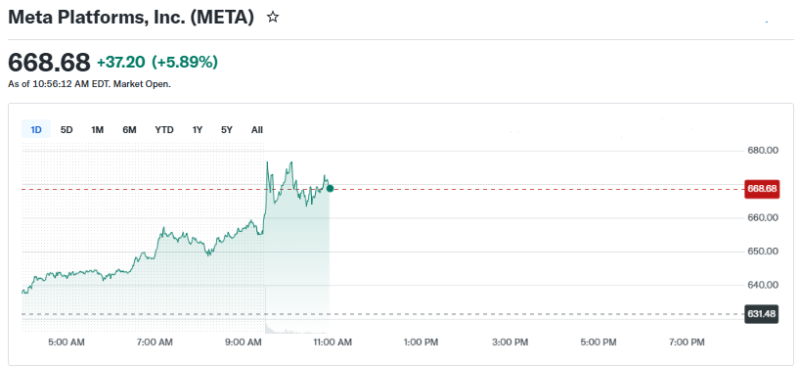
Meta shares climbed steadily from the opening bell, reaching an intraday high near $675 before consolidating around $669.
Only a year ago, Wall Street largely viewed Meta's AI investments as a growing expense that could pressure future earnings. The latest price action points to a different conclusion. Investors increasingly appear to believe the company's AI infrastructure will strengthen its competitive position rather than weigh on profitability.
That view is supported by Meta's operating performance. The company continues to finance one of the largest AI investment programs in the technology sector without sacrificing profitability. For the quarter ended December 31, revenue reached $59.9 billion, up 24% from a year earlier. Operating income totaled $24.7 billion, while the operating margin remained at 41%. Net income climbed to $22.8 billion, and diluted earnings per share increased 11% to $8.88.
Annual results tell the same story. Revenue surpassed $201 billion in 2025, a 22% increase year over year, while operating income reached $83.3 billion, underscoring the strength of Meta's core advertising business.
| Metric | Q4 2025 | YoY |
| Revenue | $59.9B | +24% |
| Operating Income | $24.7B | +6% |
| Operating Margin | 41% | — |
| Net Income | $22.8B | +9% |
| Diluted EPS | $8.88 | +11% |
| Full-Year Revenue | $201.0B | +22% |
| Full-Year Operating Income | $83.3B | +20% |
These numbers explain why investors are becoming less concerned about the scale of Meta's AI spending. Few companies generate enough cash to fund tens of billions of dollars in new infrastructure while maintaining margins above 40%. Meta can expand aggressively without depending on external financing or materially weakening its balance sheet.
That financial strength is gradually changing how the company is valued. Instead of treating AI-related capital expenditures as a drag on earnings, the market is beginning to view Meta's computing capacity, proprietary chips, and data centers as assets capable of supporting future products and services. The focus has shifted from the cost of building AI infrastructure to the economic value it could create over the next decade.
Thursday's trading reflects that reassessment. Investors continued buying shares even after the initial rally, suggesting confidence that the company's long-term earnings potential has yet to be fully reflected in its valuation.
The implications extend beyond Meta itself. Companies able to finance large-scale AI development internally are attracting a growing share of institutional capital, while firms with weaker balance sheets face much higher barriers to competing at the same level.
Meta's advance therefore represents more than a strong trading session. It signals that investors are increasingly willing to reward companies whose AI investments are backed by durable cash generation rather than speculative expectations. The market is no longer asking how much Meta is spending on artificial intelligence. It is beginning to ask how valuable that infrastructure could ultimately become.
 Artem Voloskovets