Artem Voloskovets
- Why Brent Fell $16 Without More Oil
- The Fundamentals Were Already Turning
- Hormuz Still Sets the Ceiling
- Cheaper Oil Changes the Inflation Outlook
- Lower Oil Doesn't Automatically Mean Lower Rates
- The Winners Won't Be Oil Companies
- Why Refiners May Benefit
- Importers Gain, Exporters Face Pressure
- Three Paths From Here
- Beyond Oil
The price move itself is only the first chapter.
A sustained decline in crude would reshape inflation expectations, corporate earnings, monetary policy and the outlook for both oil-importing and oil-exporting economies. Markets are no longer focused solely on the risk of supply disruption—they are beginning to price what a lower-risk environment means for the global economy.
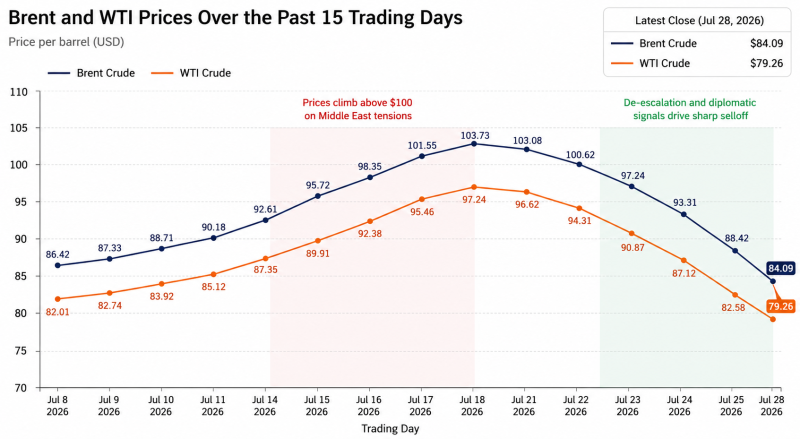
Why Brent Fell $16 Without More Oil
Nothing fundamental changed overnight. Global production did not surge. Demand did not collapse. What disappeared was the geopolitical premium — the additional price investors were willing to pay while fearing that conflict could interrupt exports from the Middle East.
Recent diplomatic efforts, including continued restraint by Washington and Tehran and President Donald Trump's meeting with Israeli Prime Minister Benjamin Netanyahu, reduced the perceived probability of an immediate regional escalation.
Risk premiums rarely disappear gradually. Once traders decide that the worst-case scenario has become less likely, speculative positions unwind quickly.
The Fundamentals Were Already Turning
The geopolitical shift arrived just as the physical oil market was becoming less supportive. The U.S. Energy Information Administration expects global supply to recover through the second half of the year, projecting Brent to average around $74 per barrel in the third quarter and roughly $70 in the fourth quarter.
The International Energy Agency paints a more nuanced picture. Crude availability has improved, but refining capacity remains constrained in several regions, keeping gasoline, diesel and jet fuel markets tighter than crude itself.
That distinction matters because falling crude prices do not immediately translate into cheaper fuel for consumers.
| Market | Current trend |
| Crude supply | Improving |
| Crude prices | Falling |
| Refining margins | Still elevated |
| Retail fuel prices | Likely to adjust with a delay |
Hormuz Still Sets the Ceiling
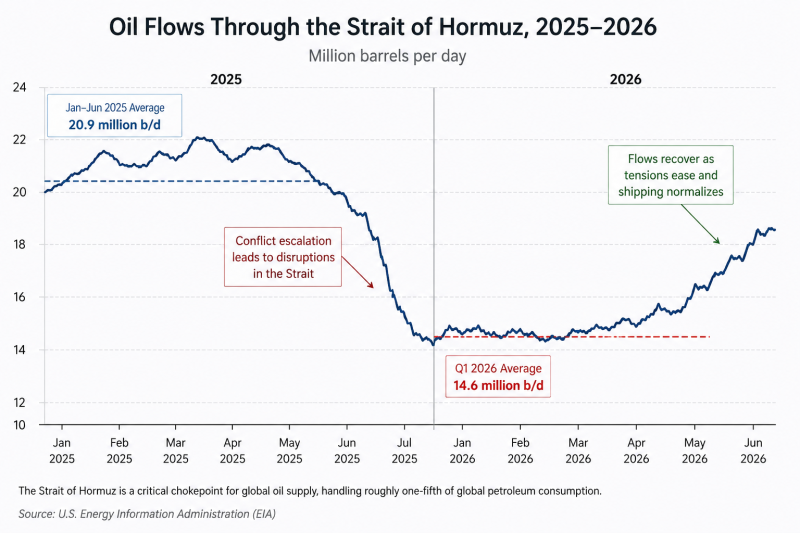
The Strait of Hormuz remains the market's most important geopolitical variable. According to the U.S. Energy Information Administration, roughly one-fifth of global petroleum consumption normally passes through the strait. Disruptions earlier this year significantly reduced traffic, demonstrating why traders were willing to push Brent above $100.
The recent selloff reflects greater confidence that shipping will continue. That confidence can disappear quickly.
Any renewed disruption would affect not only Iranian exports but also shipments from Saudi Arabia, Iraq, Kuwait, Qatar and the United Arab Emirates.
Cheaper Oil Changes the Inflation Outlook
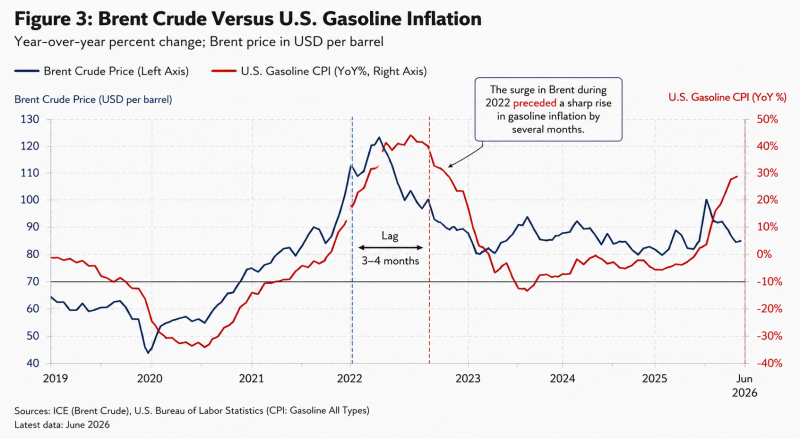
The largest economic impact of lower oil prices is likely to appear in inflation data rather than energy markets. Energy costs influence transportation, manufacturing, logistics and household spending simultaneously.
Recent U.S. inflation figures showed energy prices rising much faster than headline inflation, making fuel one of the largest contributors to consumer-price growth.
If Brent stabilizes near current levels instead of returning above $100, several inflationary pressures should begin easing:
- lower gasoline and diesel prices;
- cheaper freight and logistics;
- reduced manufacturing costs;
- weaker inflation expectations.
The transmission is gradual, but directionally clear.
Lower Oil Doesn't Automatically Mean Lower Rates
Cheaper energy improves the inflation outlook, but it does not guarantee interest-rate cuts. Central banks focus on persistent inflation rather than short-term commodity swings. One sharp decline in crude is unlikely to change policy by itself.
Instead, policymakers will watch whether lower energy costs begin feeding into broader inflation measures over the coming months. If they do, pressure to maintain restrictive monetary policy could ease.
The Winners Won't Be Oil Companies
Lower oil prices redistribute profits across industries.
| Sector | Expected impact |
| Airlines | Lower fuel costs improve margins |
| Logistics | Reduced diesel expenses |
| Manufacturers | Lower transport and input costs |
| Consumer businesses | Better distribution economics |
| Oil producers | Lower upstream revenue |
| Oilfield services | Slower investment activity |
Consumers usually benefit later than businesses because retail fuel prices adjust more slowly than wholesale crude. The energy sector is also less uniform than headlines suggest.
Why Refiners May Benefit
Refiners do not necessarily suffer when crude falls. If gasoline and diesel prices decline more slowly than crude, refining margins can remain strong or even improve.
That creates an unusual divergence:
- producers lose revenue;
- refiners may preserve profitability;
- service companies face weaker investment demand.
Treating the entire energy sector as a single trade ignores these differences.
Importers Gain, Exporters Face Pressure
Lower oil prices effectively transfers income from producers to consumers. Large importers, including India, Japan, South Korea and much of Europe, benefit from lower import bills, reduced inflation and stronger household purchasing power.
For exporters, the opposite is true.
Even countries with low production costs rely on higher oil prices to finance government spending. Sustained prices near $70–80 would increase pressure on fiscal balances and strengthen the incentive for OPEC+ to manage supply. OPEC continues to expect global oil demand to grow in 2026, while other forecasters remain more cautious. That disagreement will shape the next move in prices.
Three Paths From Here
The market now faces three realistic scenarios. Temporary rebound. Diplomacy breaks down, geopolitical tensions escalate and Brent moves back above $100. Stabilization. Supply improves while geopolitical risk remains elevated, leaving Brent in an $80–90 range. Structural decline. Production recovers faster than demand, inventories build and prices gradually move toward the EIA's lower forecasts. Current prices suggest investors see the second scenario as the most likely.
Beyond Oil
The significance of the recent selloff extends well beyond energy markets. If oil remains near current levels, inflation should ease, fuel-intensive industries should improve profitability, importing economies should receive an economic tailwind and pressure on central banks may gradually diminish.
For producers, however, lower prices would mean weaker cash flows and a renewed debate inside OPEC+ over supply policy. The market has already priced a lower probability of war.
The next repricing will depend on something less dramatic but ultimately more important: whether recovering supply meets slowing demand — or whether geopolitical risk returns before that adjustment is complete.
 Artem Voloskovets