Artem Voloskovets
Cheap yen funding is now embedded in global portfolios, while the same exchange rate that helps Japanese exporters is raising the cost of the country’s AI buildout.
Four Years of Policy Divergence
USD/JPY has risen from roughly 108 in early 2022 to above 160 in mid-2026. The advance has not been linear, but every major reversal has proved temporary.
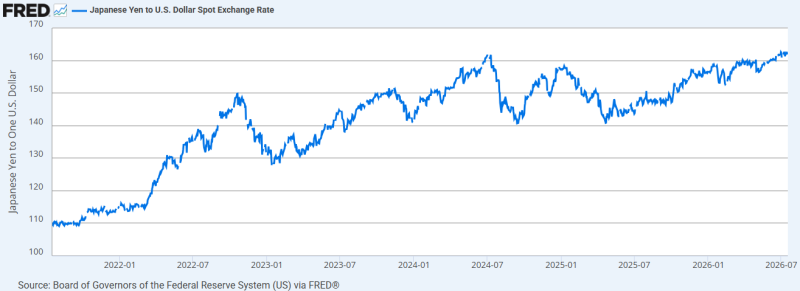
The pair approached 150 in late 2022, fell back to around 128 in early 2023, then returned to 150 by the end of that year. In 2024, it briefly reached approximately 160 before retreating toward 140. Another decline in early 2025 took it near 140 again, yet the yen subsequently lost ground and moved above 160 by July 2026.
The repeated recoveries show the limits of short-term stabilization. Verbal warnings, direct intervention and temporary changes in positioning can reverse the exchange rate, but they have not removed the incentive to hold dollar assets while U.S. yields remain higher than Japanese yields.
At 162.89, the market is not testing an arbitrary historical level. It is pricing the persistence of the rate gap.
The Funding Market Behind the Exchange Rate
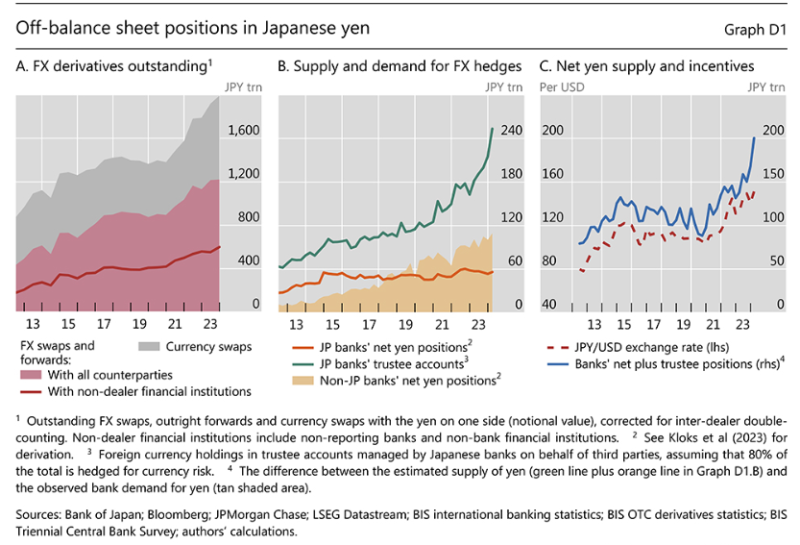
The larger risk sits in derivatives rather than the spot market. BIS data show that outstanding FX swaps, outright forwards and currency swaps with the yen on one side increased from roughly ¥800 trillion in 2012 to about ¥1,600 trillion in 2023. Positions involving non-dealer financial institutions expanded from less than ¥400 trillion to more than ¥1,100 trillion over the same period.
The difference matters. Spot-market selling reflects a view on the currency. Swaps and forwards allow institutions to obtain yen or hedge yen exposure without placing the full transaction on the balance sheet as a conventional loan.
Japanese banks’ net yen positions remained comparatively stable at around ¥40–50 trillion, according to the middle panel of the BIS chart. Foreign trustee accounts managed by Japanese banks, however, rose from roughly ¥50 trillion in 2012 to almost ¥240 trillion in 2023. Non-Japanese banks’ estimated positions also increased, reaching around ¥60 trillion.
The growth is concentrated in the parts of the market most closely connected to cross-border investment and currency hedging.
Yen Funding Is Reinforcing the Move
The BIS estimate of net yen supply rose alongside USD/JPY. Banks’ combined net positions and foreign trustee positions increased from approximately ¥80 trillion in 2012 to nearly ¥200 trillion in 2023. Over that period, USD/JPY moved from below 80 to around 140.
The two lines do not prove that every borrowed yen financed a U.S. stock or bond purchase. They do show that access to yen expanded as the currency weakened.
That is the core mechanism behind the carry trade. Investors borrow or obtain yen through derivatives, exchange it for a higher-yielding currency and purchase assets with better expected returns. A depreciating yen improves the economics because the funding liability becomes cheaper in foreign-currency terms.
The trade can persist for years when volatility remains contained. Its fragility appears when the yen rises quickly.
A sharp currency reversal increases the value of yen-denominated liabilities at the same time that leveraged investors may face losses elsewhere. Closing those positions requires buying yen and selling the assets financed with it, which can accelerate both moves.
Japan’s AI Sector Faces a Split Currency Effect
For Japanese semiconductor-equipment exporters, a weak yen can increase the domestic value of overseas revenue. Dollar-denominated sales translate into more yen, supporting reported earnings and sometimes offsetting weak demand.
Domestic AI infrastructure faces the opposite exposure. GPU systems, advanced networking equipment, software licenses and other components are often priced directly or indirectly in dollars. A $100 million infrastructure order costs ¥15 billion at USD/JPY 150. At 162.89, the same order costs approximately ¥16.29 billion — about ¥1.29 billion more, before changes in the underlying hardware price.
Energy adds another currency-sensitive expense. Japan imports much of its fuel, so yen depreciation can raise electricity and cooling costs for data centers even when global commodity prices are unchanged.
The exchange rate therefore separates Japanese technology companies into two groups. Exporters with substantial foreign revenue receive a translation benefit. Domestic cloud providers, AI developers and data-center operators pay more for compute capacity and imported energy.
A broad technology index may not reveal that difference.
Intervention Could Tighten Liquidity Without Fixing the Yen
Japanese authorities do not need to reverse the multi-year trend to disrupt markets. They only need to produce a fast enough appreciation to force leveraged positions to adjust. The first impact would be visible in USD/JPY. The more consequential impact could appear in assets financed through yen swaps, forwards or other short-term funding structures.
The scale shown in the BIS chart raises the transmission risk. Yen-linked derivatives have doubled in notional terms since 2012, while foreign trust-account positions have increased almost fivefold. A portion of those exposures represents hedging rather than speculative leverage, but both can generate rapid transaction flows when the exchange rate moves sharply.
Intervention alone cannot erase the interest-rate differential between the United States and Japan. It can still increase volatility, force yen purchases and prompt investors to reduce positions in equities, credit and other leveraged assets.
For AI stocks, the relevant risk is not a direct connection to Japan. It is their sensitivity to liquidity. Highly valued technology companies tend to react strongly when leverage becomes more expensive or investors are forced to raise cash.
The Pressure Is Building Outside the Spot Market
The move to 162.89 is notable because the yen last traded at comparable levels four decades ago. Its broader importance comes from the financial structure built during the decline.
The FRED chart shows a currency that has repeatedly resumed weakening after corrections. The BIS data show that yen-based swaps, forwards and foreign trust positions expanded at the same time. Together, they describe a market in which policy divergence supports both the exchange-rate trend and the funding activity behind it.
Further depreciation would make imported AI infrastructure more expensive for Japan while preserving favorable conditions for carry trades. A rapid appreciation would reduce those import costs but risk forcing an unwind of yen-funded positions.
The next major market event may therefore come not when the yen reaches another round number, but when the direction of this funding flow changes.
 Artem Voloskovets